From a Childhood Passion for Robotics to Shaping the Future of Industry
From discovering programming and robotics as a teenager in Senegal to becoming a mechatronics engineer working at the intersection of industry, technology and education, Kiné’s journey has been driven by the same questions: How do things work? How can I build them? How can I make them better?
Her path has taken her from science and robotics programs in Senegal and the United States to demanding preparatory studies in Tunisia, engineering and robotics projects, leadership roles, and advanced studies in robotics, artificial perception and mechatronics in France. Along the way, she developed a particular interest in AI, biomedical technologies and the convergence between intelligent systems and the physical world.
Today, her curiosity has expanded from individual machines to entire ecosystems. Through her work in industrial education, her involvement in Women in Tech Senegal, entrepreneurship with KR EXPERTS, and Future by Kiné, she explores how technology, skills and industrial capabilities can help shape the future — particularly how Africa can move from adopting technologies to increasingly building, adapting and creating them.
The questions never really changed. The scale simply did.
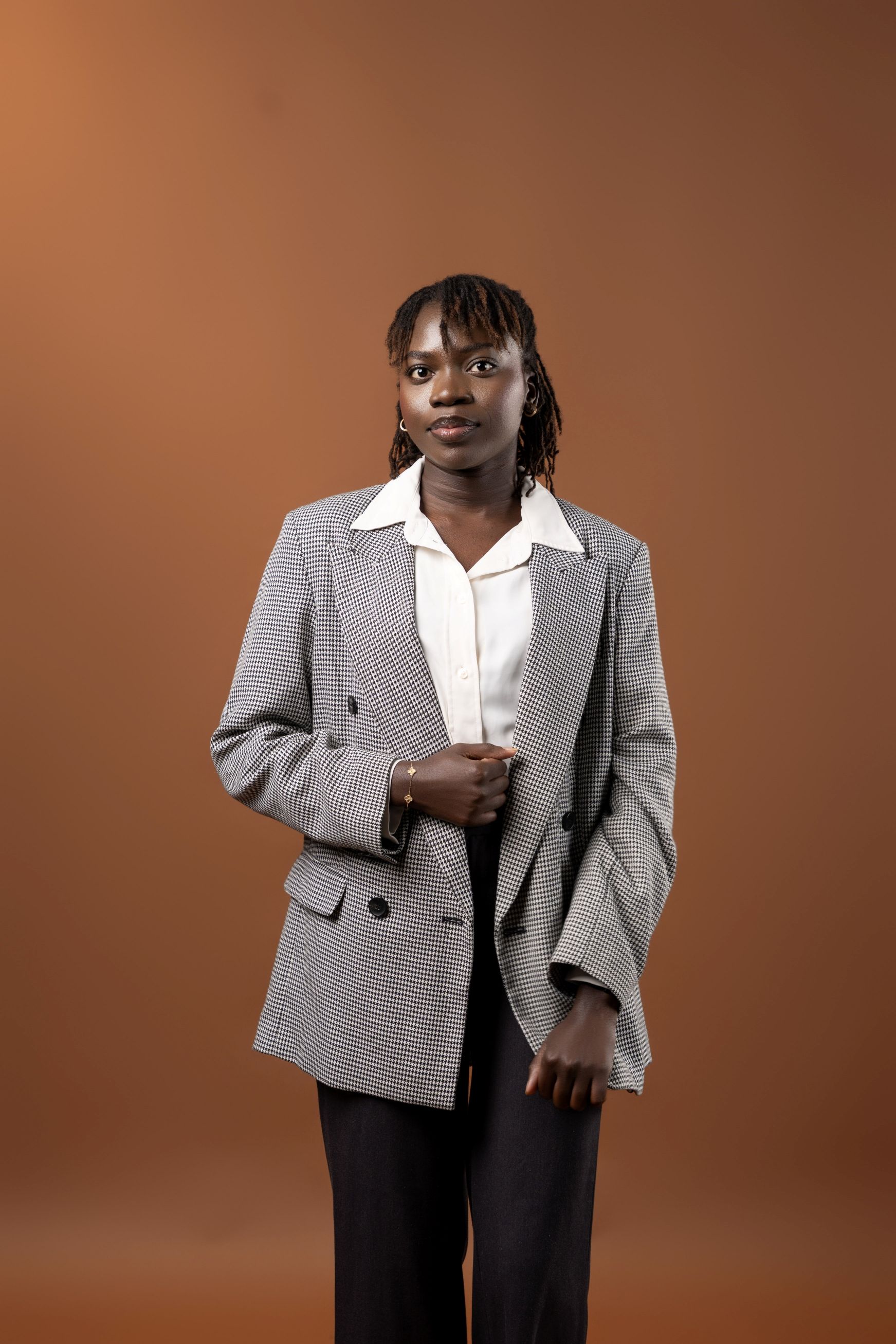
I did not discover technology through a job title.
I discovered it as a child, through curiosity.
Long before I became a mechatronics engineer, worked with industrial automation systems, or started thinking about the future of industry, I was already fascinated by three questions:
How do things work?
How can I build things on my own?
And how can I create something that does not exist yet?
I did not only want to use technology. I wanted to understand what was behind it.
If I saw a machine, I wanted to know what made it move. If I discovered a piece of technology, I wanted to understand how it had been designed. And once I understood something, another question naturally followed:
What could I do differently?
That instinct — to understand, build and then improve — became one of the strongest threads throughout my life.
Where it started
I spent seven years, from middle school through high school, at the Senegalese American Bilingual School in Dakar.
Looking back, those years shaped me in ways that went far beyond academics.
I was a very active student. I was curious about almost everything and rarely limited myself to the classroom.
I joined extracurricular activities.
Dance.
Cooking.
Games.
Wellness activities.
Science programs.
Competitions.
If there was an opportunity to discover something new, I usually wanted to be part of it.
I eventually graduated with a scientific baccalaureate in experimental sciences, with honors, a 4.0 GPA and as valedictorian of my class.
But some of the most important lessons I took from those years were not written on my diploma.
I learned the importance of giving back.
I learned to keep looking for a better version of myself.
And I learned that education becomes much more powerful when curiosity is allowed to extend beyond the curriculum.
That environment gave my fascination with science and technology somewhere to grow.
The summer that made technology tangible
Before I was even 16, I participated in Soft’Awareness Academy, a summer camp where young people were introduced to electronics, programming, sensors and technology through hands-on activities.
We experimented with tools such as LittleBits and Arduino, while also developing soft skills and socio-professional competencies.
At that age, terms like Industry 4.0, artificial intelligence or industrial sovereignty were not part of my vocabulary.
I was discovering something much simpler — but much more important to me.
The objects around me were not mysterious.
Someone had imagined them.
Someone had designed them.
Someone had built them.
And perhaps I could too.
Electronics and programming fascinated me, but robotics brought everything together.
Software.
Electronics.
Mechanics.
Sensors.
Movement.
Logic.
Problem-solving.
Robotics gave a physical form to an idea.
You could imagine something, write instructions, connect components, test them and suddenly see something that had previously existed only in your mind interact with the physical world.
That fascinated me.
Looking back, that summer camp did more than introduce me to technology.
It reinforced an instinct that was already there:
I did not want to be only a user of technology. I wanted to understand it deeply enough to create with it.
When science started opening the world
My curiosity continued to lead to opportunities I could not necessarily have imagined when I first started experimenting with electronics.
At 17, I was selected to represent my school in the Science and Technology Entry Program — STEP — in Albany, New York.
I travelled to the United States and presented a project on the mathematical modelling of the Ebola disease at Bronx Community College.
For a teenager from Senegal, this was significant.
It showed me that mathematics and science were not only subjects to study for an examination.
They were tools.
Tools that could be used to understand real problems.
Tools that could allow you to contribute to conversations much larger than yourself.
And tools that could take you beyond the environment you already knew.
It was also one of the first moments when I saw how science and technology could intersect with health and human impact.
That stayed with me.
I have always been deeply interested in biomedical applications because they bring engineering back to something very concrete: people.
A mechanism is not only a mechanism when it can help a surgeon.
A sensor is not only a sensor when it can monitor a patient.
A robot is not only a robot when it can support rehabilitation, diagnosis or medical precision.
That connection between engineering and health would continue to fascinate me throughout my studies.
Around that period, robotics was also becoming more concrete.
I was selected to participate in the first edition of the Pan-African Robotics Competition, PARC, launched by Dr. Sidy Ndao, at a time when the Dakar American University of Science and Technology — DAUST — was itself taking its first steps.
I would later make a brief passage through DAUST before beginning the next major stage of my studies.
But what stayed with me most from PARC was the experience of moving from fascination to challenge.
There was now a problem to solve.
A team.
Constraints.
Competition.
Technical choices.
And something that ultimately had to work.
That experience reinforced a principle that would follow me throughout engineering:
An idea only becomes innovation when you can turn it into something real.
Leaving Senegal
After high school and a brief period at DAUST, I left Senegal for Tunisia to attend the Institut Préparatoire aux Études d’Ingénieur de Sfax.
That transition was not easy.
I was entering one of the most demanding phases of my academic life while simultaneously adapting to a new country, new cultural codes and a linguistic environment that was not always easy to navigate.
The language barrier was real.
Suddenly, succeeding was not only about solving mathematics and physics problems.
I also had to understand people.
Expressions.
Ways of communicating.
Ways of living.
And at the same time, I had to keep pace with prépa.
The pressure was constant.
The rhythm was intense.
Everything around me felt new.
Looking back, those two years taught me one of the most important lessons of my life:
I was stronger than I thought I was.
I learned how to adapt without losing myself.
I learned that discomfort could be temporary.
I learned that not understanding everything at first did not mean that I did not belong.
And I discovered that I could survive difficult environments, grow inside them and eventually make them part of my story.
Leadership before the title
Prépa was also where another side of me became much more visible:
leadership.
While studying physics and chemistry, I became President of the Association of Foreign Students at IPEIS.
That responsibility mattered.
I was myself a foreign student learning to navigate a new environment, and at the same time I found myself representing and bringing together other students who were dealing with similar questions of adaptation, belonging and community.
Leadership, for me, did not begin as a corporate ambition.
It began much more naturally.
Through people.
Through responsibility.
Through the need to communicate.
To organize.
To listen.
To represent.
To create a sense of community.
I began to understand that I enjoyed solving problems, but I also enjoyed bringing people together to solve them.
At the end of those demanding preparatory years, I sat Tunisia's national engineering entrance examination in Physics and Chemistry and ranked 49th out of 886 candidates.
It was an academic result, of course.
But for me, it represented something else too.
Proof that the girl who had arrived in a difficult new environment, struggling to adapt, had learned how to find her place in it.
Choosing mechatronics
I entered the National Engineering School of Sousse — ENISo — in 2019 and chose mechatronics.
The choice felt natural.
Mechatronics did not force me to choose between mechanics, electronics, programming, automation and robotics.
It brought them together.
And that was exactly how I wanted to understand technology.
Not as isolated disciplines, but as different tools that could interact to create something new.
Engineering school transformed the questions of my childhood into technical problems I could actually work on.
I learned about control systems, electronics, mechanical systems, microcontrollers, PLC programming, computer-aided manufacturing and robotics.
But most importantly:
we built.
A lot.
From understanding to making
Some of my most formative engineering experiences came through group projects.
We would begin with a problem or an idea and somehow have to turn it into a working system.
We programmed.
We designed.
We assembled.
We calculated.
We tested.
We disagreed.
We debugged.
We divided responsibilities.
And very often, we discovered that what looked perfectly logical in theory behaved completely differently once it met the physical world.
Among the projects I worked on was a CNC machine designed to bend metal wire into predefined shapes, using an Arduino CNC Shield and stepper motors.
I also developed a facial detection system using a Raspberry Pi and camera module, combining programming and computer vision.
Later, my work in robotics became more advanced, including projects involving a spherical parallel manipulator.
That project was especially meaningful to me because it also connected robotics with my interest in biomedical engineering.
I have always been fascinated by technologies that sit at the intersection of engineering and healthcare — medical robotics, rehabilitation systems, assistive technologies, intelligent devices and technologies that can improve precision, autonomy or quality of life.
Biomedical applications remind me that engineering is ultimately not about machines for the sake of machines.
It is about what machines can enable for people.
That perspective added another dimension to my interest in robotics.
The same principles I was studying — motion, control, sensing, perception, precision — could be applied to industrial systems, but also to technologies designed to support the human body and human health.
And that made the field even more exciting to me.
I also continued participating in robotics activities and competitions.
These experiences taught me one of the things I still love most about engineering:
the moment when an idea becomes physical.
You begin with almost nothing.
A problem.
A sketch.
An algorithm.
A few components.
A team.
And gradually, something starts moving.
Responding.
Performing a function.
Becoming real.
But engineering also taught me humility.
A system can look perfect on paper and fail once assembled.
A few lines of code can stop an entire mechanism.
A mechanical constraint can force you to rethink your software.
A sensor can return information you did not expect.
And sometimes the idea you were convinced would work simply does not.
So you learn to iterate.
Build. Test. Fail. Understand. Improve. Build again.
In many ways, that remains my approach to innovation today.
And group projects taught me something else.
As a child, I often wondered:
How can I make things on my own?
Engineering taught me that on my own did not necessarily mean alone.
The most interesting things are often built collectively.
Technical curiosity and leadership growing together
My years at ENISo were not limited to coursework.
I joined the Robotics Club.
I participated in the Aeronautics Club.
I became increasingly active within IEEE and eventually served as President of the Industry Applications Society Chapter within the ENISo Student Branch.
Once again, two sides of my personality were growing together.
There was the engineer who wanted to experiment, understand systems and build things.
And there was the person who enjoyed bringing people together, organizing initiatives, communicating, representing a community and creating opportunities around technology.
I gradually understood that I did not need to choose between being technical and being a leader.
I could develop both.
Learning beyond what was required
Another habit followed me throughout engineering school:
I rarely limited my learning to the curriculum.
When artificial intelligence and deep learning caught my attention, I wanted to understand those technologies too.
So I started learning independently.
I studied Neural Networks and Deep Learning, then continued exploring how deep neural networks could be improved and applied.
Once again, the same childhood questions returned:
How does it work?
What can I do with it?
And what becomes possible if I combine it with what I already know?
For someone studying mechatronics and robotics, the convergence between artificial intelligence and physical systems was particularly exciting.
I could already sense that the boundaries between software, perception and machines were becoming increasingly interesting.
Robotics and perception: going deeper
In 2021, another transition began.
Through a double-degree journey between ENISo and SIGMA Clermont, I moved to France and continued my studies in Mechatronics and Robotics Engineering.
At the same time, I pursued a Master's degree in Robotics and Artificial Perception at Université Clermont Auvergne.
This allowed me to go deeper into fields such as robot perception, ROS, LiDAR and intelligent robotic systems.
Once again, my world was expanding.
The young girl who had once experimented with Arduino and sensors was now studying how robots perceive and interact with complex environments.
And the more I learned, the more I saw connections between fields that are often treated separately.
Industrial robotics.
Autonomous systems.
Artificial perception.
Biomedical robotics.
Assistive technologies.
AI.
At their core, many of them are built around the same challenge:
How can we make intelligent systems perceive, decide and act safely in the physical world?
That is still one of the technological questions I find most fascinating today.
Every environment revealed another version of me
Adaptation has quietly accompanied my entire journey.
Senegal.
The United States.
Tunisia.
France.
Different languages.
Different cultural codes.
Different academic systems.
Different expectations.
It was not always comfortable.
But over time, I realized that every new environment revealed another version of me.
I became more comfortable entering spaces where I did not initially understand all the codes.
More willing to ask questions.
More comfortable communicating across cultures.
More attentive to different ways of seeing the same problem.
And more comfortable with change itself.
Moving did not erase previous versions of me.
It added layers.
Every language.
Every culture.
Every technical challenge.
Every team.
Every country.
They expanded the person — and the engineer — I was becoming.
But adaptation never replaced the main thread of my journey.
Wherever I went, the instinct remained the same:
Understand. Build. Learn. Improve.
When the machine became a system
After completing my engineering and robotics studies, I continued at Polytech Lille with a Specialized Master's degree in Mechatronics Project Engineering and Management.
By then, something important was changing in the way I looked at technology.
Until that point, much of my curiosity had focused on machines.
How does a robot move?
How does a sensor communicate?
How does the controller make a decision?
How does software interact with a physical system?
Gradually, I started looking beyond the machine.
Because no robot exists in isolation.
Behind an automated production line are mechanical systems, electrical systems, software, data, engineers, technicians, maintenance teams, energy infrastructure, supply chains, investment decisions and entire organizations.
And behind all of them are people who need the right skills.
My professional thesis reflected that evolution.
I explored the role of the industrial expert in the development of artificial intelligence solutions for industry.
It forced me to think about AI not as an abstract technological breakthrough but as something that has to interact with industrial knowledge, operational realities and human expertise.
The question was becoming bigger.
Not only:
What can the technology do?
But:
How does it become useful in a real system?
Engineering meets education
My professional journey at Festo, and eventually Festo Didactic France, brought many of these threads together.
Technology.
Automation.
Artificial intelligence.
Industry.
People.
Education.
Festo Didactic operates at the intersection of technical education and industrial skills development.
And suddenly, the technologies I had spent years studying were connected to another question:
How do we prepare people to work with them?
Through my work, I have been exposed to industrial automation, mechatronics, robotics, smart manufacturing, maintenance, energy management, digitalization and artificial intelligence applied to industrial environments.
But my role has also taken me beyond the purely technical world.
I work with schools.
Universities.
Training centers.
Companies.
Public institutions.
And international partners.
My projects have taken me across France and into African markets, allowing me to observe technological transformation from different perspectives.
On one side, industry is moving toward increasingly connected, automated and intelligent systems.
On the other, education systems are trying to determine what people must learn today to operate, maintain and eventually design those systems tomorrow.
The gap between the two can be significant.
And it led me to one of the convictions I hold most strongly today:
There is no technological transformation without skills transformation.
You can purchase robots.
You can import machines.
You can deploy AI.
You can build a smart factory.
But eventually, someone needs to understand what is happening inside those systems.
Someone must install them.
Someone must program them.
Someone must troubleshoot them.
Someone must maintain them.
Someone must improve them.
And one day, someone should be capable of designing the next generation locally.
That last point became increasingly important to me.
The questions became bigger
The more I worked between industry and education, particularly across European and African contexts, the more I realized that I was still asking the same questions I had asked as a child.
Only the scale had changed.
How do things work?
Became:
How do industrial ecosystems work?
How can I build something myself?
Became:
How do companies and countries develop the capabilities to build technologies themselves?
And:
How can I innovate?
Became:
How do we create environments where innovation becomes possible at scale?
This is where my interest in Africa's industrial future began to take a deeper form.
Much of the conversation around technology in Africa understandably focuses on adoption.
How can we accelerate digital transformation?
How can companies use AI?
How can we deploy the latest technologies?
Those questions matter.
But I believe we need another set of questions as well.
What are we building?
Where are the machines designed?
Where are industrial technologies developed?
Where are the engineers trained?
Where are the components manufactured?
Who maintains the systems we deploy?
Who owns the technical knowledge?
And what would it take for more African companies to move progressively from technology consumers and integrators to technology creators?
This is not an argument for isolation.
Innovation has always depended on exchange, collaboration and global knowledge.
For me, it is about capability.
The capability to understand a technology deeply enough to adapt it.
To maintain it.
To improve it.
To manufacture more of what we need.
And eventually, to create technologies that others may want to use too.
That, to me, is one of the foundations of technological and industrial sovereignty.
Why I care about who gets to build
There is another question I cannot separate from technology:
Who gets to participate?
I often think back to the opportunities I received when I was young.
Someone created a summer camp where a girl could experiment with electronics and programming.
Someone selected a 17-year-old from Senegal to take part in a science program in the United States.
Someone created a Pan-African robotics competition where young people could build and compete.
Someone opened a door.
Then another.
Then another.
Those opportunities mattered.
And perhaps that is also why giving back — something I learned very early in school — remains important to me.
Engineering, robotics and industrial technology are still fields where women remain significantly underrepresented.
It is one of the reasons I became involved in building Women in Tech Senegal as a co-founder of the chapter.
Our work spans education, business, social inclusion and advocacy.
Because representation matters.
But participation matters even more.
I want more girls to program.
More women to engineer systems.
More women to create technology companies.
More women to lead technical teams.
More women to participate in decisions about AI, cybersecurity, infrastructure and industry.
And ultimately, more women to be among the people deciding:
What gets built next?
Entrepreneurship: building beyond machines
My desire to build also extends into entrepreneurship.
Alongside my professional journey, I contribute to developing KR EXPERTS, a technology company based in Dakar working across IT infrastructure, cybersecurity, automation, embedded systems, Industry 4.0, robotics, artificial intelligence and innovation.
Entrepreneurship has changed the way I think about the word build.
As an engineer, building often means creating a technical system.
As an entrepreneur, you realize that you also have to build organizations.
Teams.
Expertise.
Processes.
Trust.
Partnerships.
Capabilities.
Solutions around actual problems.
And perhaps most importantly, the capacity to keep creating after one project has ended.
Because Africa's technological future will not be created by one breakthrough invention.
It will require ecosystems of engineers, technicians, researchers, entrepreneurs, educators, investors and institutions capable of building repeatedly.
Why robotics still matters to me
After all these years, robotics still holds a special place in my journey.
It was one of my earliest doors into technology.
And today, it may be becoming even more interesting.
Artificial intelligence is increasingly moving beyond purely digital environments.
Computer vision allows machines to perceive.
AI systems are becoming more capable.
Robots are becoming more adaptable.
Digital twins are changing the way physical systems are designed and operated.
Factories are becoming increasingly connected.
Software and machines are becoming deeply intertwined.
AI, robotics and automation are converging.
And this convergence also extends into healthcare.
The same advances in sensing, perception, control and AI that are transforming factories are also creating new possibilities in medical robotics, rehabilitation, assistive technologies, diagnostics and personalized care.
That is one reason biomedical technology continues to fascinate me.
It reminds me that the future of robotics is not only about productivity.
It can also be about precision, autonomy, accessibility and quality of life.
For a mechatronics engineer who began with a fascination for robots, it almost feels like watching the different pieces come back together.
But it also makes the question of capability more urgent.
The next technological revolution will not happen only on laptops and smartphones.
It will happen in factories.
Hospitals.
Energy systems.
Logistics.
Agriculture.
Mobility.
Infrastructure.
And machines interacting with the physical world.
Countries that want to participate meaningfully in this transformation will therefore need much more than software talent.
They will need mechanical engineers.
Automation specialists.
Roboticists.
Biomedical engineers.
AI engineers.
Electricians.
Maintenance technicians.
Researchers.
Industrial infrastructure.
Energy.
And education systems capable of preparing all of them.
Understand today. Anticipate tomorrow.
This growing desire to connect technology with its wider consequences is also why I created Future by Kiné.
I wanted a space where I could explore the questions that increasingly occupy my mind:
Artificial intelligence.
Industry.
Robotics.
Health technologies.
Education.
Infrastructure.
Technological sovereignty.
And the societal transformations happening around them.
Not only from an African perspective.
Not only from a European perspective.
But by looking globally and asking what these transformations mean for different societies.
The philosophy behind it is simple:
Understand Today. Anticipate Tomorrow.
Because I believe anticipation begins with understanding.
Before asking where technology is going, we need to understand what is changing now.
And before deciding what future we want, we need to understand what capabilities will be required to create it.
The questions never really changed
When I look back, my journey might appear to cover many different subjects.
Software.
Mathematics.
Robotics.
Mechatronics.
Artificial intelligence.
Biomedical technology.
Industrial automation.
Leadership.
Education.
Entrepreneurship.
Women in technology.
Africa's industrial future.
But to me, they have always been connected.
The scale simply changed.
As a child, I looked at technology and wondered:
How does this work?
Then:
Can I build it myself?
Then:
Can I make it differently? Can I make it better?
Today, I find myself asking the same questions about much larger systems.
How do we build stronger technology ecosystems?
How do we prepare the next generation of engineers and technicians?
How do we create more companies capable of developing technical solutions?
How do we move from adoption toward creation?
How do we use engineering not only to make systems more productive, but also to improve people's lives?
How do we make sure women are among the people building this future?
And how can Africa participate not only as a market for the next technological and industrial revolution, but as one of the places where parts of that revolution are imagined and built?
I am still exploring those questions.
I am still learning.
I am still building.
Perhaps that is why the young girl who was fascinated by robots never really disappeared.
She simply started asking bigger questions.
Understand how it works.
Learn how to build it.
Then ask how it could be better.
For me, that is where innovation begins.
0 comments on “From a Childhood Passion for Robotics to Shaping the Future of Industry”
Comments from signed-in readers are published immediately. Keep it professional.
Sign in to join the conversation.