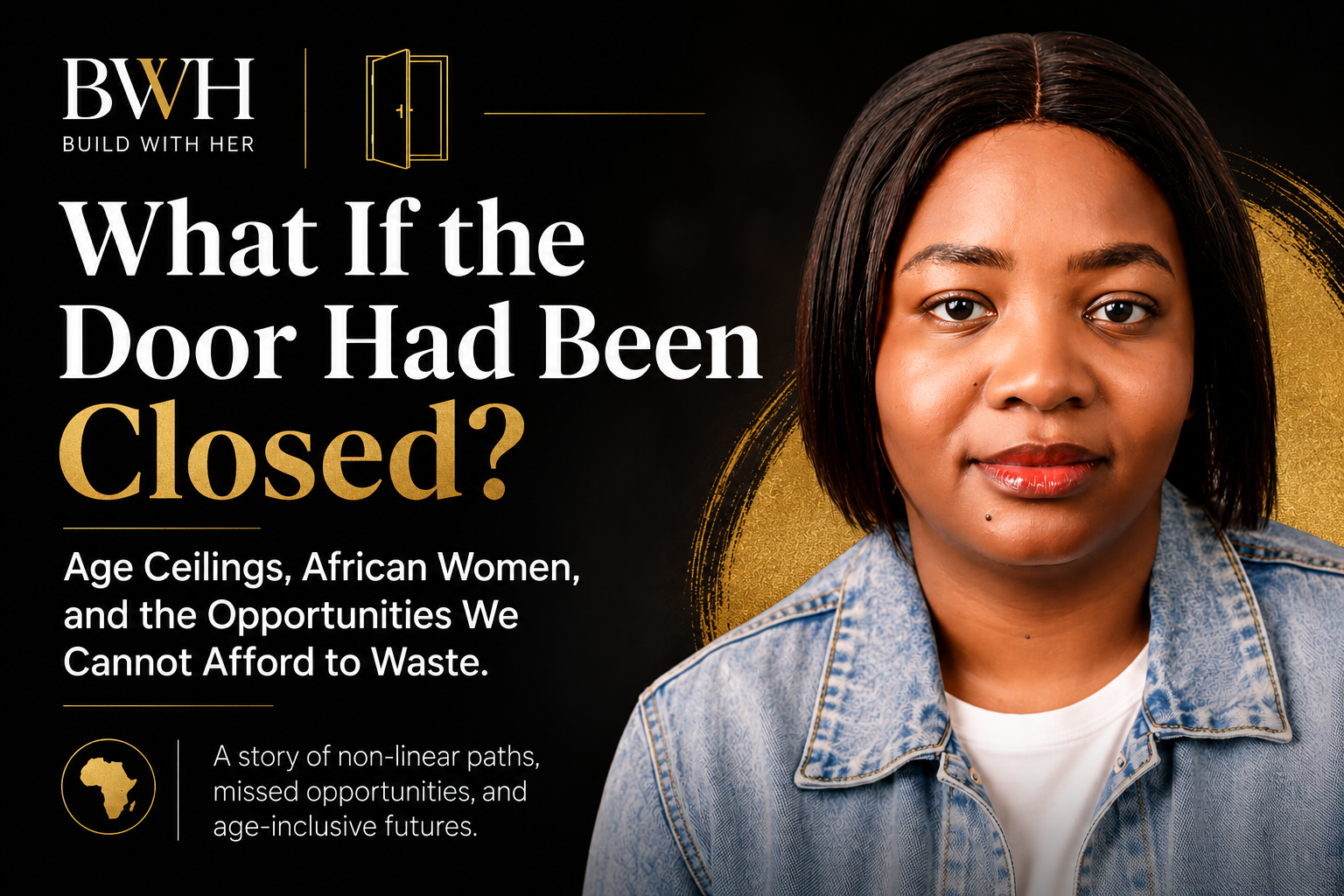
What If the Door Had Been Closed? Age Ceilings, African Women, and the Opportunities We Cannot Afford to Waste.
What if one age limit had closed the door before her journey even began? Adigo traces the chain of opportunities - from a diplomatic mentorship programme to the ECOWAS Peace Fund to postgraduate cybersecurity research - that shaped her career and makes the case that African women's non-linear paths deserve age-inclusive fellowships, not arbitrary cutoffs.
What If the Door Had Been Closed?
Age Ceilings, African Women, and the Opportunities We Cannot Afford to Waste
A Question I Cannot Stop Asking
What if HEDDA's Diplomatic Career Mentorship and Leadership Centre had set an age limit of 30 or even 35?
I would not have been eligible. I would have been turned away before I ever walked through the door. And the chain of events that followed - the visit to the ECOWAS Peace Fund, the selection for a major digitalization project, the discovery of cybersecurity, the spark that set me on the path I am on today - none of it would have happened.
I think about this often. Not just for myself, but for every African woman standing in front of a door that has already been locked - not because she was unqualified, not because she was unready, but simply because of a number attached to her date of birth.
"For how long are we going to remain quiet about this?"
Where My Journey Began
I enrolled in a one-month paid mentorship programme with HEDDA's Diplomatic Career Mentorship and Leadership Centre (HDCMLC) - a centre dedicated to building the next generation of African diplomatic and leadership professionals. I want to be transparent: it was a paid programme, and I made the choice to invest in myself. I do not say this to qualify the experience. I say it because honesty matters, and because that investment changed everything.
During one of our sessions, a cybersecurity professional based in the United Kingdom came to mentor us. She walked into that virtual room and held the floor with a quiet authority I had never witnessed up close before. She spoke about digital threats, about state-level cyber operations, about how security and peace were not separate conversations - they were the same conversation. And I sat there thinking: I want to be like this woman someday.
That session planted a seed I did not fully understand at the time. But it grew.
Later, through HDCMLC, came a visit to the ECOWAS Peace Fund - the institution charged with supporting peace and security across West Africa. That visit led to something I did not anticipate: I was selected to be part of their digitalization project, working as a contracted Digitalization Support Staff. Over two deployments, our team digitized over 20,000 institutional records.
It was there, inside that work, that everything came together. The scale of those records. The vulnerability of the systems holding them. The stakes - because these were not ordinary files. These were the institutional memory of peace and security operations across an entire region. And I realized: cybersecurity is not separate from peace. It is part of how peace is protected, preserved, and sustained.
That experience is why I am now pursuing an MSc in Cybersecurity and Digital Forensics. It is why my research focuses on the influence of cybersecurity framework adoption on the security of digitized institutional records in African and international organizations. It is why I became a Pan-Africanist in the truest sense - not as an ideology borrowed from a textbook, but as a lived conviction born from the inside of an African institution, doing African work, for African people.
It is only we in Africa who can fully understand our problems. And it is only we who can build the lasting solutions.
The Chain That Age Ceilings Break
My story is not a straight line. It is a chain - each link connected to the one before it. HDCMLC led to ECOWAS. ECOWAS led to cybersecurity. Cybersecurity led to research. Research is leading to everything that comes next.
"Age ceilings break chains like this before they even begin."
African women do not always arrive at opportunities in a straight line or on a standard schedule. Many of us took longer paths - raising children, caring for families, surviving economic hardship, navigating systems that were not designed with us in mind. Our professional journeys are not less valid because they were not linear. If anything, the length of the journey made us more prepared, more resilient, and more grounded in the realities we are being asked to solve.
And yet, fellowship after fellowship, training after training, mentorship programme after mentorship programme continues to draw an arbitrary line in the sand and tell grown, qualified, motivated African women: you are too old for this opportunity.
Too old. For an opportunity. On a continent that desperately needs every capable hand it can find.
Not every woman who benefits from a fellowship, training, or mentorship programme will go on to hold a corporate title or run a government office. But that is entirely beside the point. She might become a researcher. A teacher. A community contributor. An advocate. A mother who sits with her children and explains the world to them with clarity, confidence, and critical thinking - because someone once gave her the tools to understand it.
"That is what a small drop does in an ocean. And we are letting those drops evaporate before they ever reach the water."
A Moment That Stayed With Me
In October 2025, I came across a training on API security. I was genuinely excited - this was exactly the kind of technical upskilling I had been looking for. I clicked to apply. And then I saw it: an age limit.
I paused. I thought of every woman above 40 who might have done exactly what I just did - found something relevant, felt that spark of excitement, clicked to apply and then quietly closed the tab and moved on.
I did not close the tab. I asked.
I commented publicly, asking what provision existed for women above 40 who were interested and qualified. The organization responded. They were honest and respectful - they explained that their non-profit is shaped by their mission, research findings, and funding partner requirements, and that for this particular programme, they could only serve participants between the ages of 20 and 40. They encouraged me to explore other resources.
I thanked them. I meant it. Because in a space where many organizations simply ignore such questions or respond defensively, their willingness to engage openly was genuinely appreciated. I hold no ill will toward them. I understand that funding constraints are real, and that organizations often operate within frameworks they did not entirely design themselves.
But here is what I also know: that comment I left asking about women above 40 has now been seen by 8,591 people.
Eight thousand, five hundred and ninety-one people. On a single comment. That number is not an accident. It is a signal. It tells us that this question - what about the women above 40? is one that far too many people have been sitting with in silence, and that when someone finally asks it out loud, the resonance is immediate and wide.
The problem is not isolated. The pain is shared. And it is time the solutions matched the scale of that reality.
Who Is Getting It Right - and Deserves to Be Recognized
There are programmes and organizations that are doing this well. They deserve to be named, applauded, and studied as models by every institution that claims to be invested in African women's advancement.
The Mo Ibrahim Foundation - A Gold Standard in Two Forms
The Mo Ibrahim Foundation deserves the loudest applause of all - and not just for one programme, but for two, each approaching inclusion from a different angle and together demonstrating that age-inclusive design is not a compromise. It is a choice.
Their Leadership Fellowship, hosted at the African Development Bank, sets an age limit of 40 (45 for women with children). That distinction alone is remarkable - they looked at the reality of African women's lives and built it directly into their eligibility criteria. Beyond the age limit, the experience requirement is a minimum of 7 years of relevant professional work - not ten, not fifteen - a threshold genuinely achievable even for a woman who took a caregiving break and returned to professional life later than her peers.
Their Academy Fellowship at Chatham House goes even further. It imposes no age restriction whatsoever. Open to citizens of any African country, it asks only for a completed undergraduate degree and experience with research. The ideal candidate is described as being at the early-to-mid stage of their career - a description of a professional stage, not a birth year.
The Tony Elumelu Foundation - No Ceiling, Full Stop
The Tony Elumelu Foundation Entrepreneurship Programme requires applicants to be at least 18 years old and sets no upper age limit whatsoever. Since 2015, TEF has invested over $100 million across more than 20,000 entrepreneurs, generating jobs and business growth across all 54 African countries. TEF is also actively working to increase representation from female entrepreneurs. No ceiling. Active pursuit of women. That combination is the standard every other programme should aspire to.
WiCyS - Career Stage, Not Age
WiCyS - Women in Cybersecurity organizes its programmes by career stage - early career, mid-career, and so on - rather than imposing age ceilings. I am currently in my eighth month of WiCyS Global's professional cybersecurity mentorship programme, and it has been one of the most rigorous and rewarding professional development experiences of my career. I have also had the privilege of participating in programmes run by the WiCyS Nigeria affiliate — including a GRC mentorship - and in every case, the door was open. No age ceiling. No arbitrary cutoff. Just: are you a woman in cybersecurity? Are you ready to grow? Come in.
WiCyS is a global body, but their approach is a lesson that African programmes urgently need to learn and apply at scale. You can structure for quality and relevance without locking women out by age.
A Direct Appeal to Donors and Funding Agencies
To every donor, development fund, foundation, and funding agency operating across Africa - this is a direct appeal.
Review your eligibility criteria. Look at your age limits. And ask yourself honestly: who are these limits designed to include, and who do they quietly exclude?
If your age ceilings were inherited from a template, borrowed from a Western model, or never seriously interrogated - it is time to change them. Remove the ceiling entirely where you can. Raise it meaningfully where you cannot. And where you do maintain age criteria, consider the Mo Ibrahim model: recognize that women with dependents have been carrying more, and give them the runway they deserve. Keep your experience requirements reasonable - because a woman who spent years caregiving before returning to professional life should not be penalized twice.
I also understand that funding partner requirements are sometimes the source of these constraints - as the organization that responded to my comment honestly explained. If that is the case, then this appeal extends to the funding partners themselves. You are upstream of the problem. The eligibility criteria that downstream organizations implement often begin with requirements you set.
"The woman who gets excluded never sees your name on the grant agreement - she only sees the door that would not open."
African women are showing up ready. They are showing up capable. When they come to your application portal with motivation, preparation, and demonstrated ability - accept them. Do not let a number on a birth certificate be your reason for turning them away.
The woman who mentored me in that HDCMLC session did not know what she started. She just showed up, spoke honestly about her field, and let a room full of African women see what was possible. That is all it took to change the direction of one woman's life - and through her, the direction of the work she would go on to do.
Imagine what structured, funded, age-inclusive investment could do at scale.
Starting Now - and Asking You to Join Me
From this month, June 2026, I am committing to speaking up on this matter consistently and publicly. Not just in articles like this one, but in every space where the conversation about opportunity, inclusion, and African women's advancement is happening. Age-based exclusion is a structural injustice, and it deserves to be named as one, repeatedly, until the systems that uphold it change.
If this resonates with you - if you have ever been the woman who closed the tab, or the woman who almost did not apply, or the woman cheering quietly for someone else who asked the question you were afraid to ask - I urge you to speak up too. Share your story. Ask the question publicly. Tag the organizations. Write the article. Leave the comment. Because 8,591 impressions on a single comment tells us something important: we are not alone in this, and silence is not serving us.
African problems need African solutions. We are the ones who understand our realities from the inside. We are the ones who have lived the non-linear paths, navigated the structural barriers, and still shown up ready.
"A small drop. A whole ocean."
References
HEDDA's Diplomatic Career Mentorship and Leadership Centre (HDCMLC). LinkedIn profile.
Mo Ibrahim Foundation. Official website: mo.ibrahim.foundation
African Development Bank Group (2026). 2026 Mo Ibrahim Foundation Leadership Fellowship Program.
Tony Elumelu Foundation. TEFConnect Entrepreneurship Programme.
Originally published as a LinkedIn Article on June 1, 2026. Deposited on Zenodo as an open-access record (DOI: 10.5281/zenodo.20482563). Has not undergone formal peer review. Views expressed are those of the author.



0 comments on “What If the Door Had Been Closed? Age Ceilings, African Women, and the Opportunities We Cannot Afford to Waste.”
Comments from signed-in readers are published immediately. Keep it professional.
Sign in to join the conversation.