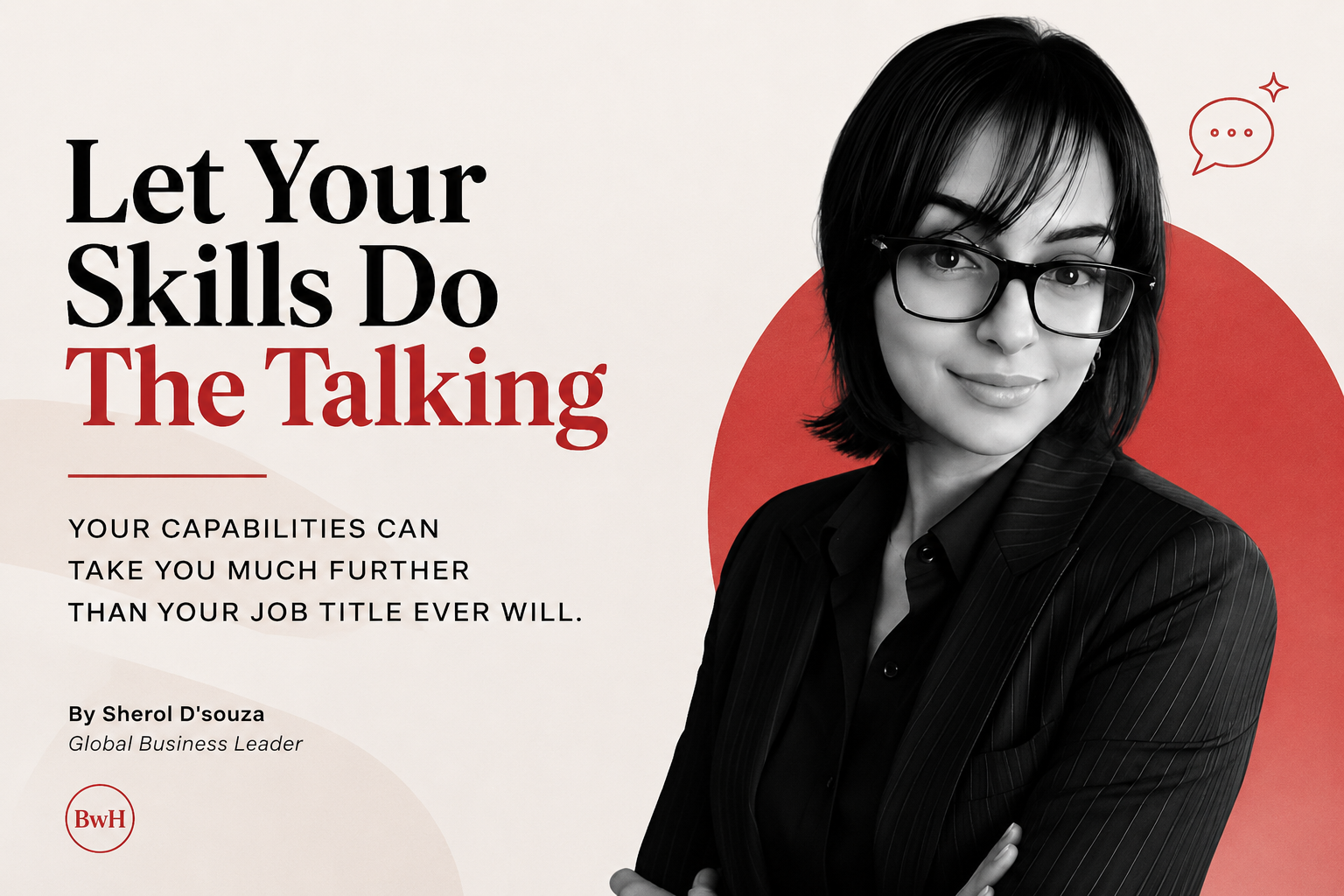
Let Your Skills Do The Talking
What if the biggest obstacle to your next career opportunity is not your experience, but the way you describe it? In this thought-provoking article, Sherol D'souza reveals how, in today's rapidly changing world of work, job titles and industries no longer define a person's true potential. Instead, transferable skills, adaptability, and the value we create are what truly open doors.

When someone asks, "What do you do?" most of us answer with our job title.
"I work in HR." "I am in Learning and Development." "I am a Project Manager." "I work in Marketing."
It sounds normal because that is how we have been taught to introduce ourselves. The problem is that after a while we also begin to believe that this is all we are capable of doing.
As someone who’s lived in the HR World for a while now, I can comfortably say it is one of the biggest mistakes people make when writing their resume (myself included at one time!)
Remember, your job title is simply the position you held. It is NOT your identity and it certainly does not define everything you can do.
Think about it this way. A company did not hire you because your business card had a particular title on it. They hired you because you had the ability to solve problems, manage people, build relationships, analyze information, improve processes, communicate well, or lead a team. Those are the things that made you successful. Those are your real strengths.
Let me walk you through 3 thoughts you may have had before but quickly brushed aside after reading one too many job descriptions.
Skills travel with you
Imagine two people who have spent ten years in different industries. One worked in shipping, the other in healthcare. On paper they look completely different, right?
But if both of them have led teams, managed budgets, built strategies, improved performance and worked with senior leaders, then they actually have far more in common than they realize. The industry may have changed but the skills did not.
This is why some people move from banking into retail, from hospitality into aviation, from education into technology or from logistics into consulting and perform exceptionally well. They are not changing who they are. They are simply applying the same strengths in a different environment.
Your experience is bigger than your industry
Many especially underestimate how transferable their experience really is. We often think,
"I have only worked in this industry." Or” I don't have experience in that field." Or “I don't think I qualify."
But what if the employer is not actually looking for industry experience first? What if they are looking for someone who can build relationships, influence stakeholders, solve difficult problems, manage change, improve customer experience or develop people?
Those are competencies…competencies that create value wherever you go. Industry knowledge can often be learned. Strong competencies take years to develop.
Side bar: Employers can sometimes limit great talent too
By the way, this is not just something job seekers do. Organizations often make the same mistake. How many job advertisements have you seen that say...
"Must have hospitality experience." Or "Must come from retail." Or "Must have shipping industry experience." Or "Must have FMCG experience."
I’ll admit, sometimes that industry experience is genuinely important and there is no getting around that.
But many times the role itself is built around competencies that exist in almost every business.
Take leadership for example. Leading a team in hospitality still requires communication, coaching, decision making, conflict resolution and building trust. Those same skills are just as valuable in logistics, healthcare, education or technology.
The same applies to project management, customer experience, business development, operations, learning and development, human resources and many other business functions.
When organizations focus only on industry experience, they may overlook someone who already has the exact skills needed to succeed. The environment may be different but the ability to solve problems, build relationships, improve performance and lead people remains the same. Add to that the use of technology such as Applicant Tracking Systems and AI screening tools to shortlist candidates, taking out human judgement. While they save time, they often prioritize job titles, industries and keywords before looking at a person's competencies. As a result, highly capable candidates can be filtered out before a recruiter ever sees their resume simply because they came from a different industry.
Some of the best ideas also come from people who bring experience from another industry. They ask different questions, challenge old ways of thinking and introduce fresh perspectives that might never have existed if everyone had followed the same career path.
Perhaps it is time for both job seekers and employers to shift the conversation. Instead of asking, "Which industry have you worked in?" Maybe the better question is, "What strengths, competencies and experiences will help you succeed in this role?"
Back to the table…
Versatility is a strength
One of the most valuable skills today is versatility. The ability to learn quickly, adapt, understand new environments, ask the right questions, connect ideas from one industry to another. Not everyone can do that!
Versatility is a skill in itself.
It allows you to see opportunities that others miss because you are not limited by one way of thinking.
Some of the most successful professionals have built careers across completely different industries because they learned to focus on the value they bring rather than the label attached to their previous role.
So, the next time you review your resume think about this:
Instead of allowing your job title to tell your story let your skills do the talking. Ask questions like:
What problems did I solve, improvements have I made, results have I achieved? What strengths can people rely on me for, and what things am I consistently good at regardless of the industry?
Someone reading this should be able to imagine you succeeding in several different roles not just the one you have already done.
Your next opportunity might be somewhere unexpected!
The world of work is changing faster than ever where careers are no longer straight lines.
People are changing industries, learning new skills and creating opportunities that did not even exist a few years ago.
Do not place yourself inside a small box simply because of your last job title.
Think about the capabilities you have built over the years. Those are the things that travel with you. Those are the things employers invest in. And those are the things that will continue to open doors long after your job title has changed.
Your career is not defined by the industry you worked in. It is defined by the value you are able to create, wherever you go!



0 comments on “Let Your Skills Do The Talking”
Comments from signed-in readers are published immediately. Keep it professional.
Sign in to join the conversation.