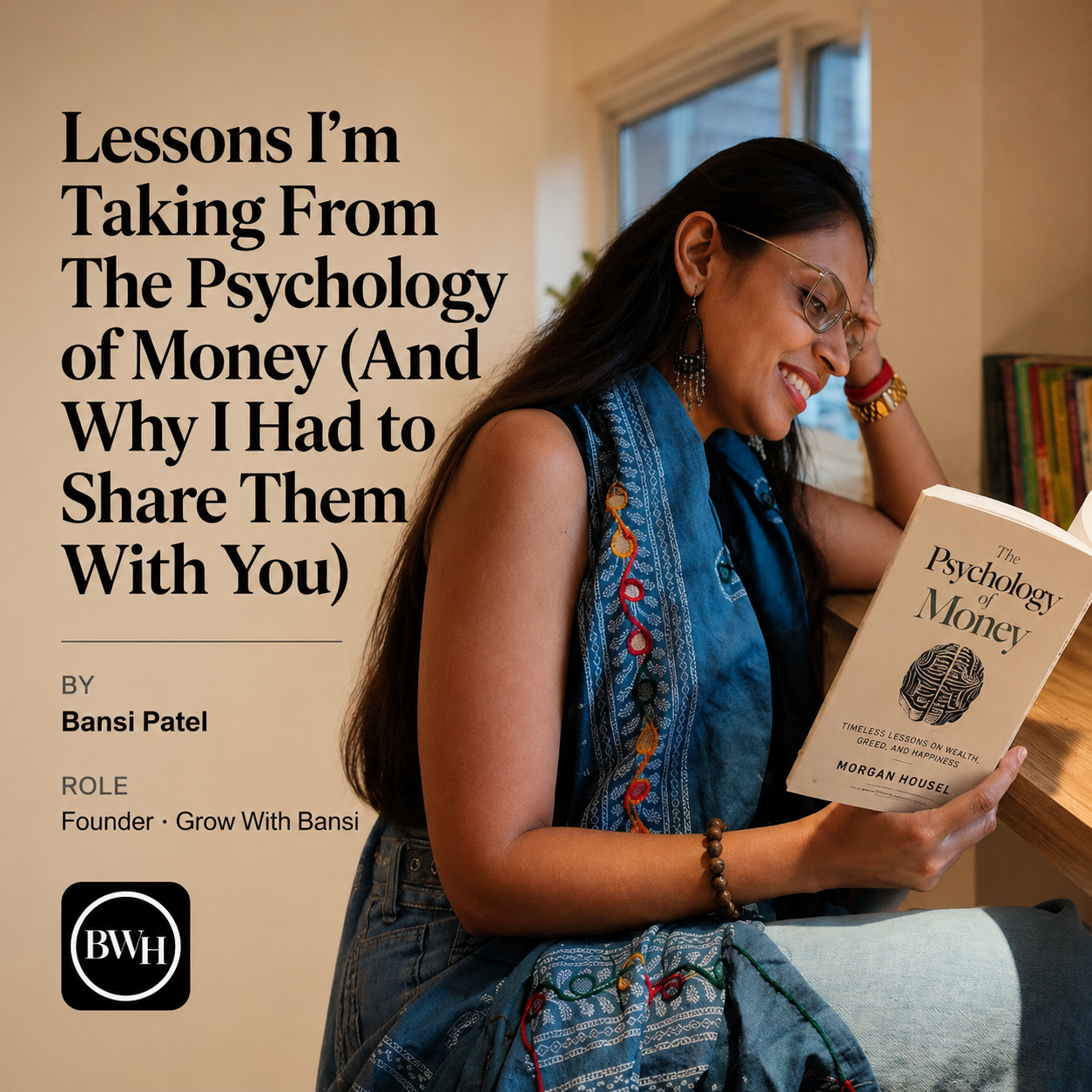
Lessons I'm Taking From The Psychology of Money (And Why I Had to Share Them With You)
I closed this book thinking I was learning about money, but what I was really learning about was myself. The way we think about wealth influences the way we show up in our careers, make decisions, take risks, and create opportunities. These are the ideas that stayed with me long after I turned the last page.

Hey my loves,
For this week's blog, I wanted to do something a little different!
Instead of writing about business, career, or leadership, I wanted to share some of the biggest lessons I've been taking from The Psychology of Money book by Morgan Housel.
Why? Well, I have two reasons.
First, they say the best way to remember something is to teach it. So consider this my very selfish attempt at making these ideas stick.
Second, I genuinely couldn't keep these lessons to myself. If you're part of the Build With Her community, chances are you're building a solid career, trying to create more freedom, and making decisions about money every single day. This book reminded me that money isn't just spreadsheets, budgets, or investing. It's psychology.
And once you understand that, everything changes.
So here are the lessons that stayed with me.
1. Doing well with money isn't about being the smartest person in the room.
We often assume wealthy people know something the rest of us don't. Sometimes they do, but more often, they simply behave differently. They stay calm, think long term, and don't let temporary emotions drive permanent financial decisions.
The same is true in our careers. I've seen incredibly talented people give up because success didn't come quickly enough, while others quietly built remarkable careers simply by staying consistent. In the long run, consistency almost always beats brilliance.
2. Everyone's money story makes perfect sense... to them.
One of my favourite ideas in the book is that every financial decision makes sense when you understand the person's experiences. Someone who grew up with financial hardship will naturally see money differently from someone who didn't. We all view money through the lens of our own lives.
It reminded me how easy it is to compare our financial decisions with people whose circumstances, opportunities, and beliefs are completely different from ours. Instead of asking, "Why don't I think like them?", a better question is, "What beliefs about money have I been carrying without ever questioning them?"
3. Decide what "enough" looks like.
If you never define what "enough" means, you'll spend your whole life chasing the next milestone. First it's a certain income, then a bigger home, then another investment, and before you know it, the finish line keeps moving.
There's nothing wrong with wanting more. Ambition is a beautiful thing. But money should create more life, not keep convincing you that life begins after your next financial goal. That line alone was worth reading the book for.
4. Money is emotional.
We like to believe our financial decisions are logical, but they're often driven by emotion. Fear makes us hold on too tightly, ego pushes us to take unnecessary risks, and comparison convinces us everyone else is ahead. Before we know it, we're making decisions based on how we feel instead of what's actually true.
The more I reflected on this, the more I realized this isn't just about money. It's about self-awareness. When you understand your emotional patterns, you make better decisions in every area of your life, including your finances.
5. Small decisions become big because of time.
We're obsessed with overnight success. Money doesn't work like that. Compounding is almost boring. Save a little. Invest a little. Repeat. Year after year. Nothing feels dramatic in the moment. Until one day you realise those tiny choices quietly changed your life. The same applies to habits. To relationships. To business. Consistency rarely feels exciting while you're doing it. Its magic only becomes obvious looking backwards.
6. Wealth gives you choices.
This one completely shifted how I think about money. We often think wealth is about buying nicer things. But real wealth buys something much better. Choice. The choice to leave a job. The choice to take six months off. The choice to say no to work that doesn't align. The choice to spend your Tuesday afternoon however you want. That's freedom. And personally, I think freedom is one of the best investments you can make.
7. Looking wealthy and being wealthy are two different things.
This one deserves to be framed. Fancy cars. Designer handbags. Luxury holidays. Those are visible. Savings aren't. Investments aren't. An emergency fund isn't. People often spend money trying to look rich while quietly giving away the very thing that creates wealth. Real wealth is usually invisible.
8. Prepare for things going wrong.
One of my favourite reminders from the book was this: don't build your financial life assuming everything will go according to plan. It won't. Unexpected expenses, career changes, and life's little surprises are part of being human. Build margin. Keep cash aside. Leave room for the unexpected. Not because you're expecting the worst, but because you're wise enough to know life is beautifully unpredictable.
9. The goal is to stay in the game.
This might be the simplest lesson in the book, and perhaps the most important. You don't need to make perfect financial decisions. You simply need to avoid the ones that take you out of the game altogether. The same is true in business, careers, and life.
The people who build lasting wealth aren't always the smartest or the luckiest. More often, they're the ones who keep showing up, stay patient, and give themselves enough time for consistency to work its magic. Time has a beautiful way of rewarding those who don't quit.
If this book taught me anything, it's that money isn't really about money. It's about our behaviour, our patience, our beliefs, and the stories we tell ourselves. Those beliefs don't just shape our bank accounts. They influence how we negotiate our salaries, price our work, take risks, choose opportunities, and define success in our careers.
We spend so much time learning how to earn more money, grow our careers, and climb the next rung of the ladder. Maybe it's time we spent just as much time learning how to think about money. Because when we change our relationship with money, we often change our relationship with work, ambition, and the life we're creating.
I'd love to hear from you. What's one money lesson that's completely changed the way you think about wealth or your career?


0 comments on “Lessons I'm Taking From The Psychology of Money (And Why I Had to Share Them With You)”
Comments from signed-in readers are published immediately. Keep it professional.
Sign in to join the conversation.