I Walked Out of High School at 16. Thirty-Five Years Later, I Finally Knew Why.
I spent my whole life knowing I was different before I ever had a word for it — pulled out of class for testing, mixing up my letters, watching the right answer come out of my mouth wrong. It took an argument with an AI chatbot, on a day I was already running on empty, to finally connect the dots and build the thing I’d needed all along.
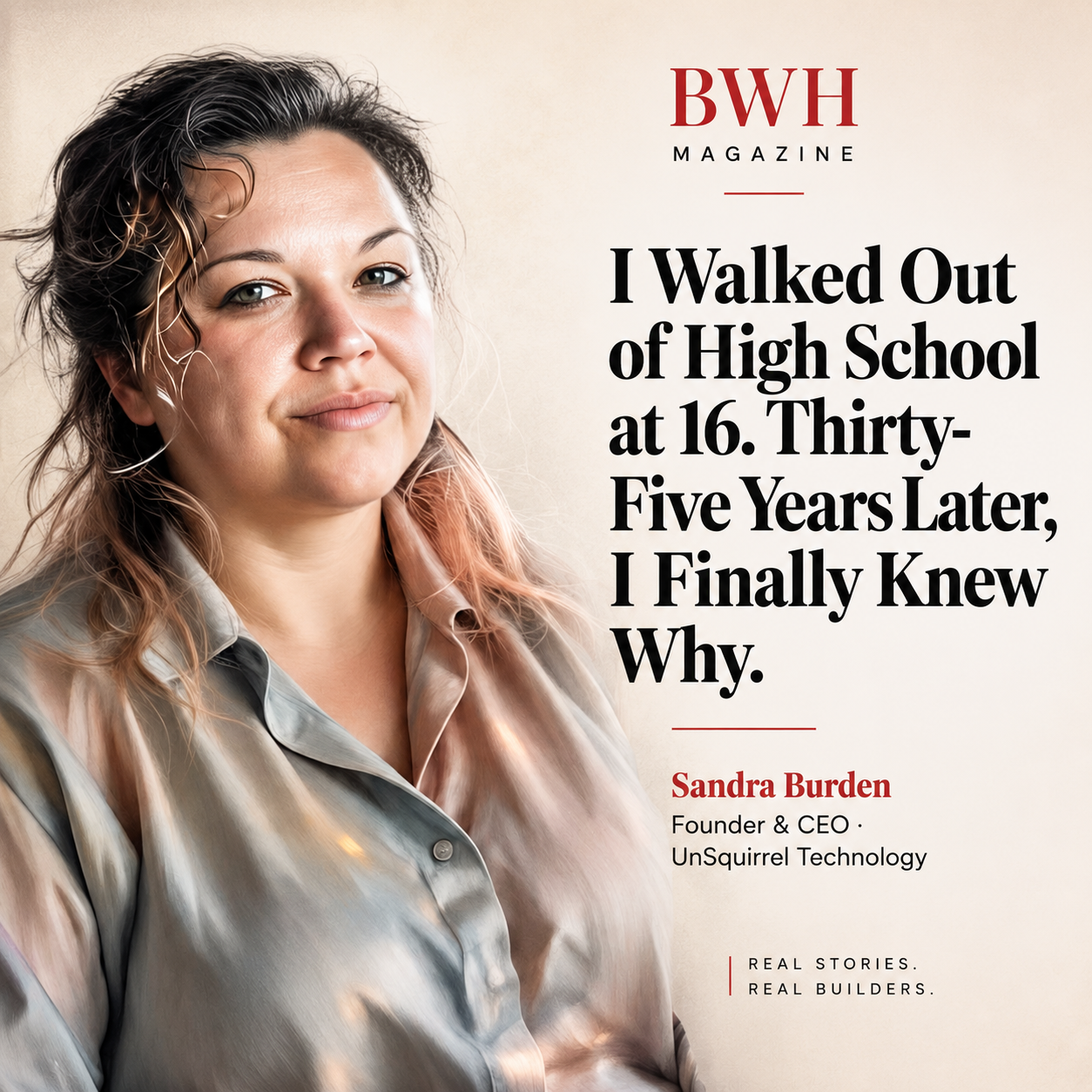
I’ve known I was different since I was a kid. In elementary school, I was pulled out of class and led into a dark tunnel behind the gym for testing — memory games, speech work, someone I thought was a teacher watching me closely. I went to Saint Joseph Hospital in Omaha for speech therapy because I flipped my B’s and D’s and couldn’t get certain sounds right. Nobody used the word dyslexia. My stepdad just told me nothing was wrong with me — that my brain thought differently, and my thoughts moved faster than my mouth could keep up with.
I remember riding the school bus and van, always worried I’d get the number wrong. So instead of trying to hold onto a number I could never remember, I’d look for people I recognized — that’s how I knew I was on the right one. I remember being exhausted as a kid, too — worn out after intense days of heavy schoolwork in a way that didn’t match how other kids seemed to handle it. That pattern never really left. As an adult, I’ve told doctors over and over that I feel tired even after sleeping far longer than I should need to, explaining exactly what it felt like. Nobody ever did anything about it.
In middle school, a teacher would ask a question, I’d know the answer, and a different one would come out of my mouth. Classmates laughed. The teacher moved on. In high school, I was pulled out again, sat in a separate room with kids I knew I understood the material better than — so I tutored them instead of resenting it. I took the SATs and scored an 8. I got pulled into the principal’s office over it. They assumed it was test-day nerves from the timer, and that was part of it — but what actually happened was I’d spend so long trying to answer a couple of questions that time started running out, and I ended up just filling in answers to get through the rest.
By 12th grade I’d already earned enough credits to graduate early, but my mother wanted me to finish the year. I didn’t make it. I stood up in advanced chemistry one day, told the teacher I was leaving, and walked out of high school for good at sixteen. I babysat, detasseled corn, worked Domino’s, then Burger King — hired because I sat in a booth there every day until the manager just offered me a job. At seventeen, I got married. My husband didn’t know I was dyslexic. We never once talked about it — not because I was hiding it, but because I didn’t have the word for it myself yet.
Part Two: Grief, and Getting Lost
When I married my husband, I married into property management. We ran a complex together — everything from lawn maintenance to unit maintenance, rehabbing units, delivering notices, and collecting rent. I left that career about a year or two before he died and went into caring for people with disabilities. As he got worse, I delivered newspapers for the Omaha World-Herald in rural areas, because it gave me the flexibility to take care of him.
My husband passed away in 2005, and my world changed. I felt grief and anxiety for so long, and I didn’t know why it hit so hard — hard enough that I couldn’t hold a job down. My body started reacting in ways I never expected. I moved to Denver, Colorado. Thirteen years after I’d last sat in a classroom, I went with a friend when she applied for college there. The admittance counselor, Jolene, talked with me while my friend went to take the placement test, and afterward she looked at me and said, “What about you?” I told her I hadn’t been in school in over thirteen years and didn’t even have a GED. She said that was fine and asked if I wanted to take the test anyway. I walked in with no preparation, joining a class that had spent an hour or two studying beforehand — I had no idea what I was walking into. When it was done, Jolene came back before the grading finished and asked how I thought I did. I told her I’d failed, that there was no way I passed, that I couldn’t even remember the formulas. She came back a second time and asked again, more gently. I said I thought I’d passed English, but I was sure I’d failed math. Then she read me my score. I don’t remember the exact number, but I remember what she told me next: I was enrolling in school, and they were going to help me get my GED. I’d scored the highest in that class — and the highest in the school’s history. I was allowed to take any course I wanted. The Department of Agriculture paid for my GED. A pretest showed I didn’t even need the prep classes, but I had to wait almost three months for the next test date, and by then I was already sitting in college classes.
For college, I decided I was going to go for surgical tech. I worked temporary jobs in the hospital cleaning up ORs and having fun conversations with the nurses and doctors there. I even got to sit in on a surgery. I loved it — but it hit too close to my husband’s death, so I switched to business management instead. After that temp position ended, I worked as a receptionist for Broomfield, in Boulder County’s mental health department. It turned out to be a blessing in disguise — for the first time in my life, I was actually receiving therapy for my grief. Even then, they misdiagnosed me with PTSD and gave me coping skills to deal with it. I kept telling them I was one way in public and a completely different way at home, but no one ever picked up on it.
I was in Denver for three years total. When I got back to Nebraska, I saw the doctor who used to treat both me and my husband. I told him I felt depressed — that I was still holding onto the grief, and carrying anxiety I’d never experienced before in my life. His answer was to medicate me. I tried it, but it just made me feel like a zombie. It wasn’t actually treating the problem underneath. I worked as a nursing scheduler for a nursing home, and this is when I went through my first true burnout. I thought it was the grief. I was out of work for two years after that, trying to get my life back on track. Eventually I told the doctor I wasn’t going to keep taking the antidepressants, because I didn’t believe it was depression I was going through — it was the anxiety. I was having trouble even walking out of my house, being in public, being around people, shopping for myself. I was also having trouble sleeping. I tried desperately, but my body would just get wired at night — so much that I’d take a basketball out and walk a school track bouncing it for hours until I finally got tired enough. Then I’d go home, sleep maybe three or four hours, get up, and fake it in the real world all over again. I felt like I was just going through the motions — not really living.
Part Three: Building a Career on Top of a Pattern I Couldn’t Name
Once I’d steadied enough, I went back into property management — first a small complex, collecting rent, delivering notices, taking care of the yard, then the corporate side, managing larger properties and staff. I stayed a couple of years at each place before moving to the next, all while ignoring how exhausted I actually felt. Eventually the burnout caught up to me again, and I convinced myself it was the job, not anything deeper. So when a job offer in Cleveland, Ohio came along, I took it and moved with no family support nearby. I tried temporary manufacturing work first, didn’t like it, and went back into property management once more.
I worked long days there — hours spent writing emails, making sure I never misspelled anything, taking care of tenants. A lot of them read me wrong, thought I was too aggressive or too frustrated in my responses when I wasn’t. I always followed the rules to the letter, explained exactly what I could and couldn’t do and what their obligations were, but I couldn’t force anyone to do anything. I had one resident who was always trying to tell me what I needed to do, which irritated me — but she paid her rent on time and was otherwise a decent tenant. Toward the end of that job, things started slipping. The owner noticed, but they didn’t understand why any more than I did. I worked long hours, six days a week, for six years in Cleveland before I decided to move again.
I’d planned to move to Alabama or Florida, to get to know family I wanted to know better. That didn’t work out, so I moved to New York instead. I knew I didn’t want to go back into property management after all that burnout, so I stuck with Uber and home healthcare. My burnouts have only gotten more frequent as I’ve gotten older. Both of my parents passed away while I was living in Cleveland, so I was never able to ask them if I had dyslexia. But honestly, at the time, that wasn’t even something I was thinking about.
Part Four: The Realization
Then one day I was scrolling through Facebook and came across a doctor talking about dyslexia — the symptoms, what it actually looks like day to day. I was fascinated. Things in my head started making sense. Oh my God, that’s me. I have dyslexia. For the first time in my life, things finally made sense.
After watching those videos, I started remembering everything at once — the classes I’d been pulled out of, the speech therapy, what my stepdad had told me. And I realized something about my mother, too. She always told me I had her brain, that I should be able to understand this stuff — meaning my schoolwork — which is why she had me doing college-level courses back in junior high. I don’t want to give the wrong impression — I always felt that pressure growing up, I just didn’t understand at the time what she was doing or why. I understand now that it was a blessing. She gave me the intelligence and strengthened the abilities that let me create UnSquirrel. I saw the connections nobody else was seeing, built off my own life and the world I’d worked in.
It also explained things I’d never had words for. When I’m working through a problem, I sometimes see pictures — almost like movie reels — playing in my head. Sometimes I hear things that aren’t actually there, just in my mind. I want to be clear, this isn’t anything like schizophrenia — I looked into it and found out it’s an actual symptom tied to how my brain works. And when a word comes out wrong, I know immediately that it’s wrong. I can feel myself looking upward, like I’m searching through my own frontal lobe for the right word. People can probably see me doing it. No one’s ever said anything. Meeting someone new is its own version of this — I’ll lose their name within seconds, and I’ve learned to mask it by just never saying it, starting the conversation anyway and hoping it comes up again naturally. I’m always too embarrassed to just ask.
Part Five: Building UnSquirrel
The moment that actually started UnSquirrel was smaller than all of this, and messier. I was already burnt out that day — I’d worked a shift, and I was running on empty. I was trying to get through a lengthy AI chatbot response and my brain just wasn’t taking the words in. I reread it over and over, exhausted, and asked the bot to just read it to me. It told me I’d need a separate piece of software for that. I got upset — why can’t you just do it? — and that’s where the argument started. That’s my actual problem: not any single task, but having to open a new app, relearn how to use it, and hold onto that context on top of everything else. If it’s too much friction, I avoid it entirely. Sometimes I talk myself through a task out loud, hoping it’ll stick in my brain — and sometimes it just disappears anyway. When I’m exhausted, the words or the thoughts jump around and won’t come out right at all.
That frustration sent me down a research hole — deep into dyslexia and ADHD both — and from there I started asking my Uber passengers if they were neurodivergent and where they struggled. The more I researched, the more I started recognizing it in people before they ever said a word. I had passengers I told, gently, that maybe they should talk to their doctor — because they were describing the exact same memory loss and burnout I’d gone through myself. Students on their way to becoming nurses, doctors, lawyers told me about fighting through reading comprehension, papers, concentration. I remember thinking, oh my gosh, I was just like you. The idea that became UnSquirrel’s “cheat to life” reputation actually came from one ride — four students, all excited, talking with me about what a tool like this could actually do: simplify text down to the level you can process, help you write an email when the words come out sporadic, a calendar that just tells you what to do next, something that learns your habits, reminders to take your medication or eat. I learned more in that one ride than in weeks of research.
Building it meant learning things I had no business knowing how to do — building a website, a prototype, a technical scope, a business plan — mostly by asking AI tools how to build what I could picture but couldn’t yet explain. I could see the complete version of what I wanted in my head, even though I couldn’t always explain how I’d arrived at it. I was meeting with SUNY to learn how to actually grow a business while also sitting down with web designers and engineers, trying to get the vision out of my head and into words they could build from. Some got it immediately. Others got partway there — on the right track, but not fully understanding it yet — which sent me back to more research and back to pitching it differently. I knew I had something. I just needed them to validate it. I remember one conversation where a designer referenced something I’d apparently told him before, and I had no memory of it at all — I asked him to fill me in, and he just kept going like I hadn’t said anything.
There were real burnout stretches during the build — one lasted almost two months. I’d research until I was completely drained, walk away to play a brain game or watch something or sit with my dogs, and still wake up exhausted the next morning. Other weeks I’d hit hyperfocus and lose entire days — forgetting to eat, or eating too late to bother and just going to bed instead. Those were also, strangely, the days I built the most.
UnSquirrel isn’t built for dyslexia alone — it’s built around both dyslexia and ADHD, because for me they’re tangled together under the same neurodivergence. I show every sign of ADHD, but I’m not formally diagnosed. The statistics on unemployment and underemployment for people with dyslexia and ADHD are brutal, and I’ve lived every part of that — the symptoms and the employment struggles both — my entire life, whether or not there was ever a diagnosis attached to it. I don’t even need to get into the smaller stuff — losing my keys, my wallet, my purse, putting something down “somewhere I’ll remember” and never remembering. That’s just daily life.
This didn’t come from a gap I spotted in a market report. It came from a lifetime of knowing something was different, a placement test I walked into cold, and years of burnout I kept blaming on the wrong thing — until a doctor on Facebook finally gave it a name, and I refused to keep waiting for someone else to build the thing I needed.



0 comments on “I Walked Out of High School at 16. Thirty-Five Years Later, I Finally Knew Why.”
Comments from signed-in readers are published immediately. Keep it professional.
Sign in to join the conversation.