I Didn't Set Out to Build an AI Platform—I Set Out to Solve a Retail Problem
This article shares my journey as a Lead Data & AI Platform Architect designing an AI powered inventory intelligence platform for retailers. It explores how understanding business processes, not just artificial intelligence, led to practical solutions that automate operations, improve inventory visibility, and help businesses make smarter decisions.

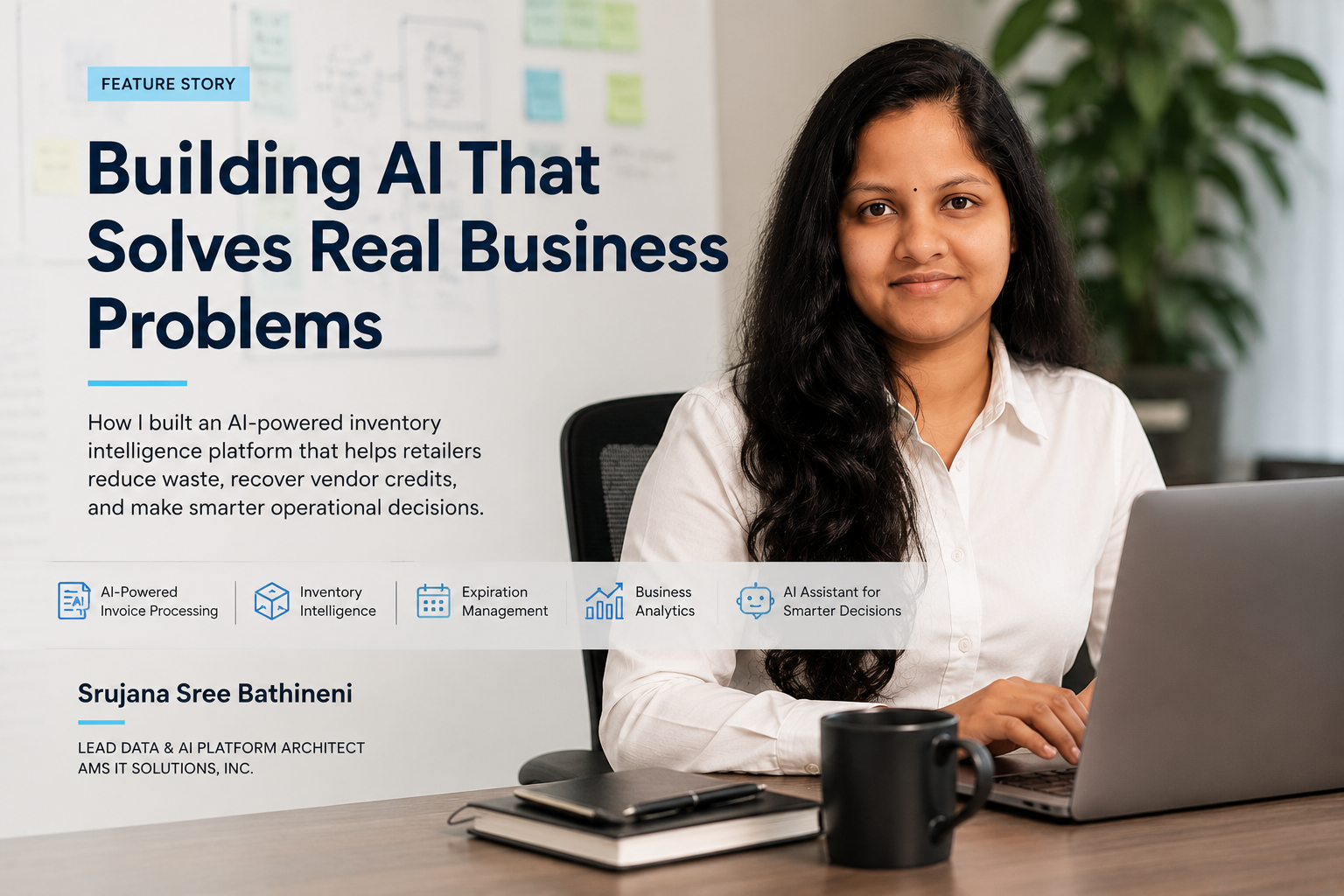
When people hear that I work in artificial intelligence, they often assume my job is about building machine learning models or experimenting with the latest AI technologies. While those things are certainly part of my work, my journey into AI began somewhere much less glamorous, with a problem that thousands of retailers face every day.
As the Lead Data & AI Platform Architect at AMS IT Solutions, I work closely with convenience store retailers. The more time I spent understanding their operations, the more I realized that many of their biggest challenges had very little to do with technology. Employees were manually processing supplier invoices, tracking inventory through spreadsheets, monitoring products approaching expiration by walking store aisles, and making purchasing decisions based largely on experience rather than data.
The software they relied on could record sales, but it couldn't help them answer the questions that mattered most.
Which products are moving too slowly?
Which items are approaching expiration?
Which products can still be returned to vendors before they become a loss?
How much inventory is actually sitting on the shelves today?
These weren't AI problems.
They were business problems waiting for intelligent solutions.
Looking Beyond Traditional Retail Software
One challenge immediately stood out to me.
Manufacturers rarely print expiration dates in a way that store employees can easily understand. Instead, they use manufacturer-specific production codes and lot numbers that vary from company to company. Even experienced employees often couldn't determine whether a product was approaching expiration without manually interpreting those codes or relying on experience.
I realized this wasn't simply an inconvenience. It affected inventory accuracy, vendor credit recovery, operational efficiency, and ultimately customer experience.
Rather than building another reporting dashboard, I wanted to design software that could help retailers make better decisions automatically.
That became the foundation of the AI-powered inventory intelligence platform I would go on to architect.
Designing AI Around Business Processes
One lesson became clear very early in the project.
AI should never be the starting point.
Before writing a single AI workflow, I spent time understanding how products entered the store, how invoices were processed, how inventory moved through daily operations, and how store managers actually made decisions.
Only after understanding those workflows did artificial intelligence begin to make sense.
The platform I designed combines AI powered invoice processing, inventory intelligence, operational analytics, expiration monitoring, and intelligent decision support into a single ecosystem. Instead of asking employees to manually organize information, the platform continuously transforms operational data into meaningful insights that help retailers work more efficiently.
The objective was never simply to automate tasks.
It was to help people make better decisions.
AI Is Only as Good as the Processes Behind It
Working on this platform completely changed how I think about artificial intelligence.
Many organizations begin AI projects by asking,
"How can we use AI?"
I believe that's the wrong question.
The better question is,
"What business problem are we trying to solve?"
If the underlying business process is inefficient, AI will simply automate inefficiency.
Successful AI begins with understanding people, understanding workflows, and understanding why existing systems fail to support everyday decision-making.
Only then does AI become truly valuable.
Lessons Beyond Technology
This journey also changed me as an engineer.
Technical leadership isn't about writing the most sophisticated algorithms or adopting every new AI framework. It's about listening carefully, understanding operational challenges, and designing technology that people genuinely want to use.
Some of my most valuable engineering decisions didn't come from reading research papers. They came from conversations with retailers explaining how they actually worked.
Those conversations shaped every architectural decision I made.
Looking Ahead
Artificial intelligence is evolving rapidly, but I believe its greatest impact will come from practical applications that quietly improve the way people work.
My goal is to continue designing enterprise AI systems that solve meaningful operational problems, simplify decision making, and make advanced technology accessible to businesses of every size.
For me, building AI has never been about replacing people.
It's about giving people better information, better tools, and ultimately better decisions.
Because the most successful AI isn't the technology people notice.
It's the technology that simply helps them do their jobs better.



0 comments on “I Didn't Set Out to Build an AI Platform—I Set Out to Solve a Retail Problem”
Comments from signed-in readers are published immediately. Keep it professional.
Sign in to join the conversation.