How I Built a Career from Nothing to Managing Millions in a Man’s World
Seeking financial independence after NYSC in Asaba, Agnes moved to Lagos on a one-year agreement with her husband, who was cautious of the unknown, to build the career she envisioned. After scoring top in her assessments, she broke into a male-dominated fitness industry, but faced gender bias when placed on an assistant's salary despite holding the Manager title. Juggling two toddlers and 4:30 AM daycare drop-offs via public transport, she proved her capability by turning a failing gym branch from ₦4M to ₦25M+ monthly, forcing equal compensation and launching her career into executive leadership.

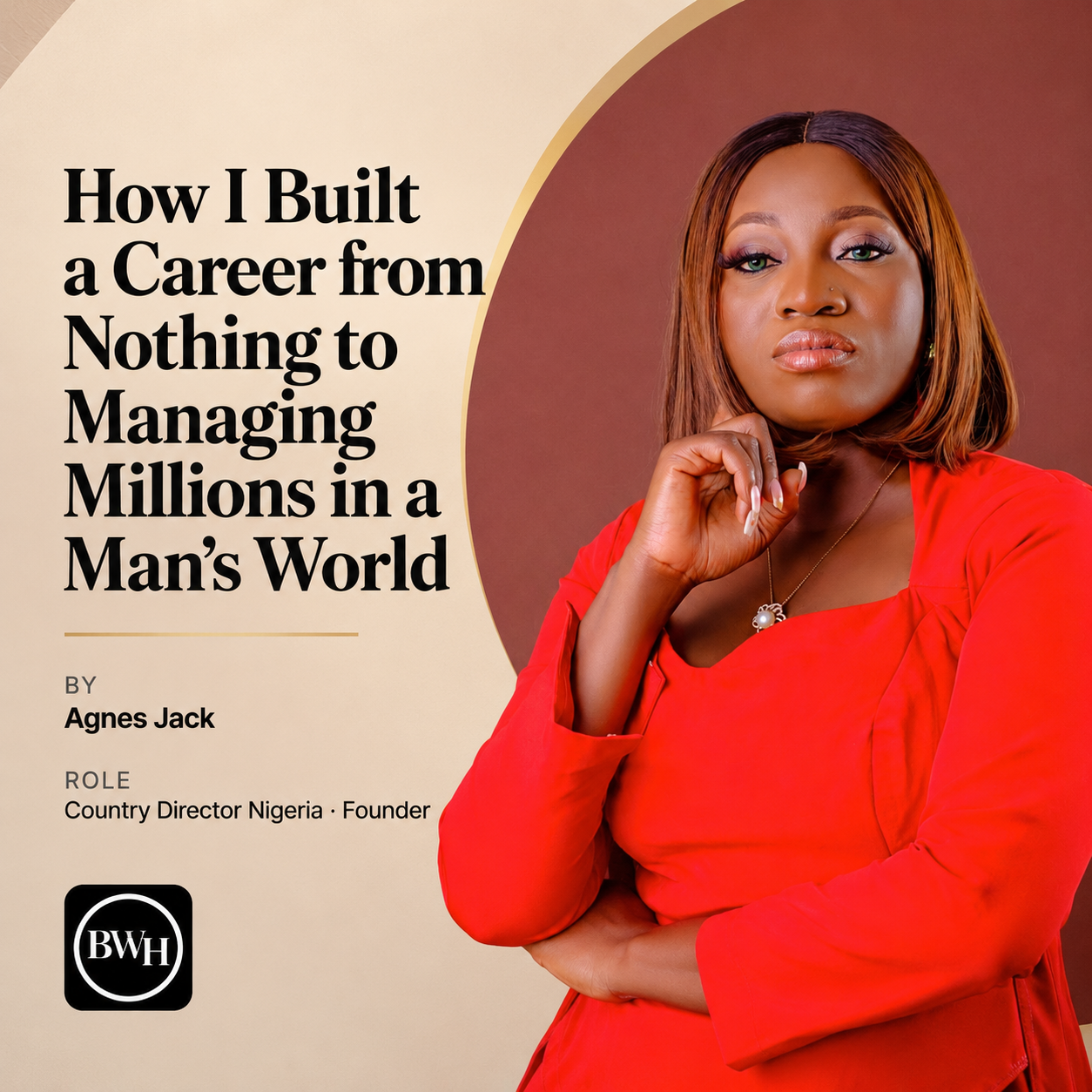
I have never been the kind of woman to sit down and wait for someone to feed me.
My real career journey didn't start in a corporate boardroom; it started right after I passed out from my NYSC service year, in Asaba. I got married during my service year, had my daughter a few months after passing out, and two years later, my son came along.
Asaba is a quiet town, but I am an ambitious woman. My husband was there, yes, but he wasn't providing the kind of life I envisioned for myself and my children. I knew early on that if I wanted real security, I had to stand up and earn it myself.
So, I started looking for work. But the offers I got in Asaba were insulting 25,000 Naira, sometimes as low as 15,000 Naira. I kept telling myself, "I didn't go to university for this."
I was no stranger to pushing through pain. Back when I was pregnant with my daughter, I worked as an ad-hoc staff at an MTN Connect store in Asaba. I was the first person to resume and the last to close every single day. My boss didn't even know I was pregnant until my nose started swelling in the third trimester and she asked me what was happening. I scheduled my antenatal visits so seamlessly around my shifts that my personal life never touched my work. But because it was contract job, there was no maternity leave. Once the baby came, I had to stop.
After three months, I traveled to Lagos to do a training with WAVE (West Africa Vocational Education). I became close with the CEO, Misan Rewane. I begged her to help me relocate to Lagos because that was where the job opportunities were. But Misan is very family-oriented; she wanted me to stay close to my husband. Out of genuine care, she tried to help me find roles in Owerri and hotel jobs nearby, but the pay was always too low. Eventually, to help me keep body and soul together, she offered me a remote internship with WAVE paying 35,000 Naira.
I did that internship from Asaba for two years, working right through my pregnancy with my son. And just like before, when I gave birth, the internship ended, and I was back at home with a newborn.
That was the hardest phase of my life.
I started dropshipping online, flipping small items just to make a tiny profit. But as I sat there looking at my two babies, a dark thought hit me: What if something happens tomorrow? What if my husband isn't here? How will I raise these children on my own?
I made up my mind. I was moving to Lagos. I was born and raised in Lagos, and I knew in my spirit that Lagos held my breakthrough.
When I told my husband, he was naturally hesitant. He is someone who is deeply cautious of change and afraid of the unknown. He looked at me and said, "There are thousands of people in Lagos with degrees who have been looking for jobs for years and haven't found anything. Why do you think yours will be different?
I rejected fear immediately. I looked at him and said, "My glory, my grace, and my star are not the same as theirs. Lagos will work for me."
He gave me an ultimatum: I had one year. If I didn't land a proper job within 12 months, I would pack my bags and come back to Asaba.
The moment my feet touched Lagos, I called Misan.
She said, "Agnes, you are so stubborn!"
I replied, "No, ma'am. I am just determined. I want to build something for myself."
Seeing my resolve, she asked if my husband was aware, and when I confirmed, she promised to have her team line up interviews for me.
My very first interview was with a major company in the fitness industry. I went through the first stage, the second stage, and then the intensive operational assessments. When the results came out, I scored the highest.
When I finally sat down across from the CEO for the final interview, he looked at my assessment scores, deeply impressed, but hesitant.
He looked at me and asked point-blank: "Are you still going to have more kids? Won't your children disturb this job? I have never hired a female branch manager before, and I'm very skeptical. But something in me is telling me to give you a chance."
I looked him straight in the eye and said: "Sir, if you give me this chance, you will never regret it. My family will never get in the way of your work."
He took the gamble and hired me.
We were 21 candidates recruited in that batch for managerial role. Our onboarding was supposed to be a two-week intensive training program. We had only completed one week when COVID-19 hit the world, shutting down businesses overnight. Everything was put on pause, and all 21 of us were sent home to wait, completely uncertain of what our fates would be.
Months later, as the country began to reopen, the company reached out. Out of the 21 people in our set, only six of us were called back to resume.
Among the six of us, there were only two females. Because I had performed exceptionally well during the recruitment interviews and assessments, my offer letter explicitly stated my title: Branch Operations Manager. The other female candidate who was recalled was given an Assistant role outright.
However, my salary was that of an assistant manager, the gender bias was undeniable. All the male managers existing and recalled were given full managerial roles with full compensation. I was given the full operational title, the full burden of responsibility, but paid the salary of an assistant.
The bias went far beyond my paycheck,it was in the very air of the company.
At the time, the business operated around 15 branches across the city, meaning there were 14 male branch managers and I was the only female manager in the entire organization.
In the beginning, strategic meetings were called, and I wasn't even notified simply because I was a woman. The men would gather, hold discussions, and make decisions without me in the room. Even when I was present in leadership meetings, major decisions were being weighed and the men were actively invited to share their opinions, while no opportunity was given for the women to speak. I was expected to sit quietly, take orders, and run my branch while the men ran the business.
To make matters worse, they handed me a dying branch, a location that was bleeding money, struggling to generate barely 4 million Naira a month, sitting right on the verge of being shut down completely. The unspoken test was clear: Let’s see if a woman can carry this weight.
My daughter was five, and my son was barely one.
Every single morning, I was up in the dark. I paid extra to drop my kids off at daycare as early as 4:30 AM, and then I would trek out to the road, flag down public transport, and hustle my way across town just to ensure I was unbolting the gym doors by 5:30 AM sharp. I was exhausted, underpaid, and running on pure grit, but I swore no one would ever use my children as an excuse to downplay my competence.
I got to work on that branch. I audited the floor, shut down internal loopholes, fixed operational leakages, and built a tight-knit community among the members.
In three months, the branch was back on its feet, hitting 8 million Naira monthly. I went back to the CEO and asked for my pay to match my title and my male peers. They dragged their feet. HR shuffled papers and made excuses.
So, I stopped arguing with words and let my numbers do the talking.
Within months, I scaled that "dying" branch from 8 million to consistently generating over 25 million Naira every single month.
Suddenly, the dynamic in the room shifted. You cannot ignore the manager bringing in the highest revenue in the company.
The same leadership that once left me off meeting invites now waited to hear my perspective. The same rooms filled with 14 men had to sit back and listen when I spoke, because my branch was setting the standard for the entire business. I didn't just earn a seat at the table, I commanded the mic.
When they finally reviewed my compensation to match my manager title, they refused to backdate my pay for all those months I had slaved on an assistant’s wage. But it didn't matter anymore. In the next company assessment, I took the test again and scored the highest across the entire organization once more. My salary was reviewed again, my authority was sealed, and when another corporate fitness chain saw what I was doing, they headhunted me for a higher executive role to run their operations, where I replicated the exact same systems and turned their revenue around completely.
Looking back at where I started, sitting in Asaba doing 35k internships, being told Lagos wouldn't work for me, and carrying my toddlers to daycare at 4:30 AM, I realize one thing:
Your environment does not determine your height; your drive does.
To every woman sitting in a quiet corner, feeling stuck, underpaid, or told that a male-dominated industry isn't meant for her: Trust your grace. Master your craft so deeply that your results become an argument no bias can win. When you know what you bring to the table, don't just ask for a seat, make them listen.
Years later, people tell me that whenever my name is mentioned in the organization, everyone reacts. The name Agnes became synonymous with absolute standard and unbeatable execution. I left a mark in that organization that time has refused to erase.
Women ask me all the time: "Agnes, how did you do it? How do you navigate being the only woman among all those men, leave such a huge mark, and make sure your name never dies?"
My answer is simple, but it requires relentless discipline:
First, you do not compete with people; you master the machine. While others are playing politics, understand every single gear of the business better than anyone else. When you possess deep operational competence, you make yourself irreplaceable.
Second, build a footprint of undeniable proof. Don't just work hard, track your numbers, document your impact, and create results so massive that even your harshest critics have to quote your metrics. That is how you build a legacy.
And finally, to the woman who asks, "What if I do all of this, what if I carry the mountain, fix the numbers, set the standard and the environment STILL refuses to compensate me, value me, or respect me?"
Hear me clearly: You pack your proof and you leave.
Your track record does not belong to the company that underpaid you; it belongs to you. It is your personal equity.
When you have turned a dying branch into a multi-million Naira revenue engine, you have proven your craft. If that room refuses to align your compensation with your worth, it is not a sign of your failure, it is proof that you have outgrown the room. You do not spend your entire life begging for equality at a table that was built to keep you on the floor. You take your documented results, walk into a higher room, and command the executive compensation you have rightfully earned.
I started joggling two toddlers and work, ignored in meetings full of men. Today, my name still echoes in rooms I no longer step into, not because I asked for permission, but because I built a standard that outlived my time there.
Trust your grace, master your craft, and never be afraid to step into the bigger doors waiting for you.



0 comments on “How I Built a Career from Nothing to Managing Millions in a Man’s World”
Comments from signed-in readers are published immediately. Keep it professional.
Sign in to join the conversation.