The AI Bias Debate: What the Research Actually Says
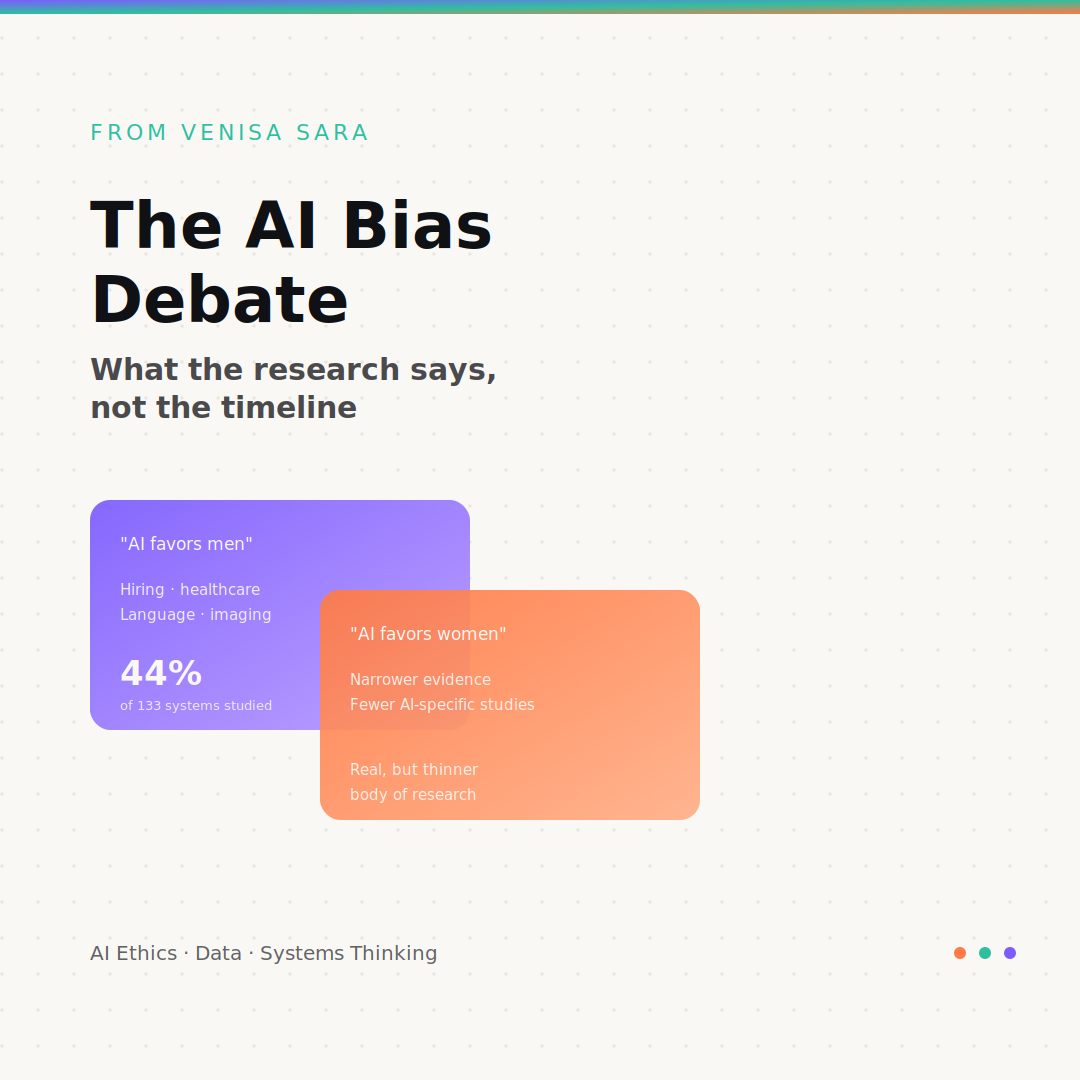
Both sides of the AI bias debate think the other is imagining things. This piece actually goes and reads the research; the evidence against women is broad and well-replicated, the evidence against men is real but much thinner, and neither side is being honest about that imbalance.

The AI Bias Debate: What the Research Actually Says
I almost didn't write this one. Every time this topic shows up in my feed, it turns into the same fight. One side posts a screenshot of an AI system saying something sexist about women. The other side posts a screenshot of an AI system being weirdly harsh on a man's resume. Both sides act like the other one is making it up. Both sides are a little bit right and mostly talking past each other, and I got tired of watching it happen without actually knowing what the research said. So before writing a single sentence of this, I went and read it.
Here's what's actually there.
The evidence against women is not a vibe, it's a body of research
This isn't a fringe claim, or one bad prompt someone screenshotted for engagement. A 2024 UNESCO study found that large language models regularly associate women with domestic and subordinate roles, words like "home" and "family", while linking men to "executive," "business," and "career." In some of their tests, roughly one in five completions to gender-based prompts came back sexist, sometimes describing women as property. That's not a fluke. That's a pattern researchers went looking for and found, again and again.
And it's not just language. It shows up in places that actually affect people's lives:
Healthcare. Diagnostic models trained on male-dominated datasets have misattributed women's heart disease symptoms to other conditions entirely. A model built to detect thoracic disease tested more accurately on men than on women, just because of who was in the training data.
Hiring. Models trained on "who got hired before" tend to repeat it, favoring male candidates simply because most past hires were male. The EEOC found one AI recruiting tool automatically rejecting older female applicants, full stop.
Search and image generation. Gender-neutral queries have returned male-dominated results. Image generators skew toward younger, male-coded faces for anything expertise or authority-related.
Translation. Across dozens of languages, "nurse" defaults to feminine and "doctor" defaults to masculine, a small thing that adds up.
Across a study of 133 different AI systems, 44 percent showed measurable gender bias, and more than a quarter of those showed bias stacked on top of racial bias too. That's a large, cross-institutional, peer-reviewed body of evidence. Not one viral post someone screenshotted at midnight.
The other side isn't imaginary, it's just smaller
I want to be honest about this part too, because pretending the counter-claim doesn't exist would be its own kind of dishonesty. There's a real study showing LLMs giving worse hiring recommendations for male candidates in certain contexts, the reverse of the pattern above, in that specific setting. That's a legitimate finding, not something invented to win an argument.
And there's a broader, well-established discrimination-against-men literature that has nothing to do with AI specifically: men receive harsher sentences than women for comparable crimes, are overrepresented in dangerous jobs and in homelessness, and face higher suicide rates. That's real, documented inequality. It just isn't, so far, evidence that AI systems are encoding an anti-male bias at anywhere near the scale or consistency of what's been found for women. Researchers who study this side of it point out that it's genuinely understudied, partly because bringing it up tends to get you the exact "is this even real" dismissal it's getting on social media right now.
So who's wrong?
Nobody, really. Not exactly. But the two claims aren't the same size, and pretending they are is where the argument goes wrong. "AI systems currently show measurable, well-replicated bias against women across hiring, healthcare, and language" and "AI systems can also show bias against men in narrower contexts, and men face broader societal disadvantages worth taking seriously" are both true. They're just not equally weighted. Treating them like two equal sides of the same coin flattens a lot of careful research into a fight that doesn't need to exist.
The question that actually matters, the one that gets lost every time this becomes a gender-versus-gender argument, is simpler than either side of the fight: whose data trained this system, and whose past decisions is it quietly repeating? Bias isn't AI having an opinion about gender. It's AI doing exactly what it was trained to do: pattern-match on history. And history wasn't fair to anyone, in different ways, for different reasons.
What actually helps, and it isn't more arguing
UNESCO's Red Teaming Playbook and the Unstereotype Alliance's tools for marketers both point at the same unglamorous fix: test for bias before you ship, with prompts specifically designed to surface it, instead of finding out from a user complaint or a viral screenshot six months later. It's not a satisfying answer if what you wanted was to win the argument. But it's the only version of this conversation I've found that actually reduces harm instead of just generating more heat.
If you're building or deploying AI systems, this isn't abstract for you. It's a testing and data problem, and it's solvable the same way any systemic bug is: by measuring it on purpose instead of assuming your training data was fine.
0 comments on “The AI Bias Debate: What the Research Actually Says”
Comments from signed-in readers are published immediately. Keep it professional.
Sign in to join the conversation.