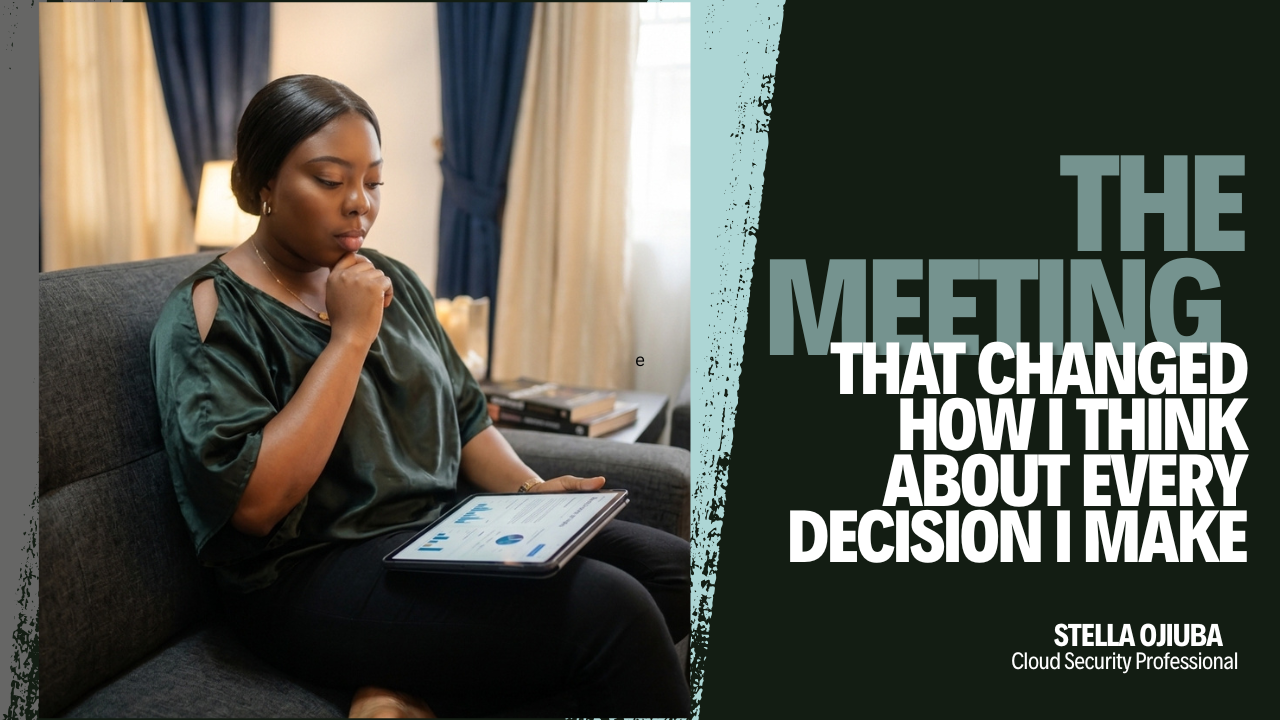
The Meeting That Changed How I Think About Every Decision I Make
This article is about that question that defines your integrity, what it reveals, and why its the most powerful leadership tool you will ever use.
It lasted twenty minutes
No agenda, slides nor follow up email. Just a conversation in a room with someone whose opinion I respected so much that I had been quietly terrified of them for months and something they said in passing, without fanfare, or any apparent awareness that they were handing me something I would carry for the rest of my career.
I have been thinking about that meeting ever since not because it was dramatic, it wasn't. No one raised their voice and nothing was decided. On paper, it was the kind of meeting that would not even warrant a note in a journal, the kind that disappears into the blur of a busy week and is forgotten by Friday. Except I have never forgotten it and I think the reason I have never forgotten it is the same reason I am writing about it now. What happened in that room did not just give me an answer. It gave me a new way of asking questions and a new way of asking questions changes every decision that comes after it. That is not a small thing, It is everything.
The Person Across the Table
I want to tell you about the kind of person this was without naming them, because the story is not really about them. It is about what they accidentally gave me.
They were the kind of professional I had been watching from a distance for a long time. The kind whose work had a quality I could not fully name but could immediately recognise a clarity, a consistency, a sense that every decision they made had been arrived at through a process that was both rigorous and deeply human. They did not make flashy decisions. They made right ones, quietly, repeatedly, over time.
I had assumed, the way you assume things about people you admire from a distance, that this came from some combination of intelligence and experience that I did not yet have and might not ever fully reach. That the clarity they carried was the kind that arrived after decades, if it arrived at all. I was wrong about where it came from.
What They Said
We were talking about a decision I was facing. A real one, with stakes, with uncertainty, with the particular quality of pressure that comes when you are trying to do the right thing but cannot quite see clearly enough to know what the right thing is.
I laid out the options. I talked through the trade offs. I was articulate and organised and secretly hoping they would simply tell me what to do or they would reach across the table and hand me the answer the way you hand someone an umbrella in the rain.
They listened, asked a few questions, then they said something I was not prepared for. They said: "Before you decide anything, I want you to ask yourself one question, not what is the smartest choice but what is the choice I can defend to myself at 3am when nobody is watching and nothing can be undone?"
I did not say anything for a moment. They continued: "I have made a lot of decisions in my career. The ones that have aged well are almost never the ones that looked best in the room. They are the ones that held up in the quiet. The ones I could still stand behind when there was no audience left."
Twenty minutes, that was all but something shifted in me that afternoon that has not shifted back.
What I Understood in the Days After
I want to be honest about something. In the immediate aftermath of that conversation, I was not sure I had understood anything at all. I walked out of the room feeling strangely moved and unable to explain why. The words seemed simple. The idea seemed almost obvious. I kept turning it over and wondering why it felt so significant when it appeared, on the surface, so straightforward. Then I tried to apply it to the decision I was facing and I understood.
The question, what is the choice I can defend to myself at 3am when nobody is watching does not sound like a security framework but it is one. It is one of the most powerful ones I have ever encountered. What it does, with surgical precision, is strip away every variable that is not actually about the decision.
It strips away the audience, what will people think? Gone. There is no audience at 3am, there is only you. It strips away the performance. What will this look like? Gone. Nothing looks like anything at 3am, there is only what it is.
It strips away the short term. What is the fastest path through this? at 3am, in the silence after the outcome has become real, only the long term is visible. What you are left with, after all of that is stripped away, is the question in its purest form, is this actually right? not right for the room, right for now. Not right for the version of me that wants to be impressive or efficient or safe. Right in the way that holds up under honest examination by the only judge whose verdict actually matters, the one that lives inside you.
What This Has to Do With Every Decision I Have Made Since
I work in cloud security and project management. My field is full of decisions. Technical decisions, which architecture serves this need?, which control mitigates this risk? and what trade off between security and usability is acceptable in this context?.
Professional decisions, which role to pursue, which opportunity to take, which relationship to invest in, which line not to cross even when crossing it would be easier.
Ethical decisions, what to say when what I know conflicts with what someone wants to hear, what to do when the right answer is also the uncomfortable one, how to hold integrity in a field where the stakes of getting things wrong are not abstract. Before that meeting, I made these decisions the way most people do by weighing the visible variables, imagining the likely outcomes, trying to be smart and strategic and efficient, by asking what is the best decision rather than what is the right one.
Those are not always the same question, the best decision is optimised for the room, the right decision is optimised for the quiet. The best decision accounts for how things look, the right decision accounts for how things are. The best decision is designed for an audience, the right decision survives the absence of one.
I make better decisions now. Not because I am smarter than I was before that meeting, though I hope I am growing. But because I am asking a different question and a different question changes everything that follows.
The 3am Test and Why It Matters in Your Field Too
I want to give you this question as a tool, because I really believe it is one of the most useful things I carry. But first I want to name something, this question is not comfortable.
The 3am test does not let you off the hook with "it seemed like a good idea at the time". It does not accept "everyone else was doing it" or "I was under pressure" or "I did not have all the information". At 3am, in the silence, those defences dissolve. What remains is the unmediated reality of what you chose and why.
That is exactly why it works. The decisions that fail the 3am test are almost always the ones that fail eventually, the ones that looked smart and felt efficient and gained approval in the moment, and then revealed themselves, over time, to have been something else. A shortcut, a compromise, a performance of doing the right thing rather than the thing itself. The decisions that pass the 3am test, the hard ones, the slow ones, the ones that cost you something in the short term are almost always the ones that hold.
In cybersecurity, the consequences of the wrong decisions are not theoretical. A corner cut in a security architecture. A risk assessed as acceptable that was not actually acceptable. A warning ignored because addressing it was inconvenient. A difficult conversation avoided because the relationship felt more important than the truth.
These decisions do not announce themselves as bad decisions in the room. They announce themselves later in the dark, when something has gone wrong that did not have to go wrong. The 3am test is not a moral judgement, it's a risk model. It asks, when the outcome is real and the room is empty and there is nothing left to do but live with what you chose, can you live with it? That question, asked honestly and early, saves you from a great deal of what cannot later be undone.
What I Now Believe About Decisions
I have come to believe that most bad decisions are not made by bad people. They are made by good people who were asking the wrong question at the wrong speed in the wrong light.
They were asking what looks best when they should have been asking what holds up. They were asking what do I gain when they should have been asking what can I defend. They were asking what will people think when they should have been asking what will I think alone, later, when the thinking cannot be changed.
The room is almost never the right place to evaluate a decision. The room has pressure in it, it has audience in it. It has the particular distortion that comes from wanting to be seen as capable, confident and clear even when you are not yet any of those things. The right place to evaluate a decision is the quiet. The 3am, the aftermath. The place where performance is impossible and honesty is the only thing left. Not every decision deserves that level of scrutiny. The small ones can move at the speed of the room but the ones that matter, the ones that touch other people, that shape your integrity, that become part of the record of who you are and what you stood for, those deserve the 3am test. Give them that.
The Meeting I Keep Having
There was something about that twenty minute conversation, something I did not understand until much later. It was not a one time gift, it was a practice.
Every time I face a decision that matters, I have that meeting again. Not in a room, not with another person, but inside myself with the question they gave me, in the quiet, at the speed that decisions actually deserve. What is the choice I can defend to myself at 3am when nobody is watching and nothing can be undone? Some days the answer comes quickly and clearly. Some days it takes longer than I want it to. Some days it tells me something I was hoping not to hear. But it has never misled me and that is more than I can say for the room.
What I Want to Leave You With
The most valuable thing another professional ever gave me was not a strategy or a framework or a contact or an opportunity. It was a question.
One question, asked in twenty minutes, that changed the lens through which I see every decision that matters.
I do not know what the equivalent question is for you. I do not know which conversation you are yet to have, which meeting is waiting for you, which twenty minutes will turn out to be the ones that reorganise everything that comes after, but I know this, those conversations happen. They happen in ordinary rooms, with ordinary scheduling, without announcement. They do not come labelled as significant. They arrive looking like a regular Tuesday.
Pay attention in between, and when someone says something that makes time feel briefly different, something that shifts the quality of the silence after it, write it down. Carry it, let it ask you things. The best mentorship I ever received lasted twenty minutes and cost nobody anything. It changed how I think about every decision I make.
That is the kind of thing that compounds for a lifetime.
0 comments on “The Meeting That Changed How I Think About Every Decision I Make”
Comments from signed-in readers are published immediately. Keep it professional.
Sign in to join the conversation.