From Patient Safety to AI Assurance: Why I Founded Orbyntis
Krishnaveni Gorijavolu shares how her background in healthcare, patient safety, and regulatory affairs shaped her approach to trustworthy AI and inspired her to found Orbyntis. The article explores why autonomous AI needs continuous assurance—testing, governance, runtime protection, and evidence—so enterprises can trust AI before it acts.

From Patient Safety to AI Assurance: Why I Founded Orbyntis
By Krishnaveni Gorijavolu
Founder & CEO, Orbyntis
My journey into artificial intelligence did not begin with AI.
It began in healthcare, where I learned very early that technology is valuable only when people can trust the decisions made around it. My academic foundation in pharmacy and pharmaceutical regulatory affairs led me into patient safety, pharmacovigilance, quality, regulatory compliance and eventually enterprise technology. Working in highly regulated environments gave me a perspective that has stayed with me throughout my career: when a system can affect people, money, safety or critical business operations, capability alone is never enough. There must also be accountability, controls and evidence.
That principle became even more important as I began working more closely with enterprise technology and artificial intelligence.
AI has evolved extraordinarily quickly. We moved from predictive models to generative AI and are now entering an era of autonomous and agentic systems. These systems do more than provide information. They can reason, use tools, interact with enterprise applications, call APIs, initiate workflows and increasingly make or execute decisions on behalf of people.
That is an exciting transformation, but it also introduces a fundamentally different kind of risk.
An AI assistant that gives an imperfect answer is one problem. An autonomous agent that takes the wrong action inside a financial, procurement, healthcare or supply-chain system is something very different.
That realization became one of the reasons I founded Orbyntis.
Why I Founded Orbyntis
I did not start Orbyntis simply because AI was becoming popular. I started it because I saw a gap developing between how rapidly enterprises were adopting autonomous AI and how prepared they were to trust it.
Organizations are beginning to imagine environments with hundreds, thousands and eventually millions of specialized AI agents. Some will assist employees, while others may operate with significant autonomy across finance, procurement, supply chain, customer service, engineering and other core functions.
The question that kept coming back to me was simple:
Who determines whether an AI action should actually be allowed to happen?
Traditional enterprise security is very good at answering questions such as:
Who are you?
Are you authenticated?
What systems can you access?
What permissions do you have?
Are you authorized to perform a particular transaction?
Those controls remain essential, but autonomous AI introduces another question:
Even if the agent is authorized, should this particular action proceed?
That distinction is important.
Imagine an AI agent working within a procurement system. It has valid credentials and permission to update supplier information. A request arrives to change a supplier’s bank account and immediately release a multimillion-dollar payment.
From a traditional access-control perspective, the agent may be completely authorized to perform both actions.
But authorization does not tell us whether the request is legitimate, whether the bank-account change originated from a trusted source, whether the sequence of actions is suspicious, whether the business impact is acceptable or whether a human should intervene.
This is why we believe the next security boundary is the decision itself.
AI Assurance Is Different From Traditional AI Governance
There is already considerable discussion about responsible AI, governance, model risk, privacy and cybersecurity. All are necessary, but autonomous agents create an additional assurance problem.
When AI begins taking actions, trust cannot exist only in policies, documents or periodic assessments. It must become part of the operating environment.
An enterprise needs to know not only whether an AI model was approved, but whether the agent is behaving within its intended authority right now.
That requires answering questions such as:
Has the agent been tested against adversarial behavior?
Can prompts or external instructions manipulate it?
Can it misuse the tools connected to it?
Has its model, prompt, knowledge source, permissions or configuration changed since it was approved?
Can we determine why it made a particular decision?
Can we prove afterward exactly what happened?
Can a high-risk action be restricted or blocked before it reaches the enterprise system?
These are not theoretical questions anymore. As agents become connected to systems that manage payments, purchasing, inventory, customer orders and sensitive enterprise information, these questions become operational requirements.
This is the problem space Orbyntis was created to address.
Building a Trust Layer for Autonomous AI
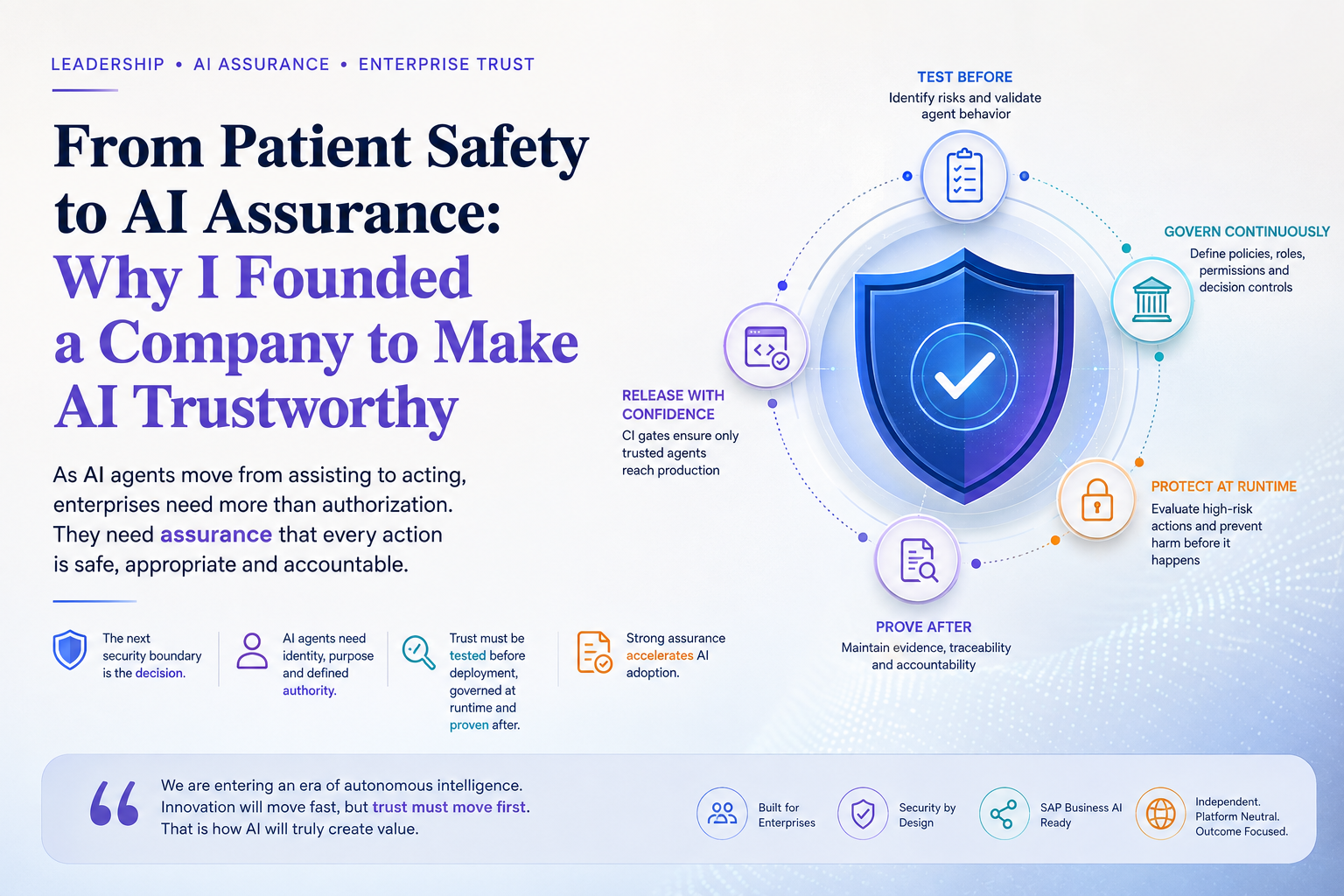
At Orbyntis, we think about AI assurance as a lifecycle rather than a single security test.
Before an agent goes into production, it should be assessed and challenged. During deployment, there should be release controls. At runtime, its behavior and authority should remain visible and governed. And after an action occurs, organizations should have evidence that explains what happened and why.
Our emerging assurance approach therefore connects several capabilities:
Agent testing and red teaming to identify vulnerabilities, unsafe behavior, prompt manipulation, excessive authority and tool misuse before deployment.
Governance and policy controls to establish what an agent is permitted to do and under what circumstances.
CI and release gates so material changes to an agent can trigger testing or re-certification before a new version reaches production.
Runtime protection to evaluate high-risk actions while the agent is operating and allow, restrict, escalate or block them when necessary.
Evidence and traceability so organizations can reconstruct what an agent saw, what it decided, what tools it used and what ultimately happened.
I often compare this to how enterprises manage human employees.
A company would never hire someone, provide unrestricted access to every system and then assume that person should remain trusted forever regardless of changes to their role.
People have identities, defined responsibilities and authority levels. Their access changes when their role changes. Certain jobs require training or certification. High-risk decisions may require additional approval.
I believe autonomous AI will eventually require a similar discipline.
An agent may need a clearly defined identity, purpose, owner, authority level, risk classification and trust status. If its capabilities, permissions, instructions or connected tools materially change, that agent may need to be tested and certified again.
In other words, trust should not be permanent.
It should be continuously earned.
Why SAP and Enterprise AI Matter to Us
One area where this challenge becomes especially visible is SAP and enterprise business systems.
Enterprise AI is moving directly into the applications where organizations run finance, procurement, supply chain, manufacturing and other critical processes. SAP Business AI, Joule and the broader evolution toward intelligent and agentic enterprise workflows create tremendous opportunities for organizations to operate more efficiently.
But the closer AI moves to the transaction layer, the more important assurance becomes.
An agent that summarizes a document carries one level of risk. An agent capable of changing supplier information, releasing an order, creating a transaction or influencing financial decisions carries another.
That is why Orbyntis combines SAP Business AI engineering and consulting with independent AI trust and assurance capabilities. We want to help organizations build intelligent workflows while also ensuring that autonomous execution can be tested, governed, observed and controlled.
SAP is an important starting point because it sits at the center of some of the world’s most consequential business processes, but the problem is much broader than any one platform.
Autonomous AI will eventually operate across cloud platforms, enterprise applications, APIs, data environments and other agents.
The underlying trust question remains the same:
Can we trust this system before it acts?
My Healthcare Background Still Shapes How I Think About AI
Sometimes people look at my background in pharmaceuticals, regulatory affairs and patient safety and see it as a completely different chapter from artificial intelligence.
I see it as the foundation.
Healthcare taught me that innovation and responsibility have to coexist. A technology can be technically impressive and still require careful validation before it is trusted in an environment where mistakes matter.
Regulatory work also taught me the importance of evidence. Saying that a control exists is different from being able to demonstrate that it worked. Saying that a system was tested six months ago is different from knowing whether changes made yesterday altered its risk profile.
Those lessons translate remarkably well to autonomous AI.
The technology is different, but many of the underlying questions are familiar: What is the intended use? What can go wrong? What controls exist? Who owns the risk? What changed? Was it tested? And can we prove that the controls are still functioning?
That perspective has strongly influenced the company we are building.
Reinvention Does Not Mean Starting Over
My own career has also taught me something that I believe is particularly important for women considering a move into AI.
You do not have to erase your previous experience in order to reinvent yourself.
I did not leave healthcare, regulatory thinking or patient-safety principles behind when I moved deeper into technology. I brought them with me.
Those experiences became an advantage because the next phase of AI will require far more than algorithms.
We will need people who understand medicine, finance, law, cybersecurity, manufacturing, supply chains, ethics, risk, human behavior and business operations. The most valuable AI systems will emerge when deep domain experience and technical capability come together.
For women who may look at the speed of AI innovation and wonder whether they are entering too late, my message is simple: your previous experience may be exactly what this industry needs.
Learn the technology, certainly. Be curious about models, agents and the new platforms being created. But do not underestimate what you already know.
Sometimes reinvention is not about beginning again. It is about recognizing that everything you have learned has prepared you to solve a different problem.
Building AI We Can Actually Trust
I am deeply optimistic about artificial intelligence. I believe it can transform enterprises, improve productivity and help people solve problems that have resisted traditional approaches for decades.
But the more authority we give AI, the more important trust becomes.
We should not have to choose between innovation and assurance. In fact, I believe strong assurance will ultimately accelerate AI adoption because enterprises will be more willing to give autonomous systems meaningful responsibility when they know those systems can be tested, governed and controlled.
That is ultimately why I founded Orbyntis.
We want to help build a future in which organizations can embrace autonomous intelligence without giving up accountability.
A future where every important AI action can be challenged before deployment, governed while operating and proven afterward.
Because as AI moves from answering our questions to acting on our behalf, the most important question may no longer be:
How intelligent is the AI?
It may be:
Can we trust what it is about to do?
About Krishnaveni Gorijavolu
Krishnaveni Gorijavolu is the Founder & CEO of Orbyntis, an enterprise AI company focused on SAP Business AI and trust assurance for autonomous systems. Her background spans pharmacy, pharmaceutical regulatory affairs, patient safety, pharmacovigilance, quality and compliance, enterprise technology and artificial intelligence.
She founded Orbyntis around the belief that as AI gains greater authority inside enterprises, organizations will need a new assurance layer capable of testing, governing, controlling and proving autonomous AI behavior throughout its lifecycle.
0 comments on “From Patient Safety to AI Assurance: Why I Founded Orbyntis”
Comments from signed-in readers are published immediately. Keep it professional.
Sign in to join the conversation.