I Don’t Want to Forget What It Felt Like to Start
Starting a career in technology can feel intimidating, especially when the learning curve seems endless. But staying close to that experience of being a beginner has become one of my greatest strengths. From learning AWS and Terraform to building projects, teaching technical sessions, and mentoring other people, I have discovered that you don't have to be an expert to help someone else begin. This is a reflection on learning, growth, mentorship, and why I never want to forget what it felt like to start.

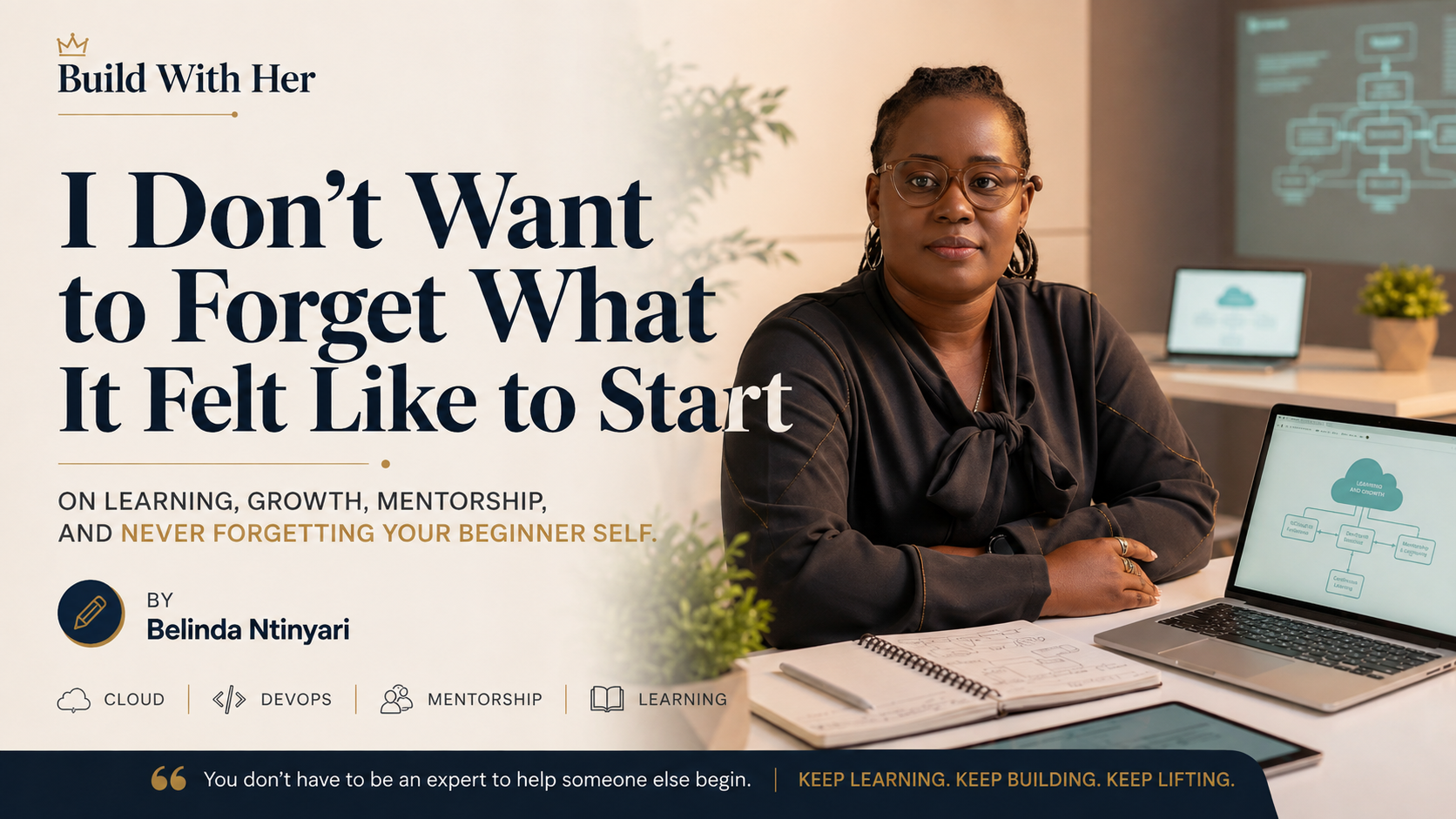
How being a beginner taught me to teach, mentor, and make technology feel a little less intimidating.
There is something I am afraid of as I continue growing in technology.
It isn't failing.
It isn't not knowing something.
It isn't even being the least experienced person in the room.
It is forgetting what it felt like to be a beginner.
Because I remember.
I remember looking at cloud architecture diagrams and wondering how anyone was supposed to make sense of all those boxes and arrows.
I remember encountering AWS services and wondering how I was ever going to understand what each one did, when to use it, and how they all fitted together.
I remember opening Terraform configurations that didn't work and staring at them for far longer than I would like to admit.
I remember reading documentation and sometimes having to read the same paragraph several times before it finally clicked.
And perhaps most importantly, I remember wondering whether I was simply not technical enough.
Today, I am still learning.
I am still building.
I still get stuck.
I still have moments when I have to go back to the documentation and say, "Okay, let's try this again."
But something has changed.
People have started asking me to explain the things I am learning.
I have started hosting technical sessions.
I have mentored beginners.
I have spoken at AWS Community Day Pwani.
I have shared what I am learning with other people.
And that has taught me something I didn't expect:
Being close to the beginning can actually be a strength.
Because I haven't forgotten what the beginning feels like.
I Know What It Feels Like Not to Understand
My journey into cloud computing began through the AWS re/Start program.
Before that, I had completed a coding bootcamp in 2022 and then experienced an unplanned break from technology.
When I eventually found my way back through AWS re/Start, I wasn't walking into cloud as someone who had everything figured out.
I was starting again.
And cloud computing introduced me to an entirely different way of thinking about technology.
There were servers, networks, storage, permissions, databases, infrastructure, automation and services I had never worked with before.
Then there was the vocabulary.
IAM.
VPC.
EC2.
S3.
Lambda.
Terraform.
Infrastructure as Code.
The list seemed endless.
I would learn one concept and immediately discover three more things I needed to understand before the first concept made complete sense.
Sometimes learning felt exciting.
Sometimes it felt overwhelming.
And sometimes I wondered whether everyone else understood things faster than I did.
But I kept going.
Little by little, things started connecting.
A service I had once found intimidating became familiar.
A concept that had confused me started making sense.
A Terraform configuration finally deployed successfully after I had spent hours trying to figure out what was wrong.
Those moments were small.
But they mattered.
They taught me that learning technology isn't always about dramatic breakthroughs.
Sometimes it is simply about staying with something long enough for it to stop looking foreign.
The More I Learned, the More I Wanted to Build
At some point, I realized that simply reading about cloud wasn't enough for me.
I needed to build.
That became a big part of how I learned.
I started working on small projects and gradually challenged myself with more complex ones.
I built with AWS.
I started using Terraform to define infrastructure instead of relying entirely on the console.
I explored serverless architectures.
I worked with services such as Lambda, API Gateway, DynamoDB and Amazon Bedrock.
I built projects where things worked.
And projects where things absolutely did not work.
There were deployments that failed.
Configurations that refused to cooperate.
Permissions that were wrong.
Errors that made me question whether I had misunderstood the entire concept.
And yes, there were moments when I wanted to close the laptop and pretend the problem didn't exist.
But building taught me something that tutorials couldn't.
It taught me what it feels like to be stuck.
And then to troubleshoot.
To search.
To read documentation.
To try again.
To finally make something work.
That experience has stayed with me.
Because whenever someone tells me, "I don't understand this," I don't hear a lack of ability.
I hear a familiar beginning.
Then I Started Sharing What I Was Learning
One of the biggest changes in my journey happened when I stopped keeping everything I was learning to myself.
I started sharing projects.
I started creating beginner-friendly technical content.
I started documenting some of the things I was learning.
And eventually, I started hosting technical sessions.
This was another uncomfortable step.
I wasn't standing there as a senior engineer with ten years of production experience.
I was still learning.
I was still building my confidence.
I was still trying to understand many of the same technologies I was talking about.
So why teach?
Because I began to understand something simple:
Teaching doesn't always mean standing above someone. Sometimes it means walking beside them.
I didn't need to pretend I knew everything.
I just needed to be honest about what I knew, explain it clearly, and be willing to say, "I don't know the answer to that, but let's find out."
That sentence became surprisingly powerful.
Because I realized that admitting you don't know something doesn't make you less credible.
Pretending you know everything does.
I Remember the Person Who Was Afraid to Ask
When I host beginner sessions now, I think about the person sitting quietly in the audience.
The person who doesn't want to ask a question because they think everyone else already understands.
The person who hears words like VPC, IAM, Terraform, or serverless and wonders whether they are already too far behind.
The person who is afraid that asking a "basic" question will expose them.
I know that person.
I have been that person.
And because I remember what that feels like, I try to create the kind of learning environment I would have wanted when I was starting.
Not one where people feel stupid for not knowing.
Not one where technical language becomes a competition.
But one where it is okay to stop and say:
"Wait. Can you explain that again?"
Sometimes that is the question that unlocks everything.
The Decision to Become a Mentor
That same realization followed me into mentorship.
When I saw the opportunity to apply for the CloudHER Mentorship Program, I found myself facing an unexpected decision.
Should I apply to be a mentee?
Or should I apply to become a mentor?
The mentee option made sense.
I was still learning.
I was still building.
I still had plenty of questions of my own.
I was still working toward my first opportunity in cloud and DevOps.
So a part of me thought:
"Surely I should be the one looking for a mentor."
But then I thought about beginners who were where I had been.
People trying to understand where to start.
People wondering which technologies to learn.
People overwhelmed by how much there seemed to be to know.
And I realized something.
I didn't have to be an expert to help someone begin.
I simply had to remember what it felt like when I was beginning.
So I applied to become a mentor.
And to my surprise, I was selected.
Mentoring Taught Me That You Don't Need to Be at the Finish Line
Becoming a mentor changed the way I think about expertise.
Before then, I had imagined a mentor as someone standing at the top of a mountain saying:
"Come up here. I've figured everything out."
But that's not how mentorship has felt to me.
Sometimes you are simply a few steps ahead.
You know what it feels like to make the mistake your mentee is about to make.
You know the confusion they are experiencing.
You know which question they are afraid to ask.
You remember searching for the same answers.
And sometimes the most valuable thing you can say is:
"I understand. I struggled with this too."
That doesn't mean you have all the answers.
It means you can help someone realize that struggling doesn't mean they don't belong.
My mentees have taught me as much as I hope I have taught them.
They have reminded me to look at my own journey from the outside.
To recognize progress that I sometimes overlook.
And to appreciate how much can change in a relatively short time.
The Beginner in Me Is Still Here
I think one of the biggest misconceptions about growth is that eventually you stop being a beginner.
You don't.
You simply become a beginner at different things.
I may understand something today that confused me a year ago.
But tomorrow I might encounter something completely new and find myself back in the same position.
Confused.
Curious.
Searching.
Asking questions.
Learning.
And I think that's okay.
Technology changes too quickly for any of us to permanently graduate from learning.
There will always be another service.
Another tool.
Another architecture pattern.
Another problem we've never solved before.
Another moment when we have to say:
"I don't know yet."
The important word is yet.
Why I Don't Want to Forget
The further I go into technology, the more determined I am not to forget the beginning.
I don't want to forget how intimidating cloud once felt.
I don't want to forget what it was like to see a complicated architecture diagram and wonder where to start.
I don't want to forget the frustration of a Terraform configuration that wouldn't work.
I don't want to forget how long it sometimes took for a concept to finally click.
I don't want to forget the courage it took to ask questions.
Because those memories influence how I show up now.
They influence how I teach.
How I mentor.
How I explain things.
How I create content.
How I speak to beginners.
And perhaps most importantly, they remind me that the person who doesn't understand something today is not necessarily someone who lacks ability.
They might simply be at the beginning.
And beginnings are allowed to be messy.
Maybe Being a Beginner Is a Strength
For a long time, I thought becoming more experienced meant leaving my beginner self behind.
Now I think the opposite.
I want to carry that beginner with me.
Because she reminds me to stay curious.
She reminds me to ask questions.
She reminds me not to assume that something is obvious just because I understand it now.
She reminds me that there is a person on the other side of every technical explanation who may be hearing that concept for the first time.
And she reminds me to remain humble.
I don't want to become so experienced that I forget what it felt like to need someone to explain something slowly.
I don't want to become so comfortable that I stop asking questions.
I don't want to become so focused on proving what I know that I forget how much I still have to learn.
To the Woman Who Is Just Starting
If you're currently looking at cloud, DevOps, AI, cybersecurity, infrastructure, or any other technical field and thinking:
"There is so much to learn."
You're right.
There is.
But you don't have to learn everything today.
You don't need to understand every AWS service.
You don't need to know every DevOps tool.
You don't need to build the most complicated project.
You don't need to sound like an expert.
Start with one thing.
Learn it.
Break something.
Fix it.
Ask questions.
Build something small.
Then build something else.
And when you finally understand something that once confused you, don't be afraid to share it.
Someone else may be standing exactly where you were.
Your explanation might be the thing that makes it click for them.
Still Learning. Still Building.
I am still very much a learner.
I am still growing into the cloud and DevOps engineer I want to become.
I still have a long way to go.
There are still technologies I don't understand.
There are still problems I don't know how to solve.
There are still rooms where I am the least experienced person.
And I'm learning to be okay with that.
Because I no longer see being a beginner as something I need to hide.
It is part of my story.
AWS re/Start gave me a way back into technology.
Building gave me a way to learn.
Community gave me a place to grow.
Teaching showed me that I could contribute while still learning.
Mentorship showed me that I could help someone else even before reaching my own destination.
And now, I want to carry that lesson forward.
I don't want to forget what it felt like to start.
Because somewhere out there, another woman is just starting too.
She might be staring at her first cloud console.
Opening her first Terraform file.
Trying to understand her first architecture diagram.
Wondering whether she belongs.
And if I can make that beginning feel even a little less intimidating for her, then perhaps being a beginner was never something I needed to outgrow.
Perhaps it was something I needed to remember.
Because sometimes the person who remembers what it felt like to start is exactly the person someone else needs at the beginning of their journey.
0 comments on “I Don’t Want to Forget What It Felt Like to Start”
Comments from signed-in readers are published immediately. Keep it professional.
Sign in to join the conversation.