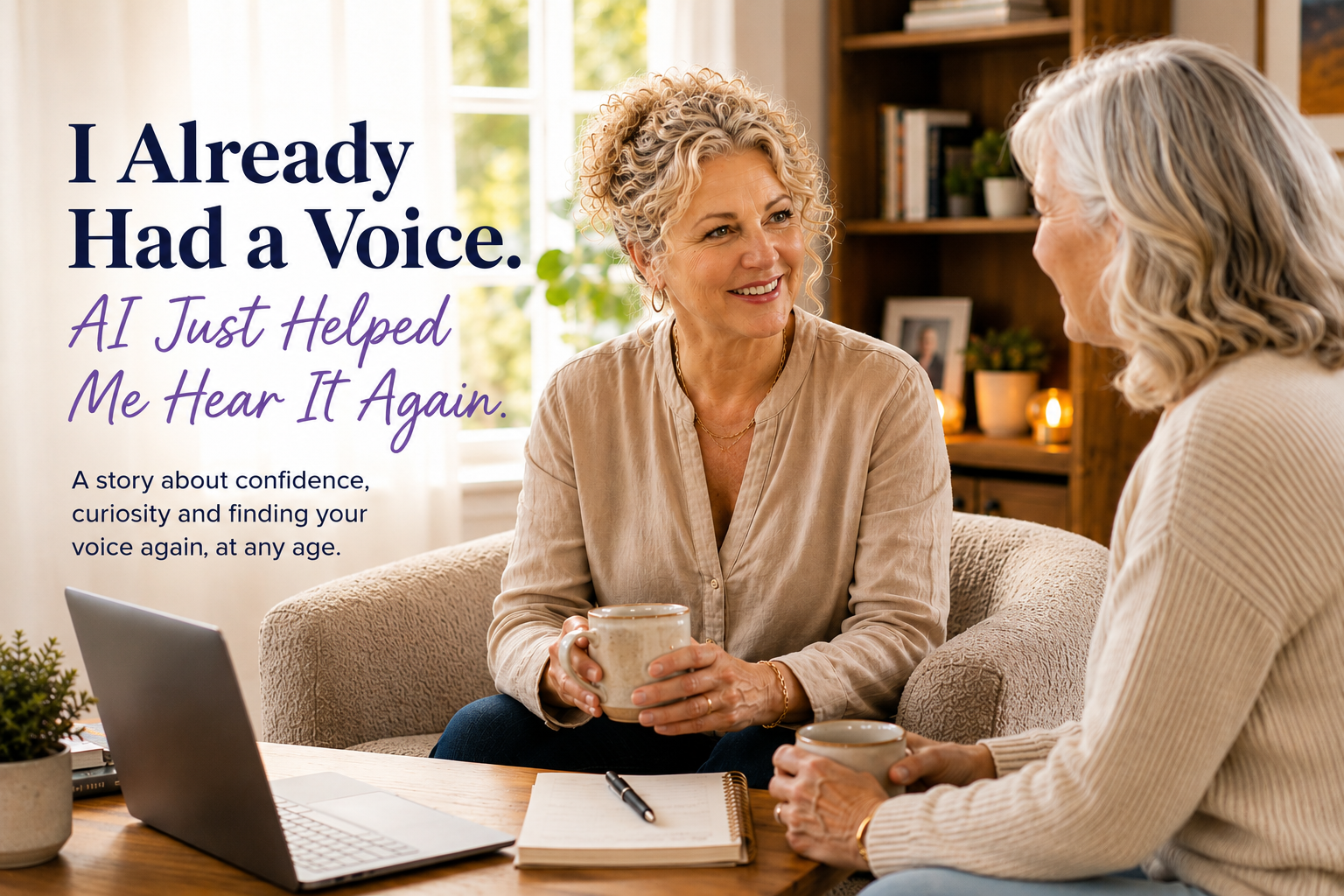
I Already Had a Voice. AI Just Helped Me Hear It Again.
After years of slowly losing trust in her own voice, Barbara found AI became more than a practical tool. It gave her space to think, create and rebuild confidence through small proof points. Her story explores how women 55+ can bring everything they already know into AI, use it in their own way, and feel that they belong in what comes next.

I wasn’t always someone who questioned herself.
For most of my life, I trusted myself to work things out. I was confident, outspoken, practical and independent. I liked learning how things worked, solving problems and helping people. If I didn’t know something, I’d learn it. If something wasn’t working, I’d look for a better way.
I could be intense. I could talk too much. I could get on my soapbox when I believed strongly in something. I’ve never been perfect and I’ve certainly never been everybody’s cup of tea.
But I knew who I was.
Somewhere along the way, that certainty began to change.
When I Started Editing Myself
It didn’t happen in one dramatic moment.
There wasn’t a single day when I woke up and suddenly stopped believing in myself. It was much quieter than that.
Over time, through a mixture of personal and professional experiences, I began to feel misunderstood more often than understood. I was told my communication style was a problem.
I found myself questioning how I said things, how I responded, whether I was too much, said too much, felt too much, or whether I should have handled something differently.
There were times when I needed support and didn’t feel I had it.
So, I did what I had always done.
I just kept going.
I worked. I helped people. I solved problems. I took responsibility. I learnt new things.
From the outside, I probably looked much the same. Inside, though, I had started editing myself.
I would draft an email and then spend far too long wondering whether I’d said it the wrong way. I could have an idea and immediately start questioning whether it was worth sharing.
I would know that I was very capable and, at exactly the same time, wonder whether I’d somehow convinced everyone that I was better at what I did than I really was.
That’s a strange place to find yourself when you’ve spent much of your life believing you could work things out and do anything.
I hadn’t lost my skills.
I hadn’t lost my experience.
But I had lost trust in myself.
That was around the time AI quietly entered my life.
A Place to Think Out Loud
At first, I used ChatGPT for exactly the reason you might expect from someone who had become overly conscious of her communication.
I wanted it to help me say things better.
I’d draft an email and ask it to make it clearer. I’d ask how I should respond to something. I’d use it to make my writing more succinct or help me find the right words.
There was nothing particularly revolutionary about it.
In fact, looking back, I think I was partly using AI as another way of checking myself.
“Does this sound all right?”
“Am I saying this properly?”
“Can you make this better?”
I didn’t realise then that something else was beginning to happen.
The more I used AI, the more conversational it became.
Instead of arriving with a perfectly formed question, I could put down the messy version first. I could explain everything. I could circle around an idea. I could say, “No, that’s not what I mean,” and try again.
I didn’t have to edit myself before I started.
I could just speak like me.
That was new.
And somewhere along the way, I stopped only asking AI to improve my words and started using it to explore my ideas.
That changed things.
When I Started Building Again
I began using AI to solve practical problems.
I experimented with building simple tools to organise information and make processes easier. Then I discovered other AI platforms and started exploring what they could do too.
Suddenly, the part of me that had always loved figuring things out was wide awake again.
I wanted to build everything.
I’d see a problem and immediately wonder whether I could create something to make it easier.
I’d have an idea and instead of stopping at, “I wouldn’t know how to do that,” I could start asking AI questions and see where they led.
Not everything worked.
Some ideas went nowhere. Some things I built weren’t particularly useful to anyone except me. Sometimes I spent far too long disappearing down a rabbit hole, simply because I wanted to know whether I could make something work.
But every time I did make something work, something small shifted.
“I did that.”
Then another one.
“I worked that out.”
Then another.
“Maybe I can do more than I thought.”
I started writing down what I call Quiet Wins.
You know, those moments that don’t necessarily look impressive from the outside but gradually change something inside you.
And I think this was all happening to me without my fully realising it.
AI wasn’t giving me confidence in some grand, transformational moment.
It was giving me small opportunities to prove things to myself again.
And perhaps more importantly, it gave me somewhere to think.
I’ve always been someone who needs to talk things through. Sometimes I need to get the whole thought out before I can work out what I actually think about it and what I actually mean.
AI gave me room to do that.
I could unload the noise in my head, sort through it, question it, challenge it and find the thread running through it.
I could ask for another perspective.
I could disagree with the answer.
I could be told when I was disappearing into yet another rabbit hole and, occasionally rather reluctantly, admit that it was right.
There was no impatience because I was taking too long.
No concern that I was explaining too much.
No feeling that I had to compress or edit everything before I was allowed to speak.
And gradually, I started hearing something familiar again.
Myself
Hearing My Own Voice Again
I don’t believe AI gives us a voice.
Our voice is already ours.
For me, AI became a space where I could hear mine more clearly.
It helped me organise thoughts that were already there. It helped me put words around ideas I hadn’t quite been able to articulate. It helped me learn, create and question things again.
And the more I did that privately, the more willing I became to use my voice publicly.
That part hasn’t been easy.
Putting myself out there again has been uncomfortable. Sharing my ideas publicly after spending years second-guessing myself has required more courage than I expected.
But I’m doing it.
There’s a Place for You
And somewhere in all of this, I began thinking about other women.
Women who’ve spent decades learning, working, raising families, running businesses, caring for people, managing homes, solving problems, adapting to change and carrying knowledge that doesn’t always come with a certificate attached.
Women who may be incredibly capable and yet find themselves hesitating when another new piece of technology arrives.
Modern life asks a lot of us.
There’s always another app to download, another password to remember, another update to install, another system that assumes you already know how to use it.
AI can look like one more demand.
One more thing we’re supposed to understand.
One more place where it can feel as though everybody else knows something we don’t.
But the more I learnt about AI, the more strongly I felt that this technology shouldn’t become another reason for experienced women to feel excluded.
Quite the opposite.
Everything we’ve already learnt comes with us.
Our judgement, our life experience, our humour, our curiosity, our mistakes, our resilience, our knowledge of people all come with us. So do the thousand things we’ve learnt simply by living.
We don’t arrive at AI empty-handed.
That understanding became part of why I created AI Doable.
I want to teach.
I want to help women, particularly women over 55, use AI in a way that feels simple and practical. I want to make the technology less about knowing the right terminology and more about discovering what it can do alongside everything we already know.
But underneath the teaching is something even more important to me.
I want women to feel that they belong here in this moment.
I know what it feels like to want your spot.
A place where you don’t have to change who you are before you’re accepted.
A place where you can ask the question you think everyone else already knows the answer to.
A place where you aren’t treated as though learning something new is surprising, simply because of your age.
I want a woman to know that her experience counts before she ever opens ChatGPT.
Her ideas matter before AI helps her organise them.
Her voice belongs to her before AI helps her find the words.
Maybe she’ll use it to write an email.
Maybe she’ll use it to explore an idea she’s been carrying around for years.
Maybe she’ll learn something completely new.
Maybe she’ll create something.
Maybe she’ll start a business.
Maybe she’ll speak up about something she has kept quiet.
Or maybe she’ll simply begin trusting herself a little more.
There doesn’t need to be one version of what happens next.
A New Chapter
I’m finding that out in my own life too as I build a new chapter.
I’m learning, teaching, creating and discovering where all of this might lead. I don’t have every part mapped out, and I no longer think I need to.
What I know is that I’m bringing myself with me.
The years of experience.
The mistakes.
The things I’ve learnt.
The problems I know how to solve.
The desire to help.
The curiosity that makes me want to build everything.
And a voice I’m learning to trust again.
Recently, I shared some of these thoughts in a conversation. I wrote about confidence, about the small proof points that help us trust ourselves again, and about how AI had helped me hear my own thinking more clearly.
Someone reading that conversation invited me to tell my story.
I nearly missed the invitation completely.
I’m so glad I didn’t.
It strikes me now that perhaps this was another one of those Quiet Wins.
I used my voice without knowing where it would lead.
Someone heard it.
And now I’m here, telling my story.
Thank you for hearing me, Tarak.
So, if you’ve become quieter somewhere along the way, or life has made you question parts of yourself that once felt certain, just start where you are.
Bring what you know.
Bring what you’ve lived through.
Bring your questions.
Bring the ideas you haven’t quite found the words for yet.
Learn the technology in your own way and decide for yourself what place you want it to have in your life.
AI didn’t give me a voice.
It helped me hear my own more clearly.
And that’s what I hope other women discover for themselves.
Your experience counts. Your ideas matter. Your voice is yours. You belong in what comes next.
0 comments on “I Already Had a Voice. AI Just Helped Me Hear It Again.”
Comments from signed-in readers are published immediately. Keep it professional.
Sign in to join the conversation.