Why I Chose to Study the Future Before It Arrived
What happens when a lawyer finds herself in rooms full of neuroscientists, engineers, and AI researchers? In this personal reflection, Namrata Bhowmik shares how an unexpected journey from law into interdisciplinary technology communities reshaped her understanding of innovation, collaboration, and the value of contributing beyond traditional professional boundaries. Through experiences spanning legal practice, emerging technologies, and global networks, her story highlights the power of curiosity, adaptability, and building bridges between disciplines.
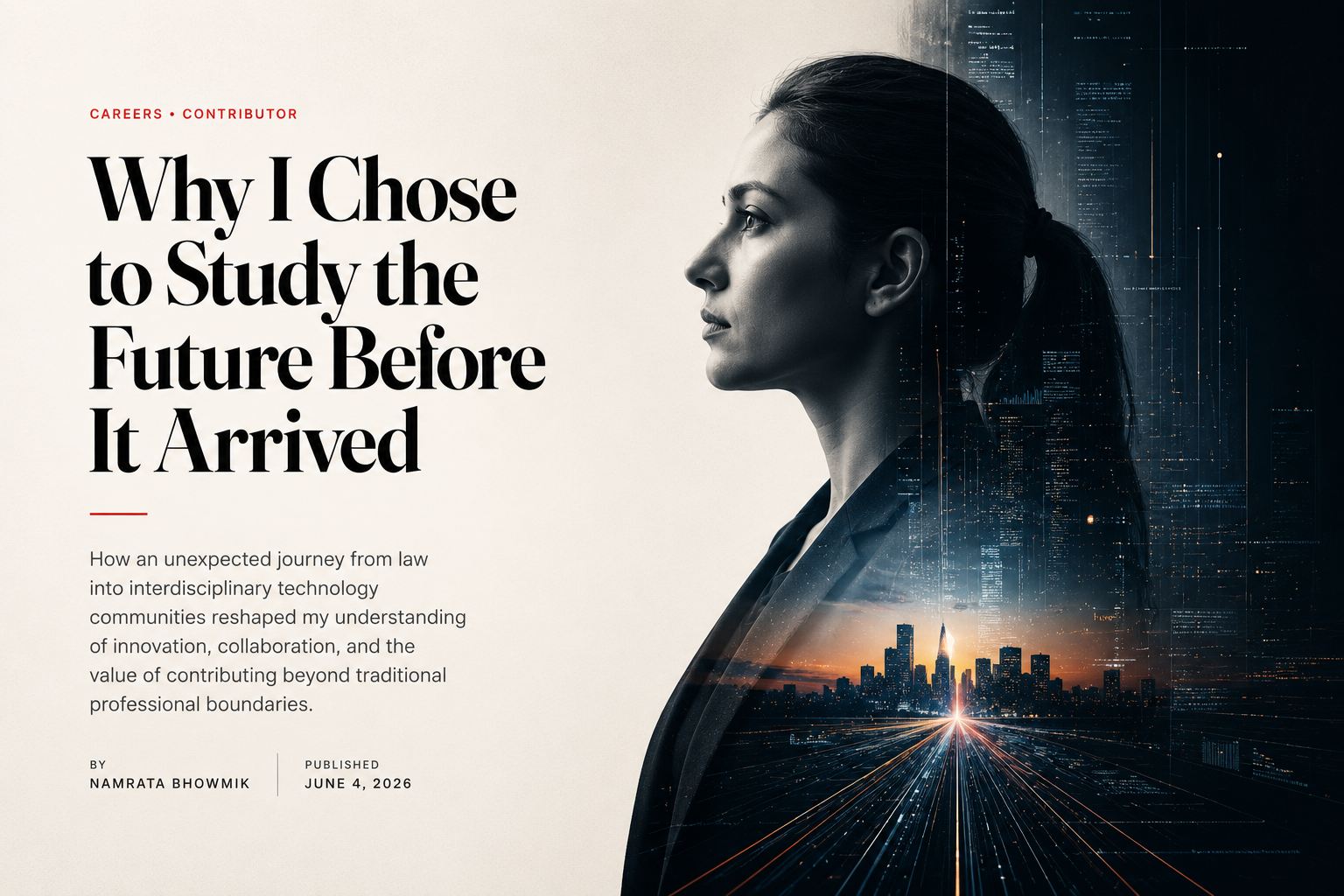
When I left India to pursue my master's degree in London, I thought I had a fairly clear idea of where my career was heading.
I was already a lawyer, and my focus was intellectual property and data protection. The plan was simple: deepen my expertise, gain international exposure, and continue building a career in technology law, but I guess London had other plans.
One of the things I love most about this city is that it constantly places you in rooms you never expected to be in. During my studies, I found myself attending events, lectures, and discussions far outside my immediate field. I met neuroscientists, engineers, ethicists, clinicians, AI researchers, and policymakers. Every conversation seemed to introduce a new question I had never considered before.
At first, I felt like an outsider.
I was the lawyer in the room. I didn't have a background in neuroscience; neither was I building brain-computer interfaces, nor was I running experiments in a lab.
But the more I listened, the more I realised that many of the questions being raised were deeply legal, ethical, and societal questions.
These were questions about privacy, about ownership, about consent, and about human dignity. Questions about what happens when technology becomes capable of understanding us in ways we may not fully understand ourselves.
What started as curiosity gradually became something much bigger.
I found myself spending evenings reading research papers that had nothing to do with my coursework. I became fascinated by the intersection of law, neuroscience, artificial intelligence, psychology, and public policy. The further I explored, the more convinced I became that the most important challenges of the future would not belong to any single discipline.
Yet I also noticed how fragmented many of these conversations were. Brilliant people were doing remarkable work, but often within the boundaries of their own fields. There were surprisingly few spaces where different perspectives could come together to examine these issues collectively.
That observation stayed with me, and that is what eventually became the foundation for GenNeuroSociety Research Lab (GNSRL).
GNSRL was never intended to be just another research organisation. It was born from a desire to create the kind of space I had been searching for myself, a place where a lawyer could learn from a neuroscientist, where an engineer could challenge a policymaker, and where curiosity mattered more than disciplinary boundaries.
Looking back, moving to London changed far more than my academic trajectory. It changed the way I thought about knowledge itself.
I arrived in London expecting to earn a master's degree. Instead, I found questions that changed the direction of my life.
For a long time, I thought expertise was about having the answers.
Today, I think it is about having the courage to ask questions that do not fit neatly into existing disciplines.
I came to London to study law, but somewhere between lecture halls, research papers, conferences, and conversations with people far outside my own discipline, I stopped asking myself whether I belonged in those rooms.
Instead I started asking a different question: "If the future is being built right now, why shouldn't I have a seat at the table?"
That question is still the reason I do what I do today. And if there's one thing I have learnt along the way, it's that some of the most interesting opportunities come from stepping outside the boxes you're expected to fit into and finding ways to connect different worlds instead.



0 comments on “Why I Chose to Study the Future Before It Arrived”
Welcome to the comments section. We moderate every submission according to our community guidelines.
Loading conversation…