The Day I Realized the Internet Was Not Built With Everyone in Mind
This article unpacks why cybersecurity is fundamentally a human issue, not just a technical one, and what every person can do right now to protect themselves in a digital world that was not designed with them in mind.

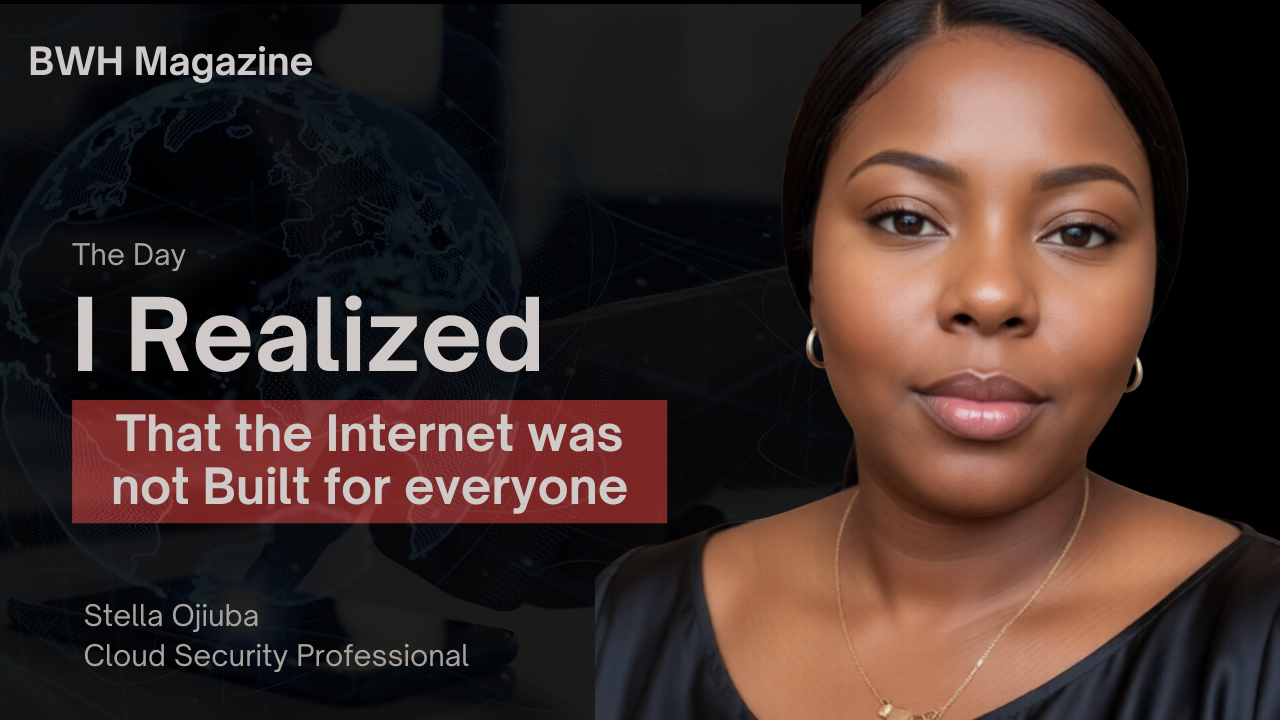
Few years ago was the first time I felt invisible online.
Not bullied nor targeted, just invisible. Like the people who built the internet had imagined a specific kind of person sitting at the keyboard, and that person was not me.
I did not have the language for it then. I just knew something felt off. Like arriving at a party where everyone seems to know the rules except you, and nobody wrote them down anywhere. Years later, transitioning to cloud security, I finally have the language and the more I learn about how the internet was built, who built it, and who it was built for the more I understand that what I felt at years back was not paranoia, It was pattern recognition.
The Internet Was Built by a Specific Kind of Person
Let me be precise about what I mean because this is not a complaint, it is a fact worth understanding.
The early internet was designed predominantly by a small, homogenous group of people mostly male, mostly Western, mostly from academic or military backgrounds. They were solving problems they understood, for users they could imagine, in contexts they recognized. That is not a moral failing, it is just what happens when any system is built by people who all look the same, think the same, and live the same kind of life. The problem is what gets left out which are the accessibility features bolted on decades later instead of built in from the start, Security systems designed around threat models that assumed users had stable identities, reliable devices, and uninterrupted internet access none of which describes most of the world. Also, Online safety designed for a world where the biggest threat was a stranger in a chat room not the intimate partner using your own phone against you, not the employer monitoring your every keystroke, not the government surveilling its own citizens.
What This Actually Means for Real People
I want to tell you about three people, none of them are me but all of them are real
The first: is a woman in her fifties who got a phone for the first time during the pandemic. She needed it to access health services, school updates for her grandchildren, and money transfers. Within three months, she had been scammed twice not because she was foolish. Because every security warning the system gave her was written in technical language she had never been taught, designed around assumptions about digital literacy she had not yet had the chance to build. The internet was not built for her and nobody told her.
The second: is a teenager who spent most of secondary school being harassed across every platform she used. She reported it, repeatedly, on every app. The algorithms that were supposed to protect her were better at recommending content than recognizing coordinated harassment, she eventually left every platform. The internet was built to maximize engagement not to keep her safe.
The third: is a professional woman who discovered that her personal data, her location, her browsing habits, her shopping patterns had been aggregated and sold to advertisers without her meaningful consent. She had technically agreed to it, buried in a terms of service document that would have taken eleven hours to read in full. The internet was built on a consent model that was never really about consent.
Three people. Three different countries. Three different problems. One common thread, systems that were not designed with them in mind.
This Is Why Cybersecurity Is Not Just a Tech Problem
This is what I want you to understand and this is the heart of everything I do and everything I write about.
Cybersecurity is not just about firewalls and encryption and penetration testing. Those things matter enormously, but they are the technical layer of something much more human. At its core, cybersecurity is about who gets to be safe online, who gets protected whose threats are taken seriously and right now, the answer to those questions is still too narrow.
When we talk about cyber threats, we often talk about nation state actors, corporate espionage, critical infrastructure attacks. These are real, but for most people the woman learning to use a smartphone, the teenager trying to exist online without being harassed, the professional trying to understand what she actually agreed to makes the threat quieter, more personal and often invisible to the systems that are supposed to protect them.
Cybersecurity that only protects the few is not security it is a gated community with a very good fence.
What You Can Do Right Now
I am not going to leave you with the problem and no path forward that is not how I write and it is not how I think. If the internet was not built with everyone in mind and it was not then the answer is not to wait for it to be rebuilt. The answer is to know how to navigate it as it actually is, while also pushing for it to be better.
These are four things worth doing today:
1. Treat your personal data like personal property.
Your name, location, email, browsing habits, and purchasing patterns are valuable. Companies knows this that is why they collect it. Be intentional about what you share, with whom, and under what conditions. Read the permissions you grant apps. Review privacy settings on every platform you use. You cannot opt out of the digital economy entirely, but you can be a more deliberate participant in it.
2. Use a password manager.
If you are using the same password across multiple accounts, you are one data breach away from losing access to everything. A password manager generates and stores unique, complex passwords for every account so you do not have to remember them. It is one of the highest impact, lowest effort security changes you can make.
3. Turn on two factor authentication everywhere it is available.
Even if someone gets your password, two factor authentication means they still cannot get into your account without a second form of verification, its usually a code sent to your phone. Turn it on for your email first, then your banking app and everything else.
4. Talk about it.
The most powerful thing you can do is to have the conversation with your parents, your children, your colleagues, your community. Most people do not know what they do not know about online safety not because they are careless, but because nobody has ever sat down and explained it to them. You can be that person.
The Reason I Do This Work
I became a cloud security professional because I am genuinely fascinated by how systems work and how they fail but I stay in this work and I write about it because of the people. The woman at fifty learning how to exist in a digital world that was not designed for her, the teenager who should be able to live online without being afraid and the professional who deserves to understand what she agreed to.
They are not edge cases, they are the majority of internet users and they deserve to be at the center of how we think about security not at the margins.
The internet was not built with everyone in mind but it can be secured like everyone matters and that starts with each of us knowing enough to protect ourselves and caring enough to protect each other.


0 comments on “The Day I Realized the Internet Was Not Built With Everyone in Mind”
Comments from signed-in readers are published immediately. Keep it professional.
Sign in to join the conversation.