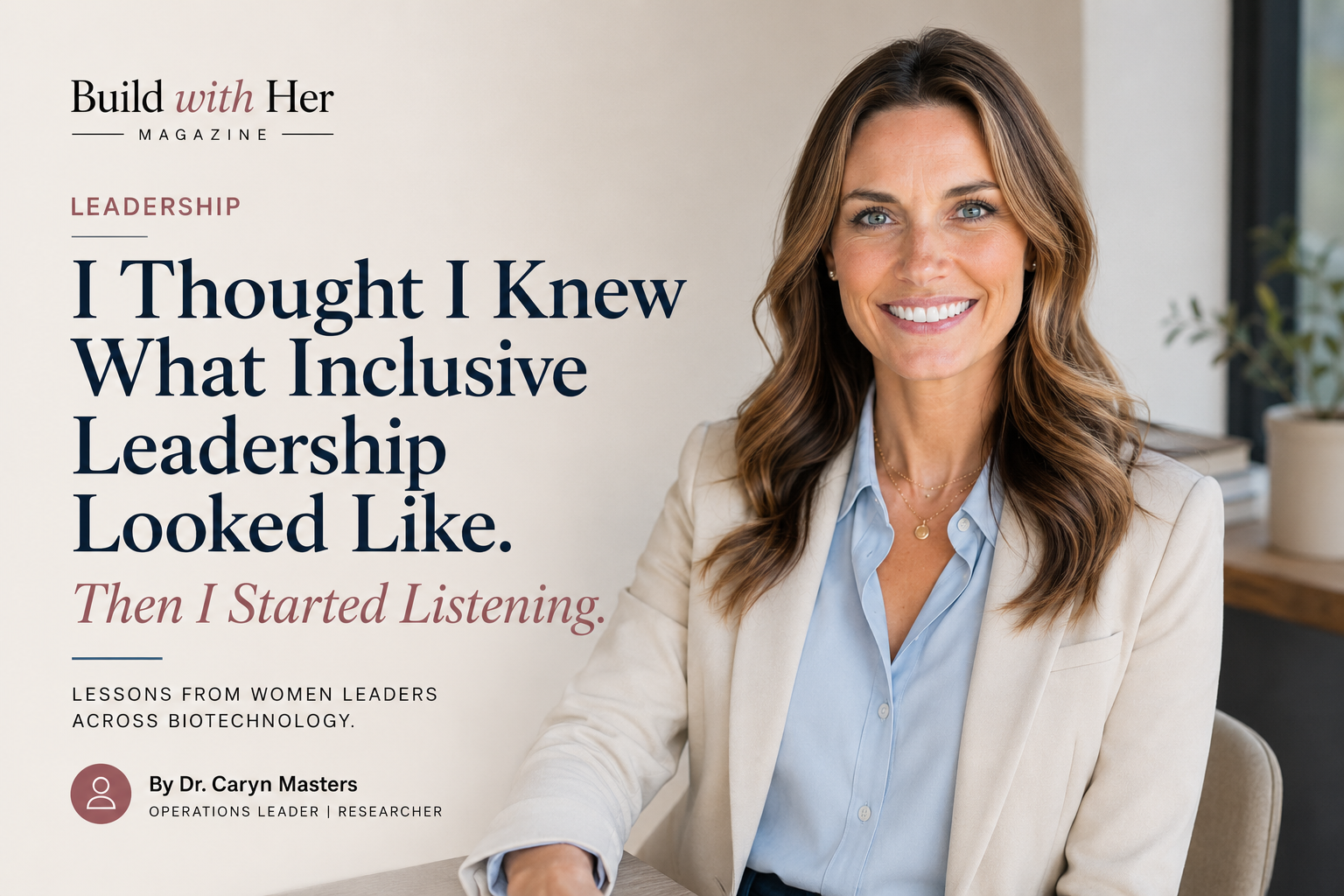
I Thought I Knew What Inclusive Leadership Looked Like. Then I Started Listening.
I began my doctoral research seeking to better understand the barriers to women’s career advancement through the lens of the Inclusive Leadership Theory. What emerged challenged some of my own assumptions about leadership and revealed practical lessons that extend far beyond gender. This article explores how research reshaped my perspective and how those insights can help leaders build stronger, more inclusive organizations.
When I began my doctoral research, I expected to validate many of the leadership principles I’d believed throughout my career.
After more than fifteen years leading teams in laboratories and manufacturing environments, I had seen firsthand how leadership decisions influenced engagement, trust, and performance. I assumed my research would reinforce what I already thought I knew.
Instead, it challenged me.
Over the course of my research, I interviewed leaders across the biotechnology industry to better understand the leadership experiences that shaped women’s careers. While every conversation was unique, I found myself hearing the same themes again and again. Sometimes they appeared in different forms or different words, but the underlying message was remarkably consistent.
What advanced women’s careers wasn’t always the company.
It wasn’t always the policies.
And it certainly wasn’t a perfect leadership development program.
More often than I expected, it came down to a leader.
Not a title.
Not a company initiative.
One person making hundreds of ordinary decisions that, over time, fundamentally changed someone’s experience at work.
That realization surprised me because companies spend enormous amounts of time building policies, processes, competency models, and leadership frameworks. Those things matter. They provide structure and consistency, especially in highly regulated industries like biotechnology and manufacturing.
But policies can only take a company so far.
Every policy eventually reaches a point where interpretation begins. Every process eventually requires judgment. Every difficult situation eventually asks a leader to decide not only what to do, but how to do it.
That’s where careers are often shaped.
One participant described a manager who made difficult decisions consistently, yet was deeply trusted because she never left people wondering why. Another spoke about a leader who noticed potential long before anyone else did and continued creating opportunities until that employee finally saw it in herself. Others remembered seemingly small moments—a conversation after a meeting, thoughtful feedback, an unexpected opportunity—that stayed with them years later.
None of those moments appeared in a policy manual.
None required a formal leadership program.
They simply required a leader willing to pay attention.
Perhaps the most surprising finding from my research was that people weren’t asking leaders to make everyone happy. They weren’t expecting every promotion decision to go their way or every organizational change to be welcomed. What they consistently wanted was fairness, honesty, and transparency. They wanted to understand the reasoning behind difficult decisions, even when they disagreed with the outcome.
Silence created uncertainty.
Transparency created trust.
That distinction has stayed with me ever since. It also changed how I think about inclusive leadership.
For years, many companies have treated inclusion as something that happens through policies, training modules, or annual initiatives. My research suggested something different. Inclusion is experienced through everyday leadership behaviors. It is reflected in who receives meaningful feedback, who is invited into important conversations, who is encouraged to stretch beyond their current role, and who is given another opportunity after making a mistake.
Those decisions rarely make headlines inside a company. Yet collectively, they define its culture.
Looking back, I don’t believe my research taught me an entirely new model of leadership. Instead, it sharpened my appreciation for something many experienced leaders already know but rarely articulate: leadership is less about extraordinary moments than it is about ordinary ones, repeated consistently over time.
Every conversation communicates value.
Every explanation builds—or erodes—trust.
Every coaching conversation either expands someone’s confidence or quietly limits it.
Leadership isn’t measured by the policies we write. It’s measured by the experiences people carry with them long after they’ve left our office.
As leaders, we often ask whether our companies have the right policies in place. Perhaps the better question is this: Are our everyday leadership behaviors creating the workplace those policies were designed to support?
Comments
Loading comments…