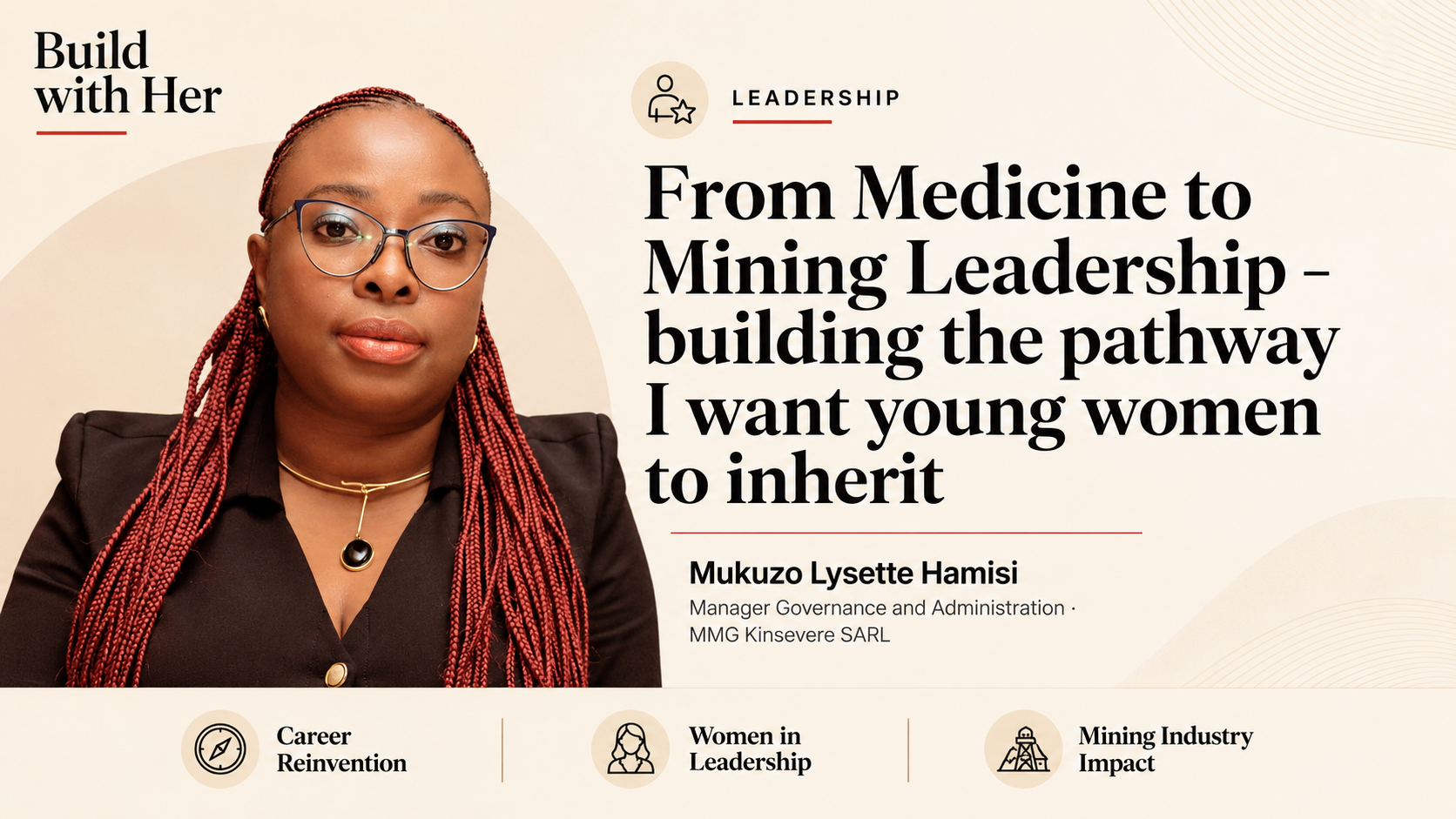
From Medicine to Mining Leadership - building the pathway I want young women to inherit
Short Bio
Dr. Lyse Hamisi is a governance and sustainability professional with more than 12 years of experience in the mining industry. A medical doctor with a Master of Public Health, she progressed from occupational health and hygiene into HSE management and now serves as Manager – Governance & Administration at MMG Kinsevere. She is also a mentor committed to supporting young graduates and developing future women leaders.
Short Article Summary
“From Medicine to Mining Leadership” reflects on Dr. Lyse Hamisi’s transition from general medicine to occupational health, HSE management, and governance leadership in the mining sector. The article shares practical lessons on career reinvention, continuous learning, resilience, and succeeding in male-dominated industries. It encourages young women to build confidence, seek mentorship, embrace non-linear career paths, and intentionally create opportunities for those who follow them.
When I addressed engineering students at the University of Lubumbashi during a 2026 conference marking International Women’s Day, I saw more than future engineers. I saw future leaders, innovators and decision-makers preparing to enter industries in which women remain underrepresented and role models are still too few.
The conference theme—“The Integration of Young Women into the Workplace: A Lever for Performance and Innovation”—resonated deeply with me. Education can open the door, but integration determines whether a young woman can step through it, contribute meaningfully, grow professionally and ultimately lead.
One student asked a question that was simple, honest and powerful: “How do I find my place in the professional world?”
The answer is not contained in a degree certificate alone. Professional success also depends on how we enter unfamiliar environments, build credibility, communicate our contribution, learn from feedback and keep developing long after graduation. My own career taught me this lesson in ways I could never have planned.
A journey defined by purpose, not profession
My career did not begin in mining. I trained as a medical doctor because I wanted to protect human health. Caring for patients taught me compassion, precision and the importance of evidence-based decisions. Public health later broadened my perspective. Instead of looking only at individual illness, I began asking larger questions: What systems shape health outcomes? Which environmental and organisational conditions create risk? How can harm be prevented before it occurs?
Those questions led me into industrial hygiene, occupational health and, eventually, the mining industry. At first glance, medicine and mining may seem unrelated. Yet I quickly discovered a shared objective: protecting people.
In mining, prevention became a practical form of leadership. Whether assessing occupational exposures, strengthening radiation-protection controls or helping teams understand critical safety measures, I learned that technical solutions only work when people understand them, trust them and apply them consistently. That requires more than technical knowledge. It requires judgement, communication, resilience and influence across disciplines.
Like many professionals entering an unfamiliar sector, I experienced uncertainty. I had to learn new concepts, understand complex operations and demonstrate that a non-traditional background could create meaningful value. Those moments did not disappear before I became confident; they became the environment in which confidence was built.
“Confidence is not the absence of uncertainty. It is the willingness to keep learning and contributing while uncertainty still exists.”
Over time, my responsibilities expanded from occupational health and hygiene into HSE management, sustainability coordination, governance, compliance and administration. Today, I work at the intersection of governance, risk, information management and organisational performance. The thread connecting every stage has remained consistent: protect people, strengthen systems and leave the organisation better than I found it.
A career does not have to be linear to be coherent
Young professionals are often encouraged to present a perfectly straight career story: study one subject, choose one profession, remain in one lane and progress through predictable titles. Real careers are rarely so orderly. They are shaped by curiosity, opportunity, exposure, changing responsibilities and the courage to transfer existing strengths into new contexts.
Medicine gave me a scientific foundation and respect for human wellbeing. Public health taught me systems thinking. Industrial hygiene taught me to recognise hazards and prevent harm. HSE management taught me to make decisions under pressure and influence operational outcomes. Governance taught me that sustainable performance depends on accountability, reliable information, disciplined processes and ethical judgement.
Each stage prepared me for the next, even when the connection was not obvious at the time. This is one of the most important messages I share with young women entering the workforce:
“Your first qualification is not a cage. Your first role is not your final identity.”
Do not ask only, “What job did I study for?” Ask also, “What problems am I equipped and motivated to solve?” The answer may lead you to opportunities that your original career plan could never have predicted.
Access is not the same as integration
Organisations rightly celebrate when more women enter engineering, mining, technology and other traditionally male-dominated sectors. Access matters. But graduation is not integration. Recruitment is not integration. Representation alone is not integration.
Integration occurs when people can contribute, learn, grow and succeed within an organisation. Many graduates enter the workplace with strong technical knowledge but limited understanding of the unwritten practices that influence professional progress. They may not know how to communicate status to a manager, ask for help early, seek feedback, participate confidently in meetings or make their contribution visible to those assigning future opportunities.
These challenges are rarely caused by a lack of intelligence. More often, they reflect insufficient preparation, exposure and workplace integration. When those gaps are ignored, capable graduates may lose confidence, remain underutilised or leave before their potential is fully developed.
For employers, this is not merely a social concern. It is a performance issue. When women are integrated effectively, organisations gain broader perspectives, stronger problem-solving, healthier challenge and a deeper pipeline of future leaders. Diversity creates value when it leads to participation, influence and meaningful responsibility.
“Access opens the door, but integration determines whether talent can thrive.”
Mentorship must move beyond encouragement
I believe deeply in encouragement, but encouragement alone is not a development strategy. Telling a graduate, “You can do it,” may inspire confidence for a moment. Structured mentorship can transform how she builds an entire career.
Effective mentorship provides practical guidance, accountability and exposure. It helps a young professional understand career pathways, identify skill gaps, improve communication, develop professional habits, navigate workplace realities, expand her network and evaluate opportunities thoughtfully.
Through international career mentoring and mentoring a graduate hydrogeologist, I have observed a consistent pattern: people grow fastest when advice is connected to real work, regular reflection and measurable action. A useful mentor does not create dependence or make decisions on behalf of the mentee. The mentor strengthens the mentee’s ability to think, decide and act independently.
Mentorship also becomes more powerful when it is combined with sponsorship. Guidance helps a young professional prepare; sponsorship helps make her visible. It may involve recommending her for a project, introducing her to a credible network or drawing attention to work that deserves recognition. Both forms of support are essential, but they must be grounded in merit, readiness and accountability.
“Encouragement inspires confidence. Mentorship creates capability.”
From inspiration to action: the vision behind ImpactPath
This conviction inspired me to create ImpactPath, a personal development initiative focused on workplace readiness, mentorship, confidence, communication and purposeful career progression. I also launched ImpactPath Weekly, a LinkedIn newsletter that shares practical guidance for graduates moving from campus to career.
The idea grew from a recurring observation: most graduates possess knowledge and ambition, but many have had limited exposure to the practical realities of professional life. The gap is rarely intelligence. The gap is preparation.
A meaningful transition programme should connect five stages:
• 1. Career positioning: understanding strengths, values, possible pathways and the contribution a graduate wants to make.
• 2. Job-market readiness: developing a credible CV, cover letter, LinkedIn profile, networking approach and application strategy.
• 3. Workplace capability: building communication, accountability, ethics, teamwork, time management and confidence in receiving feedback.
• 4. Mentorship and exposure: connecting graduates with experienced professionals, real cases and authentic workplace environments.
• 5. Employment transition: preparing for interviews, evaluating opportunities and navigating the first ninety days of professional life.
The differentiator is not another series of lectures. It is the combination of preparation, exposure, guided practice and accountability. A young woman should leave such a programme with more than a revised CV. She should leave with clearer judgement, stronger habits, greater confidence and a network capable of supporting and challenging her growth.
“We should not only prepare graduates to find jobs; we should prepare them to build careers.”
Leadership is more than a title
As I work on my first manuscript, Women in Leadership, I continue to reflect on the experiences that shape women’s professional journeys across industries and cultures. One lesson appears repeatedly: leadership is not defined by position alone.
Some of the most influential leaders hold no executive title. They raise standards, create opportunities, encourage excellence and help others see possibilities beyond their current circumstances. Effective leadership is not about becoming the loudest voice in the room. It is about creating value, building trust, exercising sound judgement and enabling other people to succeed.
For women in particular, leadership may involve building credibility in environments where representation remains limited. Yet it also offers an opportunity to broaden the model of leadership itself. The future of women’s leadership will not be measured only by how many women reach senior positions. It will also be measured by how intentionally they develop the next generation.
What each stakeholder can do
Integrating young women into the workforce requires collective responsibility. Every stakeholder can make the transition more deliberate and more effective.
• Universities: create stronger links between academic learning and professional practice through mentoring, applied projects, workplace simulations and industry exposure.
• Employers: make expectations and career pathways visible, provide meaningful assignments, give timely feedback and ensure that women are trusted with substantive responsibility—not only symbolic participation.
• Mentors and sponsors: combine support with constructive challenge, help young professionals interpret workplace realities and use networks responsibly to create credible exposure.
• Young professionals: take ownership of development by asking questions, seeking feedback, building relationships, continuing to learn and communicating contributions with confidence and humility.
Representation becomes leadership when it creates room for others
Throughout my journey—from medicine and public health to occupational hygiene, HSE, governance and administration—I have benefited from opportunities, mentors and experiences that expanded my perspective. Those opportunities created a responsibility: to make the pathway clearer for the women who follow.
That responsibility may take many forms: mentoring a graduate, reviewing a CV, opening a professional network, recommending a capable young woman for an assignment, speaking honestly about career transitions or helping an organisation improve how it integrates emerging talent.
Individually, these actions may appear small. Collectively, they can transform careers. Many professional journeys are shaped by one timely conversation, one credible introduction or one person who recognises potential before it is fully visible.
My own career has taught me that leadership is not defined solely by the position we hold. It is reflected in the systems we strengthen, the standards we model and the people we help prepare. The most meaningful success is not simply reaching a new level; it is creating a pathway that others can walk with greater clarity, confidence and opportunity.
For every young woman wondering whether her path is too unconventional, whether she belongs in a technical industry or whether she is ready to lead, my message is simple: do not allow your starting point to define your destination. Careers are built through curiosity, resilience, disciplined learning and the courage to embrace opportunities outside your comfort zone.
My journey from medicine to mining leadership taught me that purpose travels across disciplines. The knowledge we acquire, the systems we improve and the opportunities we create for others are often more enduring than the titles we hold.
“When women rise, they should not simply break barriers. They should leave bridges behind for others to cross.”



0 comments on “From Medicine to Mining Leadership - building the pathway I want young women to inherit”
Comments from signed-in readers are published immediately. Keep it professional.
Sign in to join the conversation.