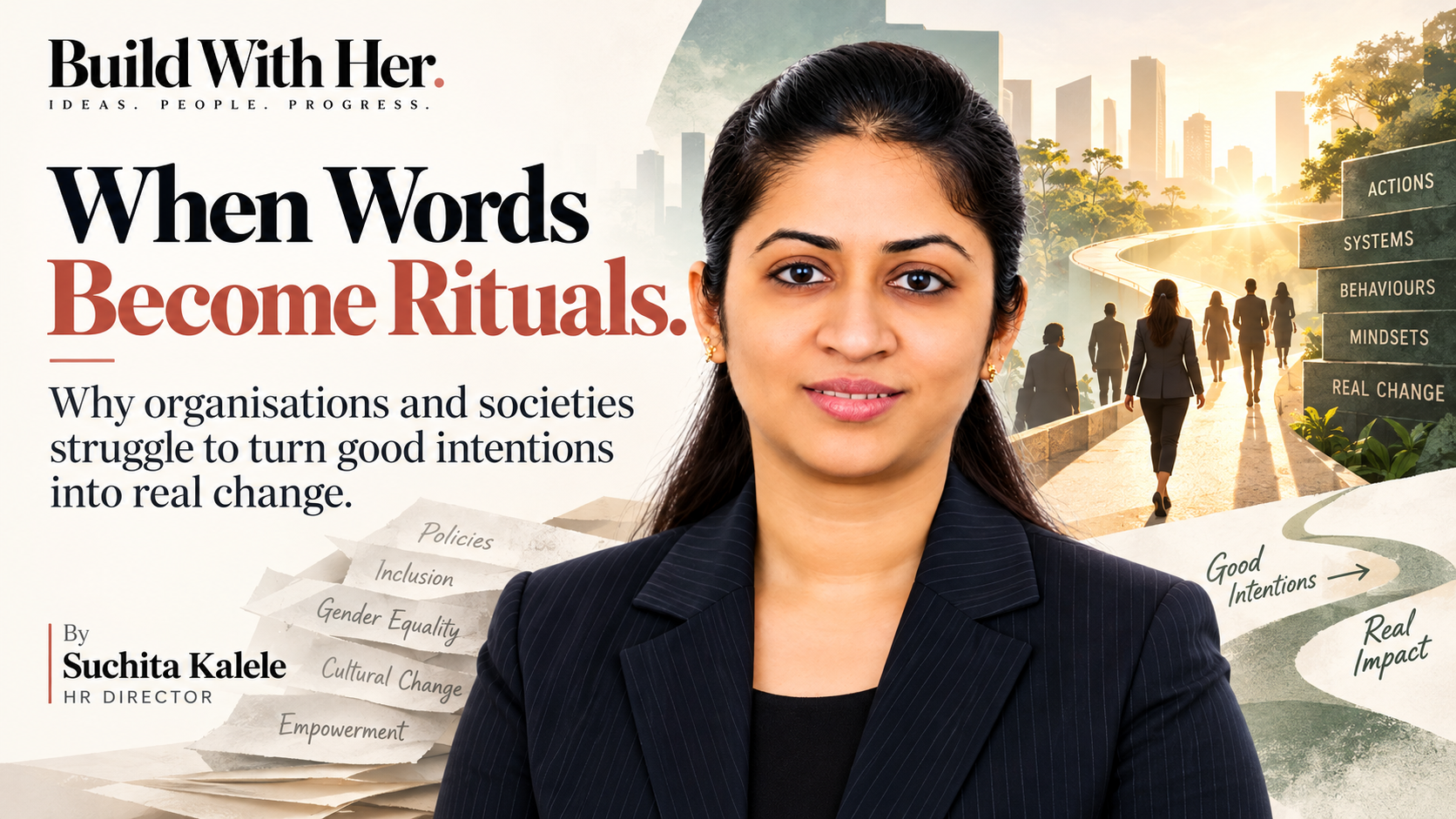
When Words Become Rituals. Why organisations and societies struggle to turn good intentions into real change.
We live in a world that speaks extensively about change: women’s safety and empowerment, inclusive workplaces, cultural transformation and organisational renewal. Yet, too often, our actions remain unchanged. We expect different outcomes while protecting the systems, behaviours and mindsets that created the old ones.
This article explores the human psychology behind this contradiction, drawing a parallel between society and organisations: why we embrace the language of change but resist the discomfort of changing ourselves. Because real transformation begins not with what we announce, but with what we are willing to change and ultimately, what people actually experience.

A woman leaves work at 8:30 in the evening. Before getting into her cab, she checks the driver's details, shares her live location with someone at home and keeps her phone within reach. Nothing has happened. Yet she has learnt to prepare for the possibility that something might.
That, perhaps, is one of the quietest indicators of where we are as a society.
We have spent years talking about women's safety, equality and empowerment. We have laws, policies, helplines, awareness campaigns and government programs. Every year, we dedicate a day to celebrating women and their achievements. Yet the lived experience continues to tell a more complicated story. The 2025 NARI report found that 40% of women surveyed in urban India felt unsafe or not very safe, while only around one in three women who experienced harassment reported it. Safety perceptions were particularly poor at night and around public spaces and transport.
This is not to suggest that nothing has changed. India has introduced significant legislation and programs addressing women's safety and empowerment, including Mission Shakti and institutional mechanisms around emergency response, policing and support. The issue, therefore, is not simply the absence of intent or action.
The more uncomfortable question is: why does the intent so often fail to translate into lived outcomes?
And that question takes us far beyond women's safety. It takes us into something deeply human, the way we respond to change.
Consider what happens inside organisations.
An organisation realizes that something is not working. Productivity has plateaued, employee engagement is falling, succession pipelines are weak or the culture has become slow and bureaucratic. So, it brings in someone from outside. The mandate is usually ambitious: challenge the status quo, transform the culture, bring fresh thinking and create a different outcome.
The new leader arrives with experience, ideas and energy. But soon discovers that the organization wants a different outcome without necessarily changing the inputs / ways of working that produced the old one.
The decision-making process remains the same. Incentives remain unchanged. Informal power structures remain intact. The same behaviours continue to be rewarded, and the same behaviours continue to be tolerated. Meetings look the same, accountability mechanisms remain the same and the unwritten rules of the organisation are still very much alive.
Yet the expectation is that somehow the result will be different.
It is a strange equation: change the person, but not the system; change the language, but not the behaviour; and then expect transformation.
Research on organisational transformation has repeatedly shown how difficult sustained change is. McKinsey's work, for example, has found that successful transformations are associated not simply with communicating a new strategy, but with leadership involvement, employee ownership, capability building and changes in mindsets and culture.
This is where many organisations encounter an interesting phenomenon.
The external hire initially challenges established thinking. They ask questions that insiders may have stopped asking. They question processes that have become habitual and call out contradictions between what the organisation says and what it actually rewards.
The organisation rarely responds with an explicit rejection. Instead, resistance comes through a thousand small signals: “We tried that before.” “It won't work here.” “You need to understand how things really work.” “The business isn't ready.” Etc.
Gradually, the new leader adapts. They learn which battles are worth fighting. They understand which subjects are sensitive. They modify their approach. In some cases, they become part of the very culture they were brought in to change. In others, they leave.
And when they do leave, the organisation often finds an explanation: the market was difficult, compensation was not competitive, the person was not a cultural fit, the timing was wrong.
The system survives.
This is not unique to organisations. It is remarkably similar to how societies deal with difficult issues.
We say we want women to be safe. But safety requires more than a slogan. It requires functioning institutions, effective policing, accountability, safe public infrastructure, responsive workplaces, education, economic independence and, importantly, changes in social attitudes and everyday behaviour.
A policy is an input; safety is the outcome.
A POSH policy is an input; a workplace where women trust the system enough to report misconduct is the outcome.
A women's leadership program is an input; women having genuine access to decision-making power is the outcome.
A safety campaign is an input; a woman being able to travel home without calculating risk is the outcome.
The distinction matters because we have become very good at measuring activity instead of impact. We count programs launched, policies issued, training sessions conducted, committees formed, town halls organized and messages posted. But people do not experience activity. They experience outcomes.
Perhaps this is why Women's Day can sometimes become symbolic rather than transformational. We celebrate women on one day, speak about inclusion and leadership, and then return to the everyday behaviours, assumptions and systems that may be preventing precisely those outcomes.
The same contradiction exists in corporate life. Organisations talk about empowerment but centralize decisions. They talk about accountability but tolerate poor performance. They talk about innovation but punish failure. They talk about inclusion but listen only to familiar voices. They hire people to challenge the system and then become uncomfortable when those people actually challenge it.
Why?
Because change is psychologically expensive.
Human beings have a natural preference for familiarity. Research on status quo bias demonstrates that people tend to prefer existing arrangements even when alternatives may offer better outcomes. Research on system justification similarly suggests that people can rationalize existing social arrangements because doing so provides a sense of order, stability and predictability.
There is another layer to this. Most of us like to see ourselves as fair, progressive and open-minded. When our behaviour contradicts that self-image, changing the behaviour can be uncomfortable. It is often easier to change the explanation.
“We are already doing enough?”, “Things are much better than they used to be”, “The problem is not really systemic”. “People misuse the system”, “The organization is simply not ready” etc.
The explanation protects us from confronting the harder truth: perhaps we are part of the system that needs to change.
That may be the real reason words so often fail to become action.
It is easy to endorse change when change means a new policy, a new initiative, a new leader or a new campaign. It becomes considerably harder when change requires us to surrender a familiar privilege, alter a comfortable behaviour, challenge a powerful person or accept accountability ourselves.
Which brings us back to the woman in the cab.
If we genuinely want her to feel safe, the question cannot simply be what program we can launch next. We have to ask what behaviours, systems and assumptions must change so that she no longer has to carry the burden of managing her own safety.
Similarly, when an organisation hires a leader to transform its culture, perhaps the first question should not be, “What will this person change?” It should be, “What are we, as an organisation, willing to change so that this person can succeed?”
That is a much harder question.
Because real change redistributes power, creates discomfort and forces people to examine behaviours they may have normalized for years. It requires more than changing the messenger. It requires changing the environment in which the message is received.
Perhaps that is the common thread between society and organisations: we want different outcomes, but we often resist changing the inputs that created the existing ones.
And until that changes, our words risk becoming rituals repeated often enough to make us feel that progress is happening, without necessarily changing the reality people experience.
The real measure of change, therefore, is not what we announce, celebrate or document.
It is what people experience when nobody is watching.
That is where intention ends.
And real change begins.
0 comments on “When Words Become Rituals. Why organisations and societies struggle to turn good intentions into real change.”
Comments from signed-in readers are published immediately. Keep it professional.
Sign in to join the conversation.