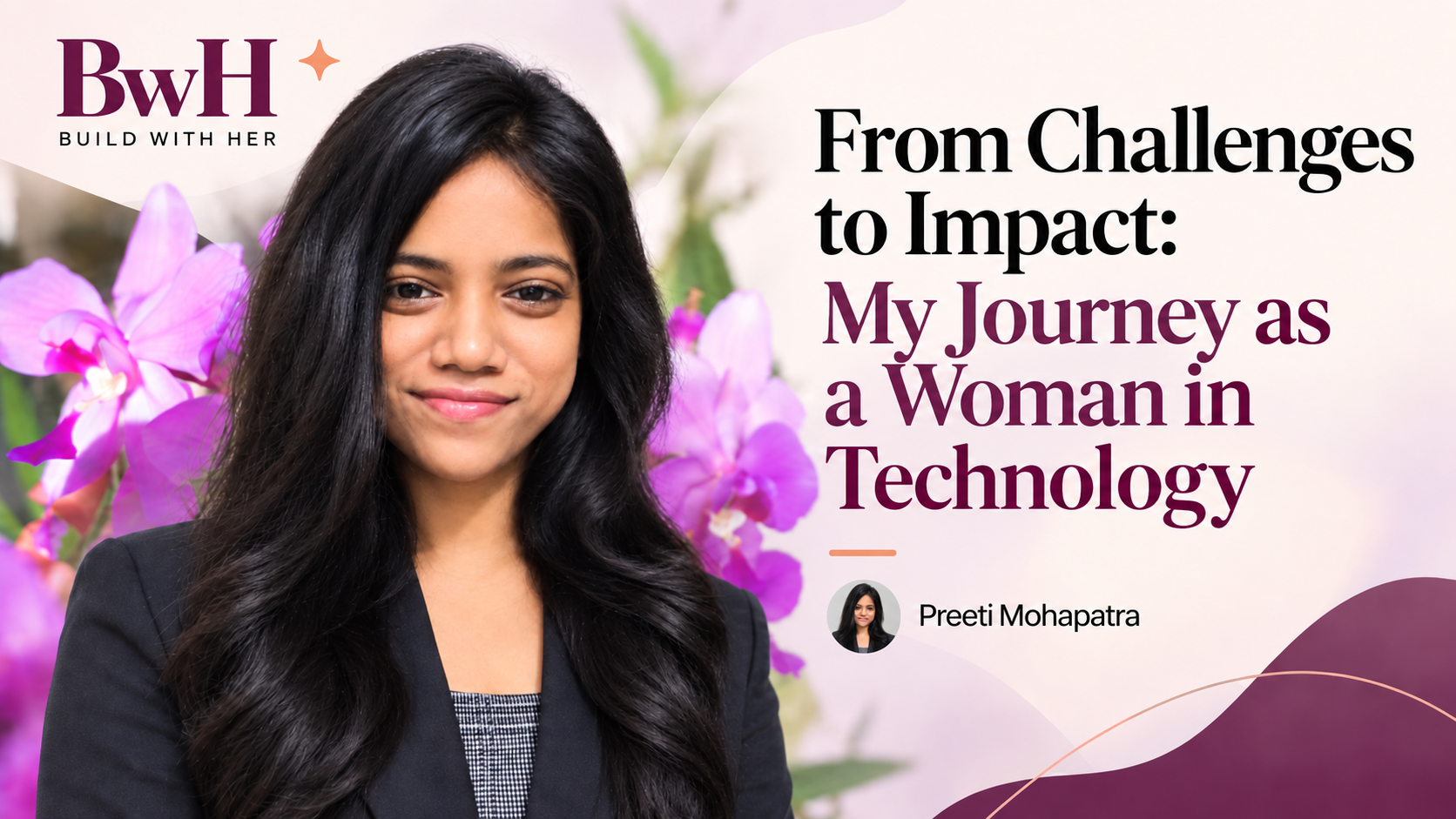
From Challenges to Impact: My Journey as a Woman in Technology
From navigating challenges as a woman in technology to building expertise in cybersecurity and emerging technologies, this is a story of curiosity, resilience, and continuous growth. It explores how technical challenges can become opportunities to create meaningful impact, build trust, and inspire the next generation of women in tech.

“Technology is not only about building what is possible. It is about having the courage to solve what matters.”
Chapter 1 — Where Curiosity Became a Career
My journey in technology began with curiosity.
I was fascinated by how systems worked, how information moved, and how a seemingly small technical decision could influence an entire organization. Over time, that curiosity evolved into a deeper interest in one of the most critical areas of technology: cybersecurity.
Cybersecurity is often described through tools, firewalls, vulnerabilities, threat detection, and incident response. But behind all of those technologies is something much more fundamental: trust.
Every digital system depends on people trusting that their information is protected, that their applications are resilient, and that the technology they rely on will continue to work when they need it most.
That realization changed the way I looked at technology.
I stopped seeing cybersecurity simply as a technical discipline and started seeing it as a responsibility.
“The strongest security strategy is not the one with the most tools. It is the one that makes security part of how people think and build.”
Chapter 2 — Learning to Navigate Challenges
Building a career in technology is rarely a straight line.
There are moments when the technology is difficult, the problem is ambiguous, and the answer is not obvious. There are also moments when the challenge is not technical at all.
As a woman in technology, I have learned that professional growth requires more than technical knowledge. It requires confidence, resilience, communication, and the willingness to keep learning even when you do not have all the answers.
There were situations where I had to speak up, defend an idea, ask difficult questions, and make decisions in environments where the stakes were high.
Those experiences taught me an important lesson:
You do not need to know everything to have something valuable to contribute.
Technology changes too quickly for anyone to know everything. What matters is the ability to learn, reason through uncertainty, collaborate with others, and take ownership of outcomes.
Chapter 3 — Cybersecurity Is a Team Sport
One of the biggest lessons cybersecurity has taught me is that security cannot belong to a single team.
A security engineer can identify a vulnerability. A developer can fix the underlying code. A cloud engineer can strengthen the architecture. A product team can redesign a risky workflow. Leadership can create the policies and culture that make secure engineering possible.
Real security happens when all of these pieces work together.
Modern environments are increasingly distributed across cloud platforms, APIs, containers, applications, third-party services, and connected devices. This creates enormous opportunities—but also an increasingly complex attack surface.
That complexity means cybersecurity professionals need to understand much more than security tools.
They need to understand architecture, software development, cloud infrastructure, data, identity, risk, and business priorities.
For me, this intersection is what makes cybersecurity so exciting.
“Security is strongest when it is built into the architecture—not added as an afterthought.”
Chapter 4 — From Solving Problems to Creating Impact
As my technical journey evolved, I began thinking beyond individual problems.
Solving a vulnerability is important. Preventing an entire class of vulnerabilities is even more powerful.
Responding to an incident is necessary. Designing systems that reduce the probability and impact of incidents is better.
That shift—from reacting to problems to designing for resilience—has shaped how I approach technology.
I became increasingly interested in questions such as:- How can we make secure engineering easier for developers?
- How can organizations detect risks earlier?
- How can cloud environments be designed with security as a foundation?
- How can automation reduce human error?
- How can AI help security teams respond faster without introducing new risks?
- How can we build security cultures rather than simply security processes?
These questions have helped me move from thinking about technology as a collection of tools to thinking about it as an ecosystem.
Chapter 5 — The AI Era Changes the Security Conversation
Artificial intelligence is transforming almost every area of technology, and cybersecurity is no exception.
AI can help organizations analyze enormous volumes of security data, identify patterns, automate repetitive tasks, accelerate investigations, and improve threat detection.
But every new capability also introduces new questions.
How do we protect sensitive information used by AI systems?
How do we manage identity and access?
How do we validate AI-generated outputs?
How do we protect models and AI-enabled applications from new forms of attack?
How do we make sure that speed does not come at the expense of security?
These are not questions that can be answered by one person or one technology.
They require collaboration between security professionals, engineers, researchers, product leaders, policymakers, and users.
That is why I believe the next generation of cybersecurity professionals must be comfortable working across disciplines.
Chapter 6 — Being a Woman in Technology
Being a woman in technology has added another dimension to my journey.
Technology needs diverse perspectives because the systems we build affect diverse populations.
When women participate in designing technology, leading engineering teams, developing security strategies, and making technology decisions, we bring different experiences and perspectives to the table.
Representation matters—but representation alone is not enough.
We also need environments where women can speak, experiment, lead, fail, learn, and grow.
I believe one of the most meaningful things experienced professionals can do is make the path easier for those coming next.
Sometimes that means mentoring someone.
Sometimes it means recommending a woman for an opportunity.
Sometimes it means simply telling someone, “You belong here.”
“We don't create more women in technology by asking them to fit into existing systems. We create change by building environments where they can lead in their own way.”
Chapter 7 — The Power of Continuous Learning
Technology rewards curiosity.
The moment we believe we have mastered everything is often the moment the industry moves forward without us.
Cybersecurity makes this especially clear. Threats evolve. Cloud architectures evolve. Attack techniques evolve. Regulations evolve. AI is changing the landscape at extraordinary speed.
Continuous learning is therefore not an advantage—it is part of the job.
For me, learning has meant staying curious about emerging technologies while strengthening the fundamentals: understanding systems, asking better questions, studying failures, learning from other engineers, and remaining open to perspectives different from my own.
The goal is not to chase every new technology.
The goal is to understand which technologies matter, why they matter, and how they can be used responsibly.
Chapter 8 — Recognition Is a Milestone, Not the Destination
Being recognized as a Techie 40 Under 40 honoree has been a meaningful milestone in my journey.
Recognition is encouraging, but I see it less as an endpoint and more as a reminder of responsibility.
Every achievement creates an opportunity to ask:
What can I do next?
How can I use my experience to solve bigger problems?
How can I help others grow?
How can I encourage more women to enter technical fields?
How can I contribute to a technology ecosystem that is more secure, inclusive, and innovative?
Those questions matter more to me than any title.
Chapter 9 — What I Would Tell the Woman Starting Today
If you are a woman considering a career in technology, cybersecurity, cloud, AI, or engineering, my advice is simple:
Start before you feel ready.
You will encounter technologies you do not understand.
You will sit in meetings where someone knows more than you.
You will make mistakes.
You may sometimes wonder whether you belong.
Keep going.
Ask questions.
Build things.
Break things safely.
Learn from people around you.
Find mentors, but also become a mentor when you are able.
And never underestimate the power of your perspective.
You do not have to become someone else to succeed in technology.
You can build your own path.
“Your career does not have to follow someone else’s blueprint. Your curiosity can become your roadmap.”
Key Takeaways
1. Build security into the foundation
Security is most effective when it is considered during architecture and development—not after a system is already built.
2. Stay curious
Technology changes constantly. The ability to learn may be more valuable than any single technical skill.
3. Think beyond tools
Cybersecurity is not just about products and platforms. It is about people, processes, architecture, risk, and trust.
4. Turn challenges into opportunities
Difficult experiences can become some of the most valuable lessons in a technical career.
5. Make space for others
Progress becomes more meaningful when we help other people grow alongside us.
6. Lead with purpose
Technical expertise creates possibilities. Purpose determines how we use them.
The Road Ahead
The future of technology will be shaped by people who can combine technical depth with empathy, curiosity, and responsibility.
As AI, cloud computing, automation, and cybersecurity continue to converge, the opportunities are enormous. So are the challenges.
I want to continue being part of that journey—not simply by building technology, but by helping build technology that people can trust.
And as I look back at the challenges that shaped my career, I see a common thread.
Every challenge taught me something.
Every obstacle strengthened me.
Every opportunity created a chance to learn.
And every lesson reinforced a belief that I now carry forward:
“Impact is not measured only by what we build. It is measured by the problems we solve, the people we empower, and the future we help make possible.”
That is the journey I am still on—from challenges to impact, one problem, one lesson, and one opportunity at a time.
0 comments on “From Challenges to Impact: My Journey as a Woman in Technology”
Comments from signed-in readers are published immediately. Keep it professional.
Sign in to join the conversation.