The Entrepreneurial Classroom Is Not Just About Business
For decades, schools have prepared students for a world built on predictability, compliance, and linear career paths. But the future unfolding around us demands something entirely different: adaptability, initiative, systems thinking, creativity, and human-centered problem solving.
This article explores why “early entrepreneurship education” is not really just about building businesses, but about helping young people become capable, resilient humans who know how to shape the world around them. It also explores how thoughtfully designed technology can help make human growth and competency development more visible across classrooms, schools, and education systems.
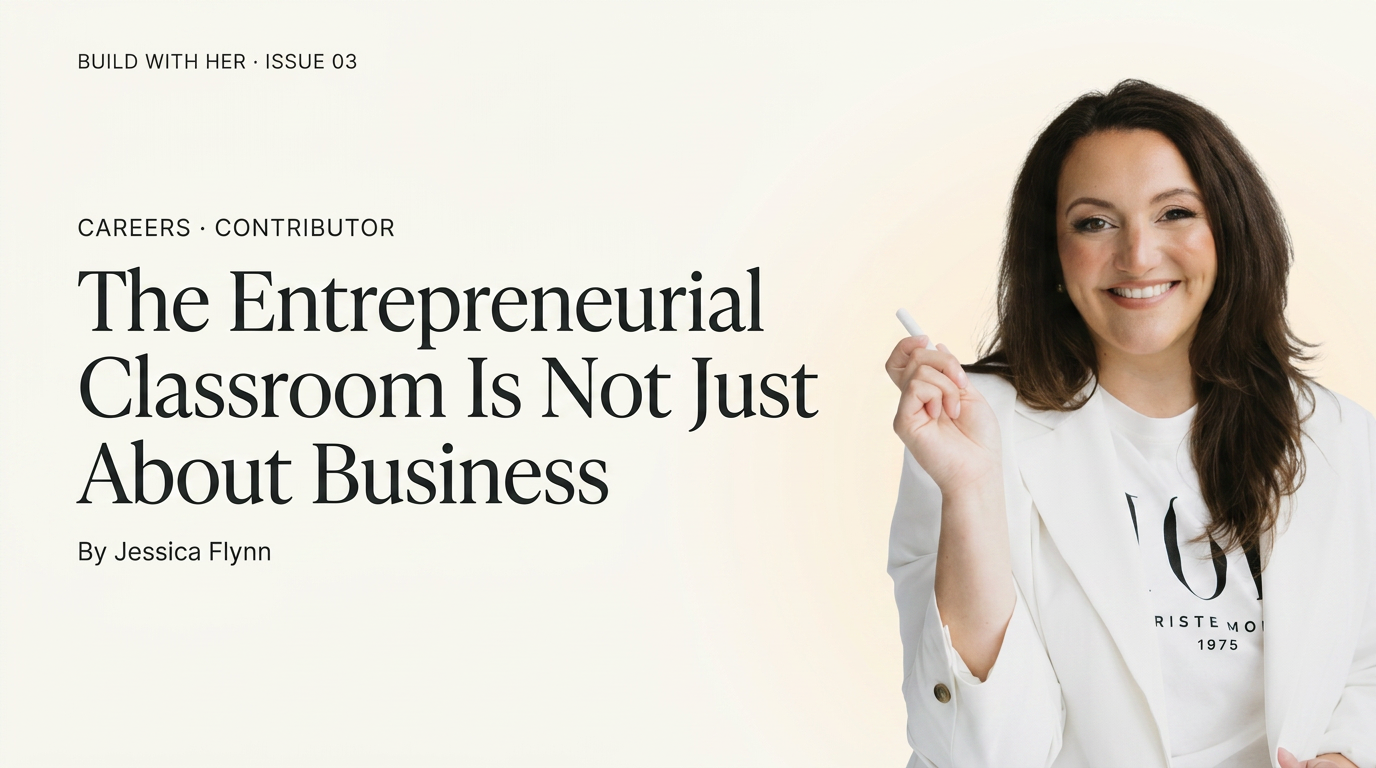
When most people hear the phrase “entrepreneurship education,” they picture Shark Tank-style pitches, business plans, or students learning how to launch startups.
And yes, this can absolutely be part of it.
But after years of working alongside young people, educators, communities, and systems leaders, I have come to believe something much bigger:
The entrepreneurial classroom is not just about business.
It is about human capability.
It is about helping young people learn how to think critically, navigate uncertainty, solve meaningful problems, communicate ideas, collaborate across differences, and recognize their own ability to shape the world around them.
And right now, those skills matter more than ever; whether we are ready or not, the world students are entering looks dramatically different than the one our education systems were originally designed for.
We are living through a moment defined by rapid technological change, artificial intelligence, economic uncertainty, climate challenges, mental health crises, and shifting definitions of work itself. Entire industries are transforming in real time. Career pathways are becoming less linear. Information is everywhere. Adaptability is no longer optional.
Yet many classrooms are still structured around models built for predictability, standardization, and compliance.
Students are often rewarded for finding the “right” answer instead of asking better questions.
They are taught to memorize rather than create.
To consume rather than contribute.
To wait for permission rather than recognize their own agency.
And perhaps most importantly, many young people are moving through systems that rarely invite them to see themselves as capable of creating meaningful change.
That gap is the most dangerous.
The future will not simply belong to those who can recall information. Increasingly, it will belong to those who can navigate ambiguity, build relationships, think systemically, identify opportunities, and take initiative in complex environments.
In other words, the future belongs to people who know how to learn, adapt, and lead.
This is why I believe entrepreneurial learning must be reframed, and not as a niche elective or a pathway only for future founders, but as a foundational approach to developing human potential.
Over the past several years through The YOU Power Project™, I have watched young people build ventures around causes they care deeply about: mental health advocacy, environmental sustainability, food insecurity, community connection, and inclusive design.
But the most important outcome was never the business idea itself.
The transformation happened in how they began to see themselves.
A quiet student who suddenly found confidence presenting to community leaders.
A teenager who realized their lived experience could become a source of leadership and innovation.
Young people discovering that their ideas had value, that collaboration mattered, and that they were capable of contributing to solutions larger than themselves.
That is the real work.
The entrepreneurial classroom, at its best, creates environments where students move from passive participants to active problem-solvers.
Where curiosity becomes a strength.
Where creativity is not treated as extra.
Where reflection matters as much as performance.
Where students learn not only how systems function, but how systems can evolve.
And perhaps most importantly, where young people begin to understand that they are not powerless inside a rapidly changing world.
But one of the biggest challenges in transforming education is this: Many of the competencies we say we value most are also the hardest to make visible.
How do we meaningfully recognize growth in leadership, collaboration, adaptability, creativity, systems thinking, resilience, or initiative?
How do educators demonstrate the development of human-centered competencies in ways that are authentic, actionable, and scalable?
And how do school systems support this work without creating even more administrative burden for teachers already carrying immense complexity?
These questions matter because what we measure inevitably shapes what we prioritize.
For decades, education systems have been exceptionally effective at measuring content retention and standardized outputs. But the future increasingly demands something broader: the ability to navigate ambiguity, solve real-world problems, collaborate across differences, and continuously adapt in changing environments.
That is part of why our team has been building technology infrastructure alongside the learning model itself.
Not EdTech for EdTech’s sake, but technology designed to help make human growth more visible.
Through competency-based tracking, reflective learning systems, and real-world project development, we are exploring ways to help educators, schools, organizations, and even Ministries better understand how future-ready capabilities develop over time, from the individual learner level all the way to broader systems impact.
The goal is not surveillance, standardization, or reducing students to data points. In many ways, it is the opposite. It is about pulling back the curtain on forms of growth that have too often remained invisible inside traditional systems...
The student who develops confidence speaking publicly for the first time.
The young person learning to collaborate across differences.
The emerging problem-solver beginning to recognize patterns within their community.
The learner discovering resilience after navigating uncertainty.
These moments matter deeply. Yet historically, many have existed outside the metrics systems are built to recognize.
Technology, when designed intentionally, has the potential to support a more holistic understanding of learning and human development — not replacing educators, but strengthening their ability to see, support, and scale meaningful growth.
Because if we truly believe that creativity, adaptability, initiative, empathy, and systems thinking are essential for the future, then we must also become more capable of recognizing and nurturing those capacities at every level of education.
This shift also changes the role of educators.
Teachers are no longer expected to simply transfer information. Increasingly, they become facilitators of exploration, critical thinking, collaboration, and real-world connection.
That is not a small transition, and educators cannot carry it alone.
If we are serious about preparing young people for the future, then governments, institutions, businesses, nonprofits, and communities all have a role to play in reimagining what learning can become.
Education is no longer just an education issue (it never should have been).
It is an economic issue.
A workforce issue.
A mental health issue.
A community resilience issue.
A social innovation issue.
And ultimately, a human flourishing issue.
The good news is that transformation is already happening.
Around the world, educators and communities are experimenting with more interdisciplinary, experiential, and human-centered models of learning. Young people are stepping into leadership earlier. Technology is creating new opportunities for access, collaboration, reflection, and creativity. Conversations around future-ready skills are growing louder.
But we cannot simply add “innovation” onto outdated systems and expect meaningful change. We need to rethink the purpose of education itself.
Not only asking:
“What should students know?”
But also:
“Who are students becoming?”
The future will not be shaped solely by technological advancement. It will be shaped by human beings who know how to think, connect, create, adapt, and care.
And perhaps that is what the entrepreneurial classroom is really trying to teach after all.



0 comments on “The Entrepreneurial Classroom Is Not Just About Business”
Welcome to the comments section. We moderate every submission according to our community guidelines.
Loading conversation…