From SAP Basis to AI Infrastructure: Reinventing Without Starting Over
In Summary, reinvention does not require starting over. The skills, experiences, and leadership capabilities developed over years of work can become the foundation for success in entirely new domains. My transition into AI Infrastructure is proof that with curiosity, adaptability, and a willingness to learn, it is possible to evolve alongside technology and help shape its future.

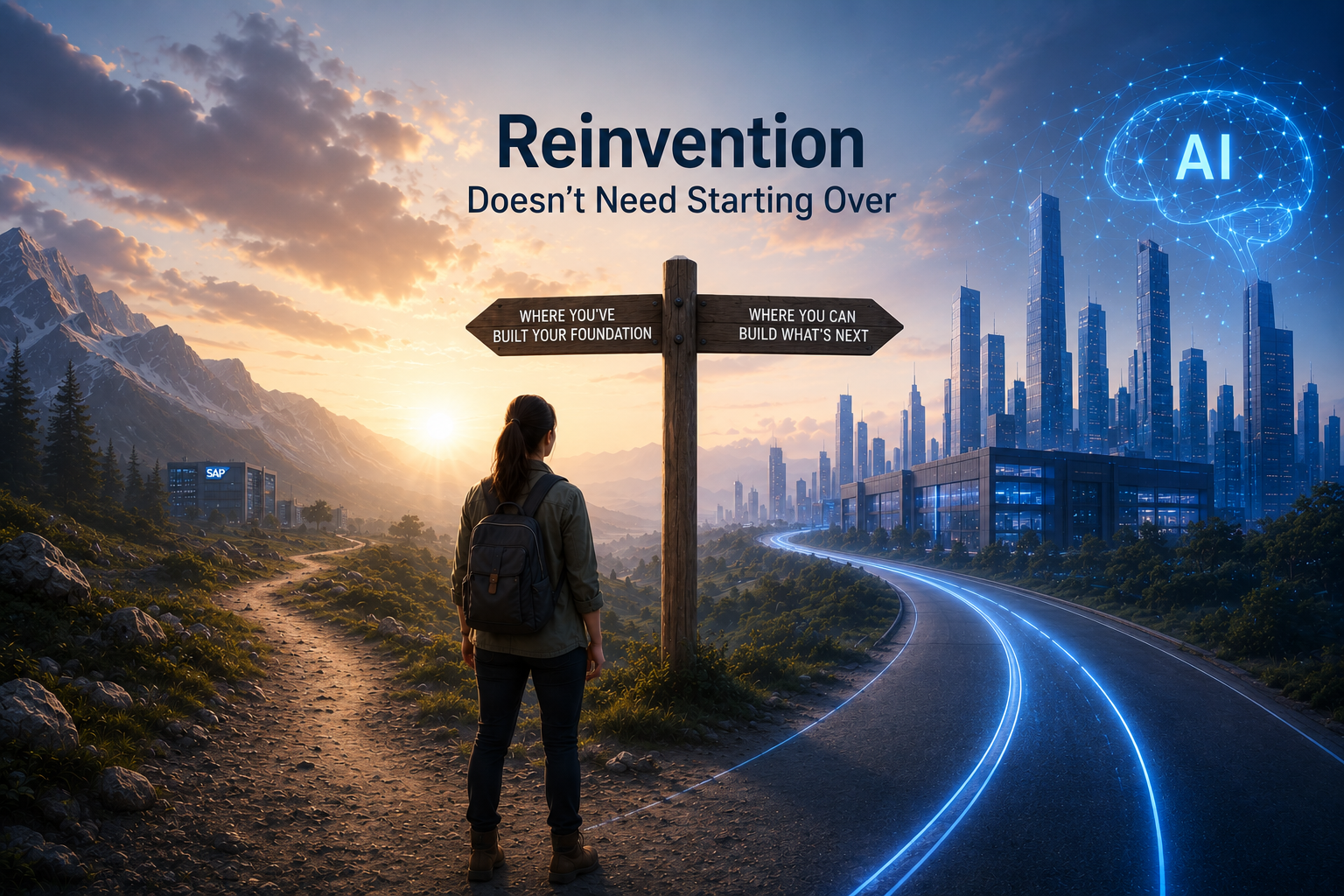
For most of my career, I worked with teams delivering complex SAP projects and helping organizations navigate transformation. Over time, I realized that technology alone doesn't drive success in large enterprises. Leaders must balance compliance, people, skills, costs, governance, and change management while keeping business goals in focus. This realization helped me grow beyond the technical domain and become a bridge between business and technology. The ability to connect strategy, people, and execution became one of the most valuable skills I developed as a leader. This experience laid the foundation for my transition into AI Infrastructure, where the challenges are different, but the leadership principles remain remarkably similar.
A few years ago, however, I found myself standing at the edge of a technological shift that was impossible to ignore. Artificial Intelligence was rapidly moving from research and experimentation into real-world business applications. While many saw AI as a completely different discipline, I saw an opportunity to apply my infrastructure background to a new and evolving domain. The journey began modestly. Our initial AI workloads ran on managed cloud services and application services. At that stage, the focus was on enabling innovation quickly rather than building sophisticated platforms. As adoption grew, however, it became clear that supporting AI at scale required a different approach. We needed greater flexibility, control, and operational maturity. This led us towards Kubernetes and cloud-native architectures, marking a significant turning point in my career.
The transition was both exciting and challenging. I quickly realized that scalability in the AI world meant much more than scaling infrastructure. In traditional enterprise environments, scaling typically involved adding compute, storage, or memory. In AI, scalability introduced an entirely new dimension: managing Large Language Model (LLM) capacity. Understanding model throughput, token consumption, latency, rate limits, and capacity planning became just as important as provisioning infrastructure. Procuring and maintaining sufficient LLM capacity was a responsibility I had never anticipated when I started my career in enterprise systems.
At the same time, I was learning the fundamentals of AI itself. Concepts such as LLMs, embeddings, vector databases, retrieval-augmented generation, model evaluation, and AI governance were all new to me. There was no established playbook and no roadmap to follow. Much of the learning happened in real time while delivering solutions for clients and building platforms that could support their growing AI ambitions.
Perhaps the most rewarding part of the journey was building the team. What started with a single team member gradually grew into a team of more than thirteen talented professionals. Scaling the team required much more than hiring. We had to create an environment of continuous learning where engineers could develop expertise in technologies that were evolving almost daily. Together, we learned not only the technical intricacies of AI platforms but also how to apply them responsibly within highly regulated industries.
Working in healthcare added another layer of complexity. Success was not simply about deploying technology; it was about understanding compliance requirements, governance frameworks, privacy concerns, and the unique responsibilities that come with supporting solutions that can ultimately impact patient outcomes. Balancing innovation with accountability became a critical part of our mission.
Looking back, the transition from SAP Basis leadership to AI Infrastructure leadership was not about abandoning my previous experience. In many ways, it was about building upon it. The technologies changed dramatically, but the core leadership principles remained the same: create scalable platforms, build high-performing teams, manage risk effectively, and continuously learn. My experience in enterprise infrastructure gave me the foundation to navigate an entirely new technological landscape.
The journey was not always easy. There were moments of uncertainty, steep learning curves, and countless challenges that required adaptation. Yet those challenges ultimately became opportunities for growth. Today, as I lead AI Infrastructure initiatives, I often reflect on how far the journey has come—from managing enterprise applications to enabling platforms that power the next generation of AI innovation.



0 comments on “From SAP Basis to AI Infrastructure: Reinventing Without Starting Over”
Welcome to the comments section. We moderate every submission according to our community guidelines.
Loading conversation…