Butterfly Effect
A powerful journey of turning rejection into community leadership in Syria. After facing closed doors, a Syrian activist shares how she embraced the 'butterfly effect' to build educational and empowerment initiatives, opening new doors for over 1,800 children and women.
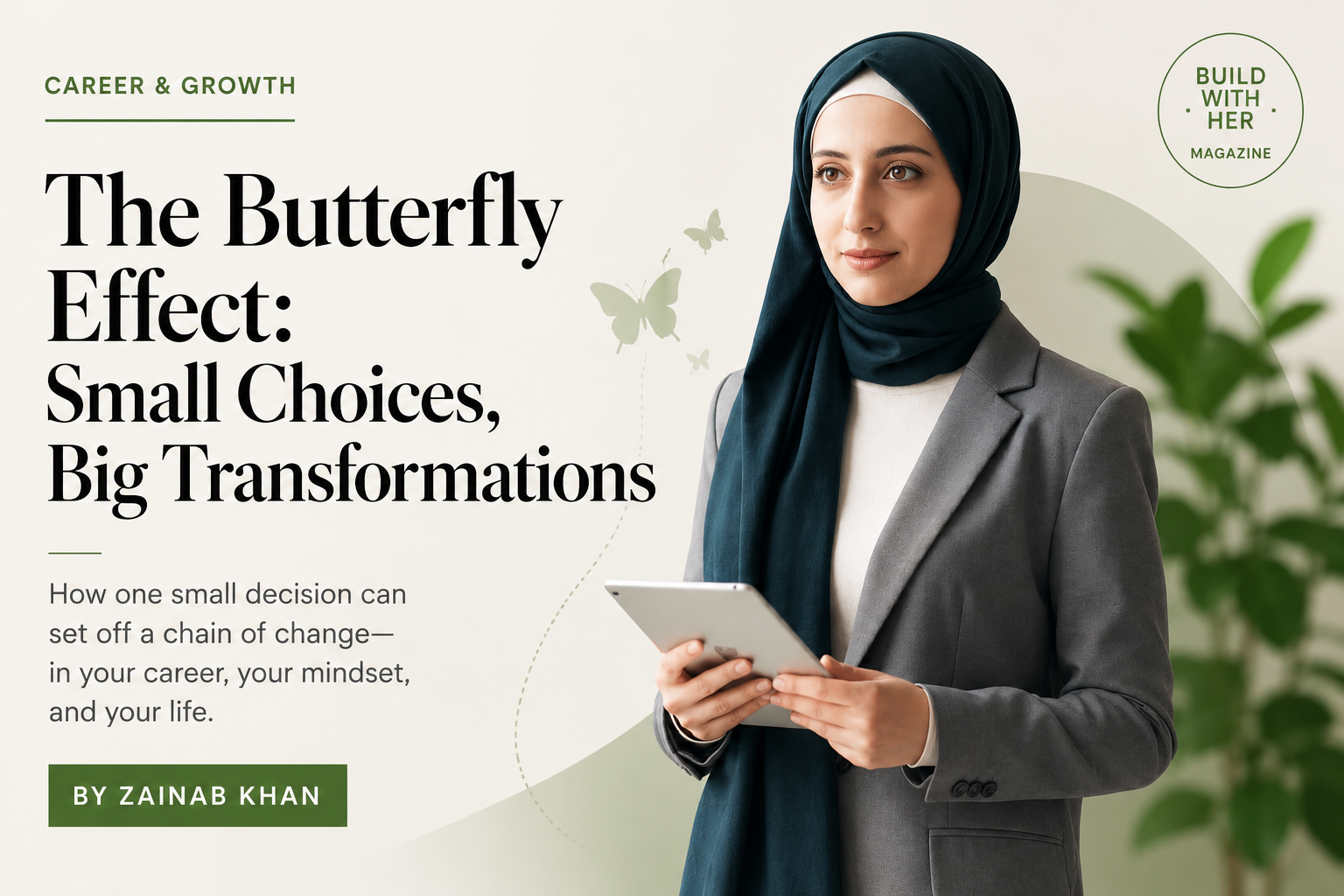
To every butterfly that has never seen its effect… keep going. Your impact is greater than what can be seen.
If there is one word that has shaped my journey, it is not success… but rejection.
Looking back today, I see that every important turning point in my life began with a closed door. What once felt like failure later became the reason I discovered myself and the mission I want to dedicate my life to.
Although my professional journey started in 2016 in humanitarian work and community programs, the real change in my identity began in 2022.
That year, I lost the opportunity to continue my Master’s studies, and I was rejected from several jobs in Northwest Syria. The reason was not a lack of skills or commitment, but because I graduated from Aleppo University at a time when the division in Syria created a strong separation between different areas of control, which also affected education and job opportunities.
For many people, that could have been the end of the story.
For me, it was the beginning.
As a Syrian woman whose family experienced displacement during the war, I learned early that circumstances can take away opportunities, but they cannot take away your right to choose how you respond.
Instead of letting rejection define my future, I decided to invest in something no one could take from me: my voice.
I became deeply involved in women’s rights, gender justice, and digital activism. I joined volunteer campaigns, contributed to women-led initiatives such as “Laha,” and worked with organizations like YALP. I also joined feminist and political networks that believe change is possible, even in the most difficult environments.
In 2023, an extraordinary woman changed how I saw the future.
Through women’s networks connecting Syrian women inside and outside Syria, I met Chevening alumna Hiba Al-Mohammad, who inspired me to apply for the Chevening Scholarship. When I reached the final stage in 2025, I felt for the first time that I belonged to a community of leaders who aim to create impact beyond personal success.
Then the rejection email arrived.
It was painful.
But something unexpected happened afterwards.
Instead of asking, “Why was I not selected?”, I started asking, “How can I help someone else reach this opportunity?”
That question changed everything.
I started mentoring students, especially young women in fragile communities, during their scholarship applications, including Chevening. In one year, I supported five young women, and all of them reached the interview stage.
At that point, I realized that my role was no longer only about starting initiatives, but about leading change and creating impact.
I founded and led two initiatives, “Nawa” and “Rooh,” which became more than community projects—they became spaces of hope in a difficult environment.
Through “Nawa,” we supported more than 1,800 children with school supplies, because I believe education is the first step to dignity and a better future. Through “Rooh,” I supported more than 40 women through awareness sessions and guidance about their children’s education, and helped some of them receive financial support to start small projects that support their families after losing the main provider.
I will never forget what one woman told me:
“You are the butterfly that changed, with its small impact, many details in my life for the better.”
I stayed with these words for a long time.
At that moment, I realized that real success is not measured by the opportunities we receive, but by the opportunities we create for others.
This year, I applied to Chevening again.
I reached the interview stage again.
And again, I was rejected.
It was painful, of course.
No one spends months chasing a dream without hoping it will come true.
But this time, the rejection felt different.
Because I had already understood that my value is not defined by a scholarship decision, an institution, or a selection committee.
Today, my work focuses on defending women’s rights, especially documenting and sharing the stories of abducted and survivor women in Syria.
This is not just activism for me—it is part of who I am.
As a daughter of a Syrian family that lost its land, and as someone who witnessed the suffering of women around me through abduction and captivity, I believe that telling these stories is not only advocacy, but a moral responsibility. My voice and my pen have become a trust I carry to share truth, protect dignity, and preserve memory.
Chevening did not change my life.
But the journey toward it did.
It introduced me to extraordinary people, expanded my ambitions, and inspired ideas and practices that I now bring into my work and community in Syria.
Even though I did not receive the scholarship, I gained something just as valuable: the confidence that I can create opportunities, not only wait for them.
Today, when I think about rejection, I no longer see closed doors.
I see five young women reaching interview stages because I supported them.
I see more than 1,800 children starting their school year with dignity.
I see women who regained confidence, and some of them starting small businesses to support their families.
And I always remember the words of that woman who called me “the butterfly.”
Maybe she meant that the butterfly’s impact is small.
But I learned that real impact, even if it looks small, can change an entire life.
I may not have won the scholarship, but I gained something greater: an impact that reaches from a child carrying a school bag to a woman who regained her ability to support her family.
And maybe this is the true butterfly effect: change begins with a small step, and then grows far beyond what we ever imagined.



0 comments on “Butterfly Effect”
Welcome to the comments section. We moderate every submission according to our community guidelines.
Loading conversation…