Building in Public as a Woman in Cybersecurity
A 30-day account of going from a nervous first LinkedIn post to a global speaking slot at Oz University — what worked, what didn't, and why visibility in cybersecurity doesn't wait until you feel ready.
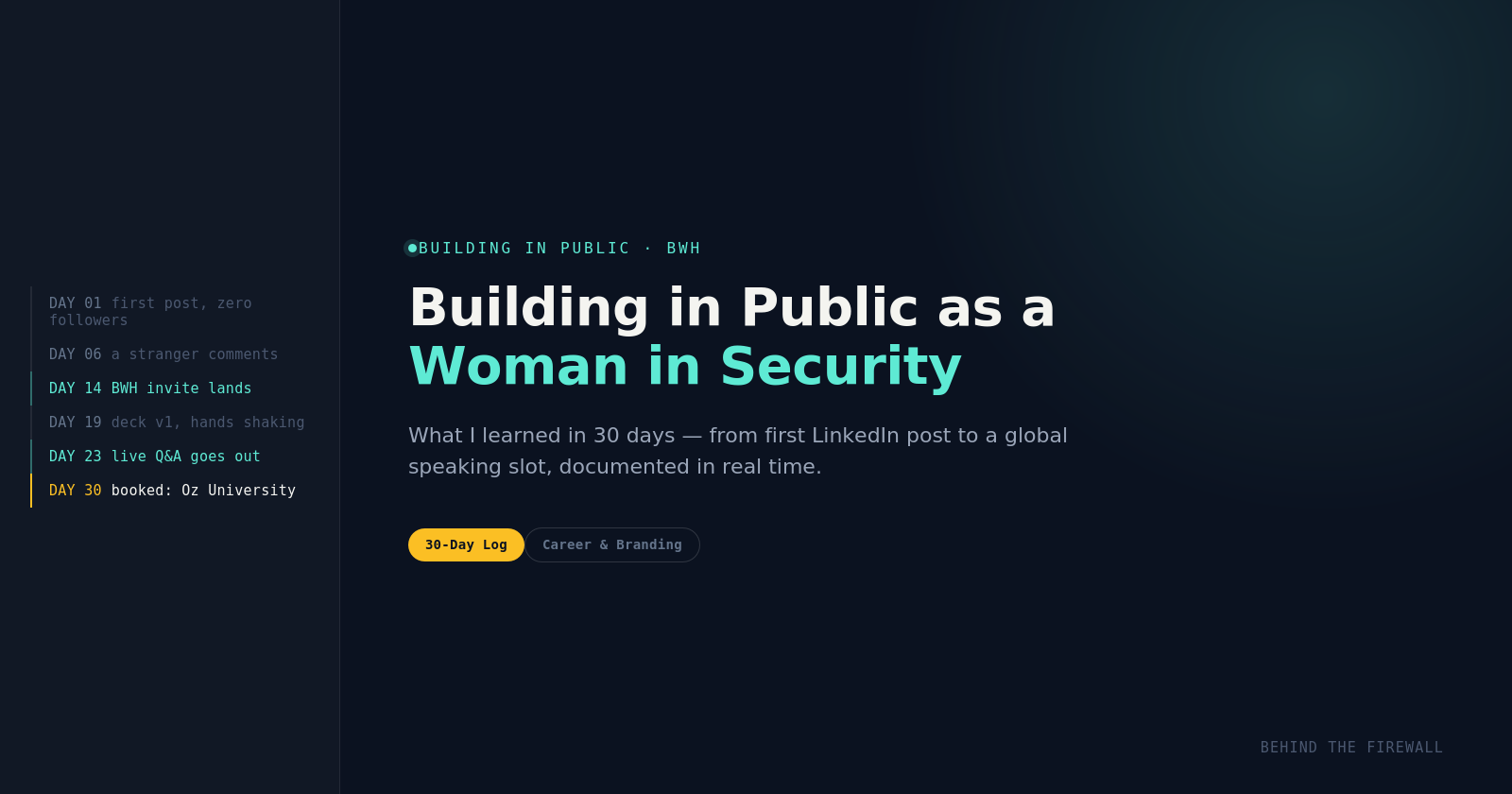
Building in Public as a Woman in Cybersecurity
What I learned in 30 days — from first LinkedIn post to a global speaking slot.
Thirty days ago, I posted on LinkedIn with my heart in my throat and zero expectation that anyone would read it. Today, I'm finalizing slides for a global session at Oz University. I didn't plan this trajectory. I just kept showing up, kept publishing, and let the work compound. Here is the honest, unfiltered account of how it happened — the wins, the awkward stretches, and the exact moves I'd repeat.
If you work in security and have been sitting on a half-written post for months, this is for you.
Why I Started Building in Public
Cybersecurity is full of brilliant women doing invisible work. We ship secure pipelines, close vulnerabilities, and defend infrastructure that nobody notices until it breaks — and even then, rarely gets credit. I didn't want a louder title. I wanted a visible track record. Building in public was the cheapest, most honest way to create one: no permission needed, no gatekeeper, just consistent proof of thinking.
So I set myself one rule for 30 days: publish something real every week, even if it was imperfect. No polished thought-leader voice. Just an analyst, in the open, thinking through her field.
The 30-Day Log
Days 1–7 — The First Post Is the Hardest
My first post was about imposter syndrome in cybersecurity — partly because it was true, and partly because it felt like the lowest-risk way to start. No followers, no algorithm favor, just a story I knew cold because I was living it. It got a handful of likes. Then, on day six, a stranger commented. That single comment did more for my motivation than any metric could have. Someone outside my network had read my words and felt something. That was the entire flywheel, started.
Days 8–13 — Finding a Format
Text-only posts were fine, but I noticed engagement jumped whenever I paired a post with a simple custom visual — an infographic breaking down a threat trend, or a clean HTML card summarizing a tool. I'm not a designer, but a clear, well-structured visual reads as credibility in a feed full of text walls. I built a lightweight habit: one core idea, one supporting visual, every time.
Day 14 — The BWH Invite
This is the moment the trajectory changed. A connection from the BWH community had seen my posts on Shift Left Security and reached out about hosting a live Q&A for the group. I said yes before I'd even thought through logistics. Visibility doesn't wait for you to feel ready — it shows up while you're still mid-sentence, and you take the opportunity anyway.
Days 15–18 — Building the Deck
I rebuilt my "How to Start in Cybersecurity" talk from scratch instead of recycling old slides. I wanted it to actually reflect how people break into this field today — not the path I took years ago. That meant new research, new examples, and three full revisions before I was satisfied.
Day 19 — Hands Shaking, Deck Done
I finished the final version the night before. I was nervous in a way that surprised me — I present at work constantly, but this felt different. This was my name, my voice, no corporate buffer between me and the room.
Day 23 — The Live Q&A
The session ran long because people kept asking questions — a good problem to have. Afterward, I did the unglamorous follow-through: cleaned up screenshots, wrote a recap post, and shared the deck publicly. That follow-through mattered as much as the session itself. A talk that disappears the moment it ends has no compounding value. A talk that becomes a post, a deck, and a recap keeps working for you for weeks.
Day 30 — Oz University, Global Stage
Word of the BWH session traveled. I was invited to bring the same talk — expanded for a global audience — to Oz University on July 11. Thirty days from a nervous first post to a global speaking slot. Not because I went viral. Because I was consistent, and consistency is legible to the people who are paying attention.
"Visibility doesn't wait for you to feel ready. It shows up mid-sentence — and you take the opportunity anyway."
What Actually Worked
One real idea beats ten polished ones. My best-performing posts were the ones where I had a genuine, specific point of view — not the ones I tried hardest to make sound impressive.
Visuals are a credibility shortcut. A clean infographic or card signals that you took the time to structure your thinking, even before anyone reads the caption.
Say yes before you feel ready. The BWH invite and the Oz University slot both arrived before I felt fully prepared. Readiness is a byproduct of saying yes, not a precondition for it.
Follow-through compounds harder than the event itself. The recap post after the live session likely did more for my visibility than the session did. Don't let a good talk evaporate the moment it ends.
Community invites travel. One genuine session for a small, engaged group (BWH) led directly to a much larger one (Oz University). Depth in one room earns you a hearing in the next.
What I'd Do Differently
Start the recap content while the session is still fresh, not days later — the details fade faster than expected.
Build a simple content calendar earlier instead of posting reactively — it would have smoothed out the weeks where I had nothing drafted.
Ask for a testimonial or short quote from BWH attendees right after the session, while the experience was top of mind.
For Anyone Thinking About Starting
You don't need a personal brand strategy. You need one true thing you know, said clearly, published on a schedule you can actually keep. The algorithm rewards consistency more than virality, and opportunity rewards visibility more than perfection. Thirty days ago I was an analyst with an idea and no audience. Today I have a global session on the calendar — not because anything went viral, but because thirty small, honest posts added up to something nobody could ignore.
If you're building in public too, I'd love to hear what day one looked like for you.



0 comments on “Building in Public as a Woman in Cybersecurity ”
Welcome to the comments section. We moderate every submission according to our community guidelines.
Loading conversation…