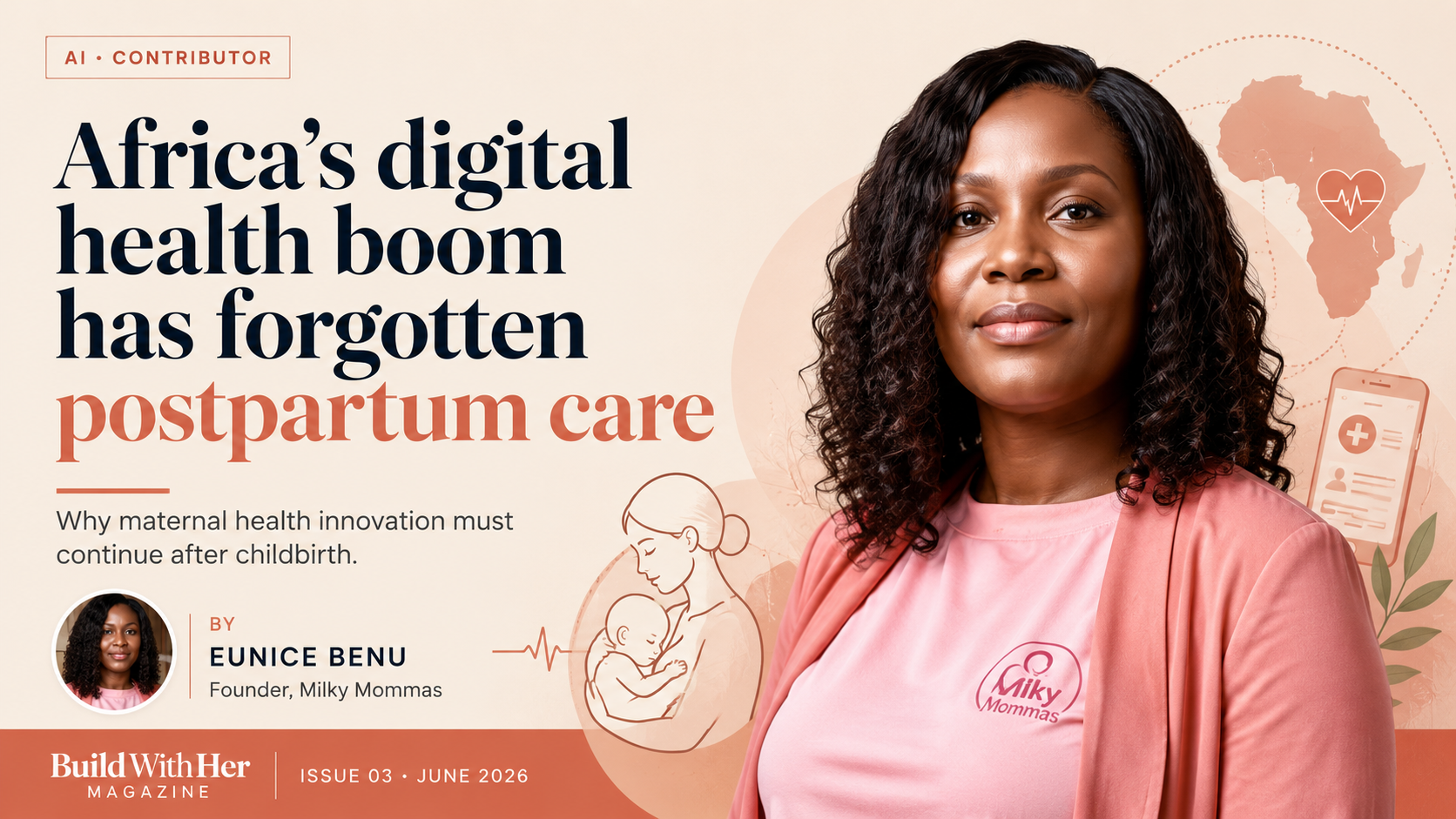
Africa’s digital health boom has forgotten postpartum care
Africa's digital health ecosystem is growing rapidly, but postpartum care remains one of its most overlooked areas. Drawing from personal experience and years of supporting mothers through Milky Mommas, this article explores why the period after childbirth deserves greater attention from innovators, policymakers, and healthcare systems. It argues that true maternal health innovation must extend beyond pregnancy and delivery to provide continuous support for mothers during the critical postpartum journey.
When I first stepped into motherhood, I assumed the hardest part would be childbirth. Like many women, I had been prepared—at least clinically—for pregnancy and delivery. There were checklists, hospital visits, and structured antenatal guidance.
But nothing prepared me for what came after.
After my child was born, I experienced significant breastfeeding challenges following a short hospital admission that disrupted the early establishment of breastfeeding. When I needed support the most, I discovered a gap that felt both surprising and systemic: postpartum care was fragmented, inconsistent, and largely dependent on chance—who you met, what hospital you went to, or whether you already had access to private support.
That experience didn’t just affect me personally. It exposed a broader structural problem that I have since seen reflected across countless mothers: Africa’s healthcare systems and its rapidly growing digital health ecosystem are not adequately designed for the postpartum period.
Over the past few years, Africa has witnessed an impressive digital health boom. Startups are building solutions for telemedicine, maternal booking systems, diagnostic tools, health records, and AI-driven triage platforms. Investors are increasingly interested in healthtech. Governments are exploring digital transformation of healthcare delivery.
Yet, amid this momentum, one critical stage of the maternal journey remains under-addressed: the postpartum period.
This gap is not minor. It is one of the most vulnerable phases in a woman’s life. It determines maternal recovery, mental health, breastfeeding success, infant nutrition, and long-term family wellbeing. And yet, it is often reduced to a brief discharge note and a follow-up appointment that many women never attend.
In many African contexts, postpartum care is still treated as an extension of childbirth rather than a distinct, complex health phase requiring continuous support.
What I find most striking is not just the absence of services, but the absence of sustained digital innovation in this space. We have apps that help women book antenatal appointments, but very few that support them through sleepless nights of newborn care, breastfeeding difficulties, postpartum depression, or recovery complications. We have systems for hospital efficiency, but not for maternal continuity of care at home, where most postpartum challenges actually unfold.
The irony is that postpartum needs are highly suited to digital intervention. They are continuous rather than episodic. They require reassurance, education, peer support, escalation pathways, and timely guidance—precisely the kinds of problems digital platforms are designed to solve.
But there is a deeper issue beneath the technology gap: an attention gap.
Postpartum care is often invisible in policy discussions, underfunded in health systems, and undervalued in innovation pipelines. It sits at the intersection of maternal and child health, and yet it is frequently assumed to be “already handled” by existing structures. In reality, it is often handled by overwhelmed mothers, informal networks, or no support at all.
This is where I believe Africa’s digital health conversation must evolve.
We cannot claim to be building comprehensive health ecosystems if we stop at delivery. We cannot speak about maternal health innovation while ignoring the period when mothers are most in need of guidance, reassurance, and structured support.
For me, this is not just a policy argument—it is a lived reality that shaped the direction of my work. It is what led me to focus on building community-driven maternal support systems through Milky Mommas, designed to bridge the gap between clinical care and real-life maternal experience. Not as a replacement for healthcare systems, but as a complement to them, especially in the fragile postpartum window.
What I have learned from engaging with mothers is simple but powerful: information alone is not enough. Mothers need continuity. They need connection. They need systems that recognize that care does not end at discharge.
If Africa’s digital health boom is to achieve its full potential, it must expand its definition of innovation. Innovation is not only about new technology—it is about solving the right problems at the right stage of the human experience.
And right now, one of the most overlooked stages is the one that begins after birth.
Until we address postpartum care with the same urgency and creativity as pregnancy and delivery, our digital health ecosystem will remain incomplete. Not because it lacks innovation, but because it has left out one of the most critical parts of the maternal journey.
The future of African healthtech will not be defined by how many apps we build, but by whether those apps stay with women when they leave the hospital bed and step into the realities of motherhood.
That is where the real gap is.
And that is where the next phase of innovation must begin.


0 comments on “Africa’s digital health boom has forgotten postpartum care”
Welcome to the comments section. We moderate every submission according to our community guidelines.
Loading conversation…