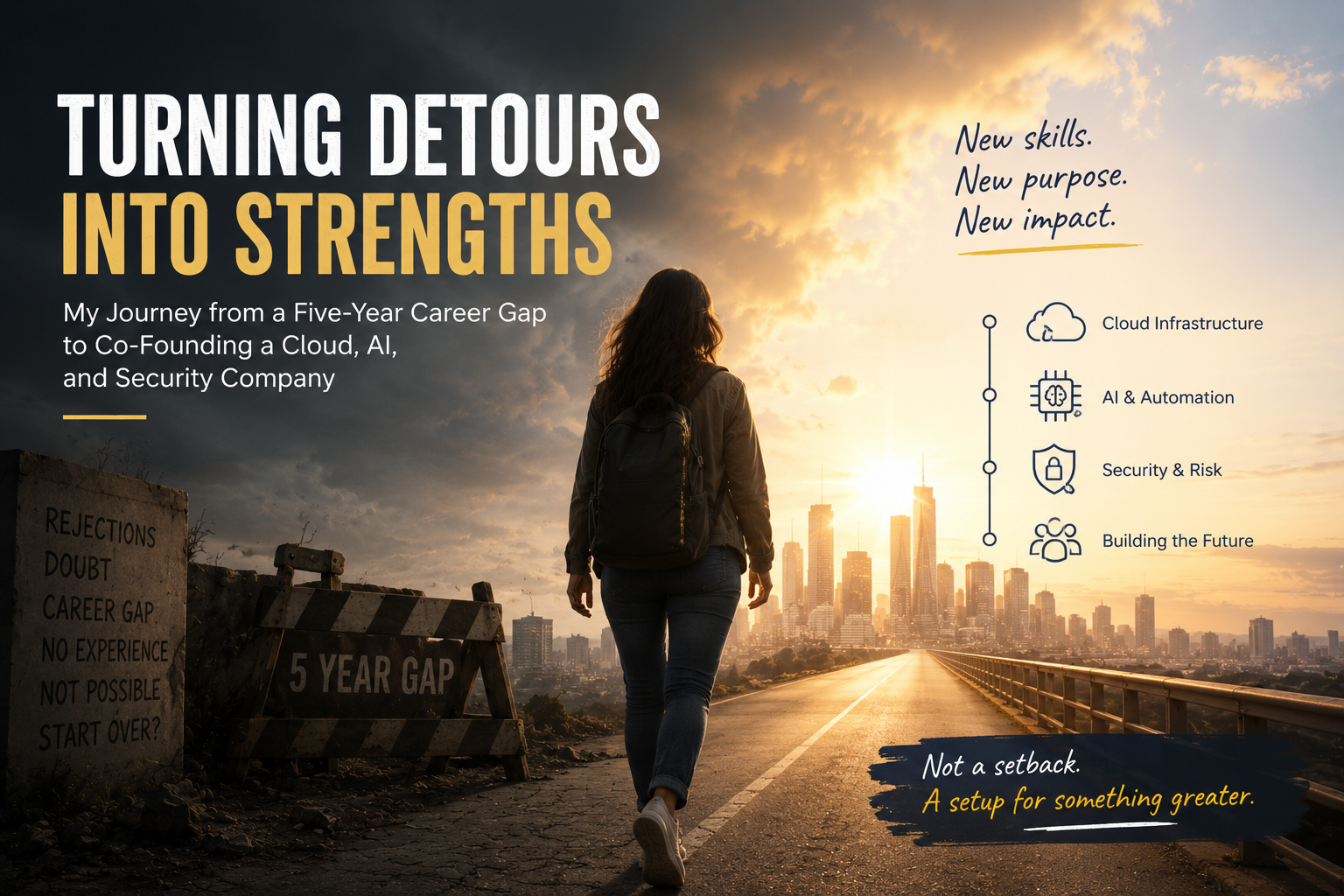
# Turning Detours into Strengths: My Journey from a Five-Year Career Gap to Co-Founding a Cloud, AI, and Security Company
After graduating with a B.Tech in Electronics and Communication, I thought my path would lead to robotics and chip manufacturing. Instead, a global pandemic, five years of competitive exam preparation, and countless rejections forced me to build a completely different route into technology. This is the story of how those seemingly unrelated experiences became the foundation for a career in cloud, AI, and security—and why I believe no learning is ever truly wasted.
## The Plan That Never Happened
When I graduated with a B.Tech in Electronics and Communication in 2019, I thought I knew exactly what my future looked like.
I wanted to work in robotics and chip manufacturing. I loved the idea of building intelligent systems and working on technologies that existed beyond the screen.
A few months later, COVID changed everything.
Hiring slowed. Opportunities disappeared. Entire industries went into survival mode. Coming from a small town, the path into technology already felt narrow. Overnight, it felt almost impossible.
Like many graduates during that period, I adapted.
I began preparing for competitive government examinations.
What I expected to be a temporary decision slowly became five years of disciplined preparation. I cleared multiple preliminary and mains examinations across banking, railways, and engineering services, but I never reached the final destination.
For a long time, I believed those years had taken me away from engineering.
Looking back, I think they were preparing me for it.
## The Career Gap Everyone Could See
By 2025, I knew I wanted to return to technology.
What I didn't expect was that my biggest challenge would not be learning new technologies.
It would be convincing people that I still belonged.
Almost every opportunity seemed to begin with the same question.
"You have a five-year gap. Why should we take a chance on you?"
Some organizations saw me as too experienced to be considered a fresher and too disconnected from the industry to be considered experienced.
For a while, I almost believed what I kept hearing.
That perhaps I had missed my opportunity.
But engineers are trained to solve problems.
So I stopped looking at the gap as a judgment about my future and started looking at it as an engineering problem.
How do I compress years of learning into months?
How do I build practical experience without waiting for permission?
How do I prove capability before someone gives me a title?
## Learning in a Different Way
I started my cloud journey inside the Microsoft ecosystem, learning Azure from the ground up.
Identity management, networking, infrastructure, automation, governance, Terraform, platform services—almost everything was new.
At the same time, I discovered something that completely changed the way I learned.
I used AI as a force multiplier.
From the very first day, I never saw AI as a replacement for knowledge.
I used it as a way to accelerate understanding.
It helped me explore unfamiliar concepts, challenge assumptions, debug problems, review architectures, and think through technical decisions from multiple perspectives.
It never replaced reading documentation.
It never replaced building.
It never replaced the responsibility of solving production problems.
But it multiplied every hour I invested.
People often ask whether AI will replace engineers.
My own experience has been the opposite.
I believe AI rewards people who are curious, disciplined, and willing to learn continuously.
## The Skills I Didn't Know I Was Building
One of the biggest surprises of my journey was realizing that those five years were not empty.
They were building capabilities that I simply didn't know would become valuable later.
Preparing for banking examinations forced me to think deeply about finance, economics, numbers, trade-offs, and systems.
When I eventually started working with cloud infrastructure, FinOps didn't feel like a foreign concept.
Managing cloud costs, optimizing resource usage, extending startup runway, and balancing engineering decisions against business realities felt surprisingly familiar.
I had been building that way of thinking for years.
The same thing happened with risk.
Studying economics, governance, and geopolitics taught me to think beyond immediate outcomes.
What are the second-order effects?
What assumptions are we making?
What risks are visible today, and which ones are quietly developing beneath the surface?
When I entered cloud and security, I realized these were exactly the questions good engineers and security professionals ask every day.
For a long time, I thought I was trying to come back to engineering.
Looking back, I don't think I ever really left.
I was building the way I think.
## Becoming Comfortable With Uncertainty
Later, I had the opportunity to help build cloud infrastructure for startups.
Ironically, much of that work involved AWS, a platform I had almost no practical experience with when I accepted the challenge.
I said yes anyway.
That experience reinforced something I now believe deeply.
Engineering is not about already knowing the answer.
It is about reducing uncertainty.
Read the documentation.
Break the problem down.
Test assumptions.
Learn quickly.
Adapt.
Repeat.
The technologies change.
The mindset does not.
## Looking Back
Sometimes people ask how so much happened in such a short period of time.
The truth is, I don't think it happened in one year.
I think it happened over six.
The years of competitive examinations taught me discipline.
The uncertainty taught me resilience.
The constant learning taught me how to absorb new information quickly.
AI multiplied that ability.
Technology gave it a place to be applied.
My journey never followed the traditional path.
I did not graduate, join a company, steadily collect promotions, and arrive exactly where I had planned.
Nothing about my career has been linear.
And today, I would not change that.
Because it taught me that careers are not built by perfect timelines.
They are built by curiosity, consistency, and the willingness to keep building even when the outcome is uncertain.
If there is one lesson I hope other women take from my story, it is this:
Do not let someone else decide that your story is already over.
A career gap is not the end of an engineering journey.
Sometimes it is simply where a different one begins.



0 comments on “# Turning Detours into Strengths: My Journey from a Five-Year Career Gap to Co-Founding a Cloud, AI, and Security Company ”
Welcome to the comments section. We moderate every submission according to our community guidelines.
Loading conversation…